
LatAm Tech Weekly
226: GPT-5.4 is here, my personal test on the new model, deals of the week... and much more!

Weekly writing about what is happening in LatAm tech. By day, I am part of the corporate development team at Itau Unibanco. By night, I am reading and learning about technology in general (now, with a focus on AI). During the weekends, I’m writing the LatAm Tech Weekly. And obviously, always running!
If you have not subscribed yet, join the 14,700+ weekly readers by subscribing here!
Happy International Women’s Day Sunday!
A quick acknowledgment to the women building companies, investing capital, advancing technology, leading teams inside large organizations, and quietly pushing industries forward every day. As a woman working in finance, it’s especially meaningful to see more women not only founding startups and investing, but also leading teams, managing complex businesses, and shaping decisions inside major institutions across Latin America.
As much as I’m trying not to make AI the focus of this intro every single week, it’s becoming increasingly difficult. Between last week’s Anthropic clash with the U.S. government, OpenAI stepping into the vacuum, the fallout that continued throughout this week, and the launch of GPT-5.4, it would feel almost artificial not to address it. And, as I always say, these tectonic shifts in global tech don’t stay confined to the U.S. — they shape capital flows, product adoption, startup behavior, and competitive dynamics across Latin America too. So I still feel very much aligned with the core mission of this newsletter.
P.S. If you’re new here — and more than 200 of you joined just this past week — welcome. Quick note for you: I’m obviously fully aware of the broader geopolitical backdrop and its implications, but you won’t see here any commentary on these themes… (ever). There are many excellent people covering that full-time. My lane remains tech — and what it means for Latin America.
Last week, I wrote in detail about the Anthropic–Pentagon standoff and what it could mean for markets, capital allocation, and even public equities. This week, I want to focus on what happened next. The biggest measurable consumer signal was clear: Claude surged. Reuters reported that Claude became the most-downloaded free app in Apple’s U.S. App Store on Monday, overtaking ChatGPT for the first time. Reuters also cited analytics pointing to a sharp rise in demand for Claude and Claude Code after the dispute escalated. What I have not seen from a credible source is a verified figure for “how many users left OpenAI,” so I won’t overstate this point. What is fair to say is that the episode translated into real momentum for Anthropic’s products, at least in downloads and visibility.

On the OpenAI side, Reuters reported that the company reached an agreement with the U.S. Department of Defense to deploy its models on classified cloud networks, a move that immediately triggered criticism both externally and internally. Days later, Sam Altman said OpenAI was already working with the DoD to amend parts of the agreement, clearly recognizing the backlash and trying to soften the perception that the company had moved too fast. Today, Reuters also reported that Caitlin Kalinowski, OpenAI’s head of robotics and consumer hardware, resigned over concerns about the Pentagon deal and the speed at which it was approved. In public remarks, Altman has defended the partnership while reiterating that OpenAI’s technology would not be used for domestic surveillance or lethal autonomous systems.
GPT-5.4 launch
If you know me, you know I’m obsessed with model launches. I also know they don’t stay “state of the art” for very long — when I came back from San Francisco, I mentioned here that I learned that the window now is closer to four weeks (or when one of the other big 3 launches an upgrade). Tech experts also said in this trip that model capability itself will soon become a commodity, and what will matter most are the vertical applications built on top. Still, I find it fascinating to watch — and feel — the pace of progress firsthand. It’s impressive how these models are moving fast.

On March 5, OpenAI launched GPT-5.4, and yes, I got very excited. Given how packed my week was, I only had time to really dig into the release yesterday — and of course, I ran a quick test myself before writing this.
GPT-5.4 came with more anticipation than some of the recent releases because it was framed as a more meaningful step forward: OpenAI described it as a model that brings together its latest advances in reasoning, coding, and agentic workflows into one “frontier model” built for professional work. It also comes with a 1 million token context window. For readers who don’t live and breathe model specs, the easiest 101 definition is this: a context window is the amount of information a model can keep “in mind” at once. A larger window means it can work across longer documents, more tabs, more instructions, and more multi-step tasks without losing the thread.
The company was especially explicit about two priorities this time: knowledge work and computer use. “Computer use capabilities” essentially mean the model can operate a computer the way a human would — by interpreting what’s on the screen and using a mouse and keyboard to complete tasks across applications. In OpenAI’s own benchmarks, GPT-5.4 reached a 75.0% success rate on OSWorld-Verified, a benchmark that measures whether a model can navigate real desktop workflows via screenshots, clicks, and keystrokes. That is notable not only because it’s far above GPT-5.2’s 47.3%, but because it also edges past average human performance on the same benchmark. In plain English: models are getting materially better at actually using software, not just talking about it.

That matters because the next major interface shift will most likely not be humans clicking through websites and software themselves — it will be agents doing it for us. And if that becomes true, then companies will increasingly need products, websites, and workflows that are not only easy for humans to navigate, but also easy for agents to understand and execute. This point immediately reminded me of some of the very early startups I met in Palo Alto that are already helping companies rethink their UI/UX for an agentic future — in other words, designing digital environments that machines can browse and complete tasks more efficiently (which is obviously very different than an interface humans would).
OpenAI also emphasized performance on GDPval (see chart above), its benchmark for professional knowledge work across 44 occupations spanning the top nine industries contributing to U.S. GDP. In simple terms, GDPval measures how well the model performs on real-world professional tasks — things like spreadsheets, presentations, scheduling, analysis, and other deliverables people actually produce at work. On that benchmark, GPT-5.4 matched or exceeded industry professionals in 83.0% of comparisons, versus 70.9% for GPT-5.2. The company also showed a significant jump in spreadsheet modeling tasks - from 68.4% to 87.3%. That is especially relevant for finance-heavy workflows.
And yes, OpenAI clearly had finance in mind. Alongside the model launch, it also introduced ChatGPT for Excel, a beta add-in that brings GPT-5.4 directly into spreadsheet workflows. That matters because one of the most obvious early enterprise use cases for these models is financial modeling, scenario analysis, and data-heavy work that still consumes a disproportionate amount of analysts’ time.
So of course, my very simple test had to be related to… finance. It wasn’t a deep institutional-grade use case, but I was still impressed. And frankly, I chose something simple for a reason: I’m human too, and I already spend around four hours writing this every Sunday, so in this test I chose an easy one because I also want to enjoy with my family at least a few of the remaining hours of my weekend… 😊
The Experiment: Modeling Nvidia’s Data Center Business
A good tech-finance test case for GPT-5.4 is Nvidia, because it combines three characteristics that make forecasting interesting:
• Massive growth
• Multiple segments
• Significant uncertainty around AI demand
To test the model, I ran a simple experiment: build a five-year revenue scenario model for Nvidia.
Step 1 — The Dataset
I exported five years of Nvidia segment revenue into a CSV file and uploaded it to GPT. Below is the exact structure I used. Numbers are in USD billions.
(These figures come from Nvidia’s reported segment revenue)

Step 2 — The Prompt
I then gave GPT-5.4 the following instruction:
“Act as a technology investment banker. Build a simple 5-year revenue model for Nvidia with bull, base, and bear cases. Assume AI infrastructure spending continues but growth normalizes. Return a table that can be pasted into Excel.”
Step 3 — GPT’s Output
GPT returned a clean scenario table that could be copied directly into Excel.
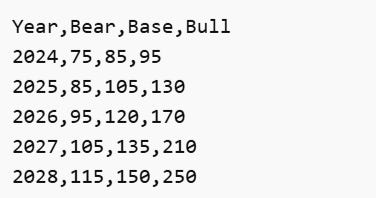
What was interesting was not just the table — but the reasoning GPT provided for each case.
Bear Case
• Hyperscaler capex slowdown
• GPU pricing compression
• Competition from custom silicon (Google TPU, Amazon Trainium)
Base Case
• Continued expansion of AI infrastructure spending
• Gradual normalization from the extraordinary 2023–2024 growth spike
Bull Case
• Inference workloads dominating compute demand
• Nvidia maintaining its CUDA ecosystem advantage
• Continued GPU supply expansion through TSMC
This type of written reasoning is something traditional Excel models do not provide. And I found it useful…
Where GPT Was Actually Useful
1. Building the First Version of the Model - Normally this step involves:
• Structuring the model
• Selecting growth assumptions
• Creating scenario tables
That process typically takes 20–30 minutes.
GPT did it in under 30 seconds.
2. Generating Sensitivity Ideas
I then asked GPT:
What are the five most important sensitivities for Nvidia’s revenue over the next five years?
It returned:
• Hyperscaler AI capex
• GPU pricing trends
• Training vs inference demand mix
• Custom silicon competition
• Power availability for datacenters
That is actually a very reasonable starting list for an investment memo… or a pitchdeck
3. Translating Assumptions Into Excel Formulas
I also asked:
Write Excel formulas to generate this scenario table.
GPT suggested formulas like:
=PreviousYearRevenue*(1+GrowthRate)
It also recommended building a scenario selector cell (or a football field), which is a common modeling technique.
Where GPT Still Struggles
1. Precision in Financial Modeling
LLMs are not deterministic spreadsheet engines.
Typical issues included:
• occasional incorrect cell references
• inconsistent CAGR calculations
• rounding inconsistencies
In other words: every formula still needs to be checked.
2. Data Hallucinations
When I asked GPT to generate Nvidia’s historical segment revenue on its own, it invented numbers.
The solution is simple:
Always upload the real dataset.
Never trust generated financial data.
3. Real Industry Drivers
The model also cannot fully capture structural drivers such as:
• GPU supply constraints
• economics of training vs inference
Those still require industry knowledge and judgment.
The Bottom Line
After testing GPT-5.4 with a simple Nvidia model, my conclusion is straightforward.
It will not replace financial modeling (yet). But it dramatically compresses the time required to go from zero → first draft.
Old workflow:
Blank Excel → build model → test assumptions → write memo or pitchdeck
New workflow:
Prompt GPT → generate rough model → refine in Excel → write memo or pitchdeck
PS- I know this is a very simple test to do… but I encourage you to test the new model out in as many ways as you can think of!

General news:
Locaweb launched Locaweb Cloud, its proprietary cloud computing platform targeting SMEs and developers with pricing up to 70% lower than major global providers and fully localized Portuguese support. Initially built for internal infrastructure, the platform now serves about 150 clients and runs on Locaweb’s own São Paulo data centers, part of a network handling roughly 20% of Brazil’s internet traffic. 🇧🇷
Creditas reported record loan originations of R$1.1B in Q4 2025, up 35.4% year over year, while its managed portfolio reached R$7.1B as the fintech expanded products including auto-backed loans and digital payroll credit. Revenue totaled R$582.7M for the quarter (+17.3% YoY), though margins remained pressured by high interest rates and the company posted a net loss of R$143.3M. 🇧🇷
Eden is expanding its medical imaging platform in Brazil following a $22M funding round that raised total capital to $32M. The company operates a cloud-native PACS infrastructure and AI-powered radiology tools across 18 countries, working with more than 2,600 institutions and processing around 5B medical images annually. Brazil has become a key strategic market, with over 100 imaging departments already connected as the platform integrates AI workflows to accelerate diagnostics and address specialist shortages. 🌎
Digital policy advocate Alessandro Molon launched Dig.ia, a new industry alliance aimed at attracting global investment into Brazil’s digital infrastructure, including data centers, submarine cables and edge networks. The initiative brings together major players such as Google, Meta, Amazon, Microsoft, Ascenty, Scala and Tecto to advocate for regulatory frameworks and fiscal incentives that support large-scale infrastructure deployment. The effort comes as Brazil debates new incentives for data center development amid rising global demand driven by cloud computing and AI. 🇧🇷
Madrid is positioning itself as a European hub for Latin American tech talent through programs led by its Innovation and Entrepreneurship Department that attract founders, investors and professionals in sectors including fintech, edtech and AI. Initiatives such as Madrid Emprende and Puentes de Talento provide legal support, mentoring, ecosystem access and up to one year of free workspace. The strategy is gaining traction as roughly 300 startups are launched annually in the city, about 30% led by Latin American founders. 🇪🇸
Deals:
Colibri was acquired by RS Solutions in a R$100M transaction with NCR, marking a new expansion phase for the restaurant management and POS platform that currently serves 15,000 clients in Brazil. 🇧🇷
Elephan.AI raised R$3M in a new funding round led by Triaxis and Crescera through the Criatec 4 fund, with Antler remaining on the cap table. The B2B revenue intelligence startup uses AI to enrich CRM leads and generate pipeline insights, expanding its customer base from 50 to about 250 clients in one year while increasing ARR sevenfold in 2025. . 🇧🇷
Zapia raised $7M led by Prosus Ventures to accelerate development of its consumer AI assistant and strengthen its standalone mobile platform. The funding brings total capital raised to $19.3M and supports the rollout of Zapia Max, an autonomous AI agent capable of executing tasks such as scheduling meetings, sending emails and completing purchases. 🌎
Carryt acquired Chilean startup Paket, an Instagram-born e-commerce venture, as part of a broader regional consolidation wave in Latin America’s startup ecosystem. The deal strengthens Carryt’s cross-border expansion strategy by integrating Paket’s customer base and social-first commerce model, highlighting growing interest in startups that validate demand through social platforms before migrating to proprietary infrastructure. 🌎
TESS AI raised a R$25M seed round led by Hi Ventures with participation from DYDX Capital and Honeystone, reaching a valuation of R$200M in its first institutional funding. The platform orchestrates interactions across more than 270 large language models—including ChatGPT, Claude and Gemini—to build AI agents that automate enterprise tasks. 🌎

General news:
Itaú Unibanco is advancing research in emerging technologies through its ICTi institute, including quantum computing applications for finance. A recent peer-reviewed study published in Nature Portfolio explores how quantum algorithms could optimize diversified portfolio construction and other complex financial decisions. The initiative reflects Itaú’s strategy to invest in applied research and academic partnerships to strengthen long-term technological competitiveness. 🇧🇷
ChatGPT uninstallations in the U.S. surged 295% after OpenAI’s DoD agreement, while downloads fell 13% in a single day following the announcement. The backlash also drove a 775% jump in one-star reviews, as rival assistant Claude saw downloads rise up to 88% and briefly surpass ChatGPT in the U.S. App Store. 🇺🇸
Amazon launched Amazon Now in Brazil, a rapid delivery service offering groceries and essentials in up to 15 minutes through a partnership with Rappi. The service debuted in selected neighborhoods of São Paulo and is expected to expand to eight cities including Rio de Janeiro, Curitiba, Fortaleza and Belo Horizonte. 🇧🇷
SpaceX is preparing for a potential IPO that could become the largest in history as analysts project strong long-term growth driven primarily by its satellite internet service Starlink. The company generated $16B in revenue and $8B in profit in 2025, with projections pointing to $150B in revenue by 2040. Despite the strong outlook, analysts warn the stock could mirror Tesla-like volatility due to leadership overlap with Elon Musk’s broader ecosystem. 🌎
Deals:
Afya invested in Brazilian healthtech CareOn through its corporate venture arm to accelerate the startup’s national expansion and strengthen digital healthcare workforce infrastructure. CareOn connects hospitals, clinics and laboratories with medical professionals and has already registered more than 40,000 doctors while publishing over 100,000 job opportunities. The investment marks Afya’s fifth CVC deal in two years as it expands its strategy of backing digital health solutions across Brazil. 🇧🇷
Banco Serfinanza acquired a 30% stake in fintech Tpaga to accelerate its digital financial services strategy and expand embedded finance capabilities. The partnership integrates Tpaga’s technology infrastructure with Serfinanza’s banking operations to develop digital payments, wallets and AI-driven financial products across its ecosystem. 🇨🇴
Propi raised $4.2M in a seed round to expand its digital real estate transaction platform across underserved Latin American markets. The proptech manages a database of roughly $4B in residential property records and plans to enter Honduras, the Dominican Republic and Costa Rica while strengthening digital mortgage and prequalification tools. 🌎

General news:
Brazil leads Latin America’s next wave of potential unicorns, with nine of the 12 startups most likely to reach a $1B valuation headquartered in the country, according to Distrito’s Unicorn Race 2026 report. The study analyzed 50 high-growth companies, most at the Series C stage and operating scalable recurring-revenue models across fintech, SaaS and B2B segments. Artificial intelligence has become a foundational layer across the ecosystem, with all top candidates integrating AI into their operations. 🇧🇷
Keeta postponed the launch of its delivery operations in Rio de Janeiro and laid off around 200 employees while reassessing its expansion strategy in Brazil. The company cited structural barriers such as exclusivity agreements and logistical challenges, despite securing interest from roughly 17,000 restaurants and planning an initial R$400M investment in the city. Keeta will keep about 1,200 jobs and focus operations in the São Paulo region while maintaining its broader R$5.6B investment plan in Brazil over the next five years. 🇧🇷
Brazilian authorities charged 11 individuals linked to a cybercrime network accused of moving more than R$150M between 2021 and 2024 by exploiting vulnerabilities in fintech onboarding systems. Investigators said the group created hundreds of fraudulent accounts and laundered funds through cryptocurrency transfers, shell companies and simulated asset transactions. The operation included four arrest warrants and 23 search orders as part of a broader crackdown on digital financial fraud. 🇧🇷
CADE upheld a preventive order against Meta suspending new WhatsApp Business terms that could restrict third-party AI chatbots while the regulator investigates potential abuse of market dominance. The ruling requires Meta to restore access for excluded chatbot providers within five days and maintain interoperability during the investigation. The case is emerging as a landmark precedent for competition policy in AI-enabled messaging ecosystems. 🇧🇷
Brazil’s Central Bank issued new regulations integrating crypto firms into financial system controls by extending governance, compliance and cybersecurity requirements to Virtual Asset Service Providers. The rules standardize internal controls, accounting and auditing frameworks across the crypto sector, strengthening oversight as Brazil’s digital asset ecosystem continues to expand. 🇧🇷
Deals:
Celero raised R$15M in a Series A round led by Headline with participation from Visa to expand its financial data infrastructure across Brazil and Latin America. The startup converts raw transaction data into AI-driven insights for banks and fintechs and currently processes more than R$1B in monthly transactions while revenue has grown fivefold in two years. 🇧🇷
Pagsmile acquired a 49% stake in A55 Sociedade de Crédito Direto and is seeking Central Bank approval to obtain control of the credit fintech. The deal expands Pagsmile’s capabilities beyond cross-border payments by adding lending infrastructure to its platform, which processes about $800M in monthly transactions across 11 Latin American countries. 🌎
Ualá raised $195M in a funding round led by Allianz X at a $3.2B valuation with participation from Tencent, Soros Fund Management and D1 Capital. The Argentine neobank serves more than 11M customers across Latin America and will use the capital to expand its financial services ecosystem and scale insurance products with Allianz. 🌎
Accenture agreed to acquire Ziff Davis’ connectivity division for $1.2B, including platforms such as Ookla, Speedtest and Downdetector. The unit generated $231M in revenue in 2025 and its network performance data will be integrated into Accenture’s analytics and AI capabilities to support telecom, cloud and digital infrastructure clients. 🌎
Vitrify raised a R$1M angel round to expand its AI-driven data infrastructure platform for Brazil’s private credit market. The fintech aggregates more than 9,700 financial instruments including CRIs, CRAs and debentures and currently serves over 50 institutional clients while generating more than R$100K in monthly recurring revenue. 🇧🇷
Cicada raised $13.5M in a Series A round led by Citi with participation from B3’s L4 fund, Kaszek and Dila to digitize trading of Latin American local-currency bonds. The SEC-registered platform introduces electronic order books and execution tools to markets that remain largely voice-traded, starting with Mexico’s $500B local bond market. 🌎

General news:
Revolut is expanding its strategy in Brazil by launching credit cards across all plans, enabling U.S. stock and ETF investing through its app and introducing the premium Ultra plan. The fintech, which serves more than 70M customers globally, aims to position its app as a full financial platform combining payments, FX, credit and investments. The new offering also expands the RevPoints rewards program to debit purchases and adds travel perks such as airport lounge access and international transfers. 🇧🇷
Technology M&A activity in Brazil accelerated in 2025 with 245 deals completed, up 25% year over year, and a record 220 unique buyers participating in transactions. Major deals included Totvs’ R$3.05B acquisition of Linx and Visma’s R$2B purchase of Conta Azul, while activity expanded beyond traditional acquirers to include regional tech groups and diversified corporate buyers. The trend highlights how companies are increasingly using acquisitions to accelerate digital transformation across sectors such as fintech, cybertech, healthtech and martech. 🇧🇷
China set a 2026 GDP growth target between 4.5% and 5%, the lowest in decades outside the pandemic period, signaling a strategic shift toward domestic consumption and advanced technology investment. The plan prioritizes sectors such as artificial intelligence, quantum computing, 6G networks, hydrogen and fusion energy while allocating more than ¥900B in stimulus measures to support investment and lending. 🇨🇳
Deals:
Agibank launched Agibank Asset Management after receiving regulatory approval from Brazil’s CVM, expanding its capabilities to structure credit products and institutional financing. The new unit will debut with a private credit and fixed-income strategy through a FIDC fund while using AI-driven analytics to scale credit evaluation and investment operations. 🇧🇷
The Colombian Stock Exchange and Fundación Grupo Social partnered to support a2censo, making the foundation the first anchor investor in the exchange’s regulated crowdfunding platform. The initiative aims to expand financing access for SMEs while strengthening confidence in crowdfunding as a capital markets channel for high-growth businesses. 🇨🇴

General news:
DolarApp rebranded to ARQ as it expands its financial platform strategy and accelerates growth in Brazil following a $70M funding round. The fintech is evolving beyond FX and remittances to offer international investments, yield-bearing dollar accounts and credit lines linked to global cards, leveraging stablecoin infrastructure for faster settlement. With more than $10B in annualized transaction volume and two million users across the Americas, ARQ aims for Brazil to represent half of its total transactions. 🌎
Jusfy surpassed R$50M in annual revenue after growing about 118% in 2025, driven by adoption of its AI-powered legal tools among independent lawyers and small firms. Its flagship product JusGPT now serves more than 50,000 subscribers, and the company expects recurring revenue to grow 80–90% in 2026 while expanding partnerships with bar associations across Brazil. 🇧🇷
Banco do Brasil launched Pix payments in Argentina through a partnership with Banco Patagonia, enabling Brazilian users to pay local merchants via QR codes with automatic currency conversion. The initiative marks the first international expansion of Brazil’s instant payment system and could serve as a model for broader global rollout. 🇦🇷
Brazilian fintech stocks listed in the U.S. closed the week mostly lower amid global risk aversion triggered by geopolitical tensions in the Middle East. StoneCo fell 17.05% for the week, while PicPay dropped 14.36% and XP declined 5.43%, reflecting pressure on growth-oriented financial stocks. 🌎
Reuse doubled revenue to $30M between 2024 and 2025 as demand for refurbished electronics expanded across Latin America. The circular tech platform partners with retailers such as Samsung, Falabella and Coppel to collect, refurbish and resell devices, and expects revenue to surpass $60M by 2026. 🌎
Oracle is evaluating expanding investments in Brazil as part of its global Stargate program focused on AI data center infrastructure. While the company already operates six cloud regions in the country, regulatory uncertainty around tax incentives could affect investments that might reach nearly R$1T by 2030. 🇧🇷
PitchBook introduced the AIBQ framework to evaluate the business quality of leading AI startups and revealed a widening gap between valuations and fundamentals. Databricks achieved the highest score at 8.7/10 despite a valuation far below peers such as OpenAI and Anthropic, highlighting how narrative and technological optionality continue to drive AI market valuations. 🌎
Deals:
Netflix acquired AI startup InterPositive to strengthen automation in film post-production workflows. The technology helps optimize tasks such as framing, color correction and visual effects while keeping creative control with human teams. With visual effects representing up to 25% of production budgets, Netflix estimates the tools could reduce costs by roughly 10%. 🌎
Elo acquired Chatbank’s AI technology to expand conversational banking services integrated with WhatsApp. The move will allow the company to develop AI agents capable of executing payments and purchases while strengthening digital financial experiences within Brazil’s open finance ecosystem. 🇧🇷

See above!!!!

South Summit Brazil 2026
Date: March 25–27, 2026
Location: Porto Alegre, Brazil
Description: A global innovation platform connecting startups, corporations, and investors to foster entrepreneurship and scalable business growth.
More infoBrazil at Silicon Valley 2026
Date: April 6–8, 2026
Location: Sunnyvale, CA, USA
Description: A conference connecting Brazilian leaders and entrepreneurs with Silicon Valley to promote innovation, investment, and cross-border business.
More infoVTEX Day 2026
Date: April 16–17, 2026
Location: São Paulo, Brazil
Description: One of the world’s largest digital commerce events, bringing together global retail leaders, brands, and technology innovators.
More infoGramado Summit 2026
Date: May 6–8, 2026
Location: Gramado, Brazil
Description: A technology and innovation festival combining business, strategy, marketing, and public-sector innovation discussions.
More infoRIO2C 2026
Date: May 26–June 1, 2026
Location: Rio de Janeiro, Brazil
Description: A creativity-driven event connecting technology, media, audiovisual, music, sustainability, and entrepreneurship.
More infoSouth Summit Madrid 2026
Date: June 3–5, 2026
Location: Madrid, Spain
Description: A global innovation conference connecting startups seeking scale with investors and corporations looking for new opportunities.
More infoWeb Summit Rio 2026
Date: June 8–11, 2026
Location: Rio de Janeiro, Brazil
Description: Part of the Web Summit global series, the event connects startups, investors, and tech leaders across Latin America.
More infoFebraban Tech 2026
Date: June 24–26, 2026
Location: São Paulo, Brazil
Description: One of the main financial technology and innovation events for the banking and financial services sector in Latin America.
More info



“There is no limit to what we, as women, can accomplish.” — Michelle Obama
Hoje fiz um teste e escutei pelo notebookLM. O raciocínio sobre o futuro dos desenvolvedores de UX com esses novos agentes, motivo da crise do GPT e sua força com essa nova atualização como resposta. Tudo muito bom 👏🏽👏🏽
Excelente edição, bem impressionado com o GPT novo! E obrigado pela menção, Ju!!!