
LatAm Tech Weekly
#201: cross-border remittances are entering a new era, secondaries in Brazil, deals of the week... and much more!

Weekly writing about what is happening in LatAm tech. By day, I lead the business development team at Itau Unibanco. By night, I am reading and learning about technology in general (now, with a focus on AI). During the weekends, I’m writing the LatAm Tech Weekly.
If you have not subscribed yet, join the 13,500+ weekly readers by subscribing here!
Happy Sunday — or should I say, Lazy Sunday?
Today was one of those rare days where I stayed home and did absolutely nothing. No workouts, no social plans — just rest. My body reminded me (not so gently) that I’m not Superwoman, and that sometimes, slowing down is non-negotiable.
Marathon training is reaching peak intensity. We’re in the final stretch of the cycle, and the volume is no joke. Just yesterday, I ran 30km — bringing my weekly total to over 65km. Add in long work hours and (let’s be honest) less-than-ideal nutrition, and, well… here we are.
Yesterday’s long run hit me hard. I’ve been struggling with energy gels lately — just the smell makes me nauseous. I only managed two during the entire run, which tanked my energy and performance. After wrapping up, I barely had time to recover before rushing to a kid’s birthday party. Fries, nuggets, brigadeiro — delicious, yes, but definitely not the recovery my body needed.
I woke up today with a sore throat, full-body aches, and absolutely no energy.
But honestly? As annoying as these days are, they’re also grounding. They remind me that everything is interconnected — training, work, food, sleep, stress. And that sometimes, the most productive thing you can do is pause.
So here I am, curled up at home, feeling like a mess… but still writing to you. How will I push through this edition? No idea. But I’ll figure it out.
Now, without further ado… let’s dig in.
Follow me on LinkedIn , Instagram or X for daily updates!
Opinions expressed here are solely my own and does not represent those of people, institutions, organizations that I may or may not be associated with in any capacity, unless explicitly stated.
Two things stood out this week: a Valor Econômico piece on how cross-border remittances are entering a new era, and Spectra + Beacon Founders’ first (ever) report on the state of Brazil’s secondary market. Let’s dig into both and unpack the key takeaways.
Starting with Valor Econômico: the paper ran a sharp diagram mapping the main contenders to SWIFT for cross-border transfers. I translated the labels from Portuguese and included them below to ground the discussion and help illustrate what’s changing—and why it matters.
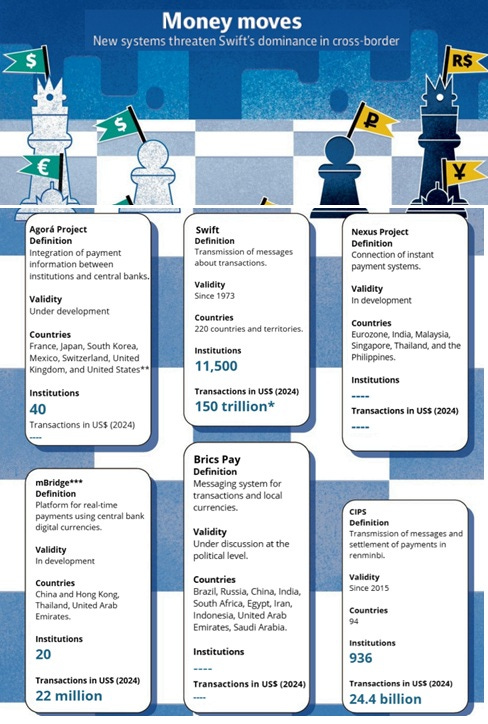
Geopolitics and rapid advances in crypto, blockchain, tokenization, and real-time payment rails are reshaping the half-century status quo built around SWIFT. The dollar’s “exorbitant privilege” won’t disappear overnight, but sanctions risk and credible technical alternatives point to a gradual, managed fragmentation of cross-border payments.
The G20 has spent five years pushing faster, cheaper rails; the BIS is incubating wholesale projects like mBridge (CBDC settlement) and Project Agora (tokenized bank-to-bank transfers), while retail efforts such as Project Nexus aim to interconnect national instant systems (e.g., India’s UPI, ASEAN schemes, and Europe’s TIPS). China already operates CIPS, a renminbi messaging and settlement network spanning 90+ jurisdictions, and is exploring BRICS Pay—though meaningful de-dollarization remains slow given RMB capital controls and the lack of a true USD substitute. Importantly, SWIFT no longer captures all cross-border value: IMF estimates put total flows in the quadrillions, with a growing share moving through stablecoins and other alternative corridors.
Brazil has not formally joined these new schemes, but the Central Bank is advancing Pix internationalization via eFX, which already lets Brazilians pay abroad with Pix and enables visitors in Brazil to pay using local equivalents.
The practical question now is how a multipolar settlement stack—CBDCs, tokenized bank money, corporate networks, and crypto rails—will coexist, and which connections Latin America should prioritize to lower remittance costs and settlement times.
State of the Startup Secondaries Market In Brazil - 2025
Brazil’s startup economy is shifting from a primary-round mindset to a more mature mix that includes secondary transactions as a core liquidity tool. According to the State of the Startup Secondaries Market in Brazil 2025, 52% of surveyed startups executed a secondary this year. Crucially, alignment isn’t suffering: in 82% of cases, founders sold <10% of their stake—enough to ease personal risk without diluting commitment. Liquidity here isn’t an exit; it’s breathing room to keep building.
By the numbers (2025 YTD):
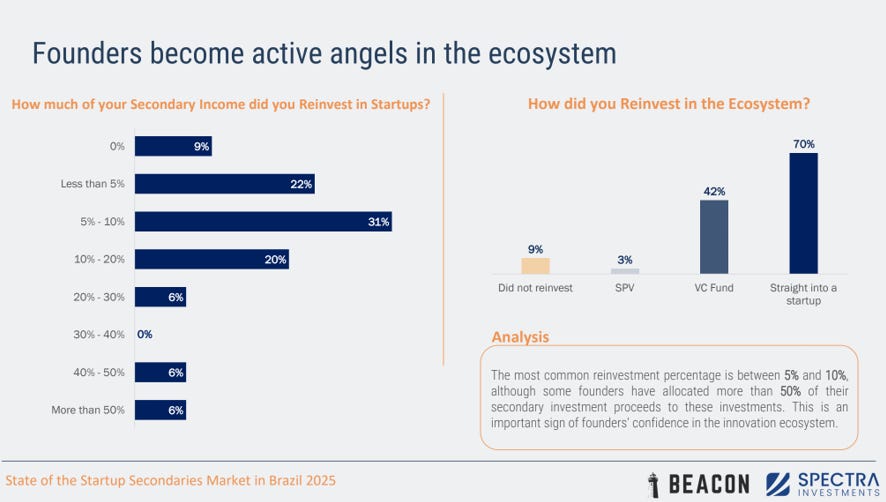
91% of founders who sold reinvested proceeds into the ecosystem (as angels, LPs, or direct backers), creating a capital-and-know-how flywheel.
Secondary discounts tightened from -55% (2023) to -13% (Q2’25), signaling sharper price discovery and stronger demand for high-quality equity.
42% of founders reported better execution post-sale; none reported lower motivation.
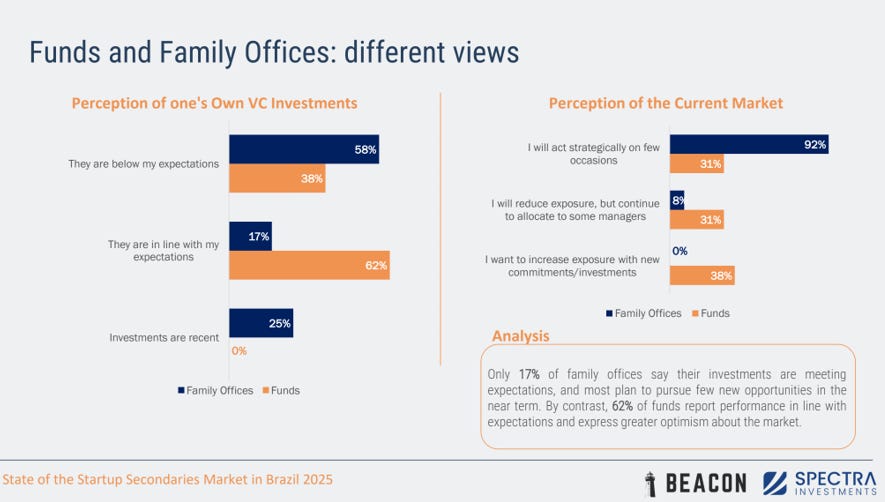
On the buy side, VC funds remain the most active; family offices favor larger companies via SPVs/funds. 85% of current buyers plan to increase exposure over the next 12 months.
Why founders sell (top reasons): diversification/personal security (30%), attractive pricing (18%), round dynamics/oversubscription (18%), life needs such as housing (12%), and regulatory reasons (4%).
The global backdrop: Companies now stay private far longer (median time to IPO: <4 years in 2000 → ~12 in 2015 → ~16 today). With more than US$2T funneled into private markets in the past decade and IPO/M&A windows uneven, secondaries have become the pragmatic way to manage portfolios, refresh cap tables, and provide employee liquidity without waiting a decade.
Cultural shift: What once felt taboo is being reframed as good governance. As Paulo Veras (co-founder of 99) notes in the report, when structured within reasonable limits, secondaries can benefit founders, companies, and investors alike—stabilizing the personal side so leaders can take bold decisions, and making stock options “real” for teams.
Outlook: The report projects ~40% growth in secondary activity by year-end 2025, with domestic and international appetite rising. By early 2026, the momentum could contribute up to 2% of GDP growth as startups deploy capital to expand, hire, and innovate. Net-net: Brazil isn’t just catching up—it’s on track to lead Latin America in secondary liquidity, turning a onetime workaround into a structural pillar of a healthier, more dynamic venture cycle.

General news:
Kyriba, a global SaaS platform for liquidity performance, used by CFOs, treasurers, and IT teams to connect bank data, secure payments, forecast cash, and optimize enterprise liquidity, has just launched in Brazil! Its real-time data and AI deliver financial intelligence and automation to improve performance and efficiency for ~3,000 customers worldwide. The team is now with a strong focus in Latin America.
Itaú is rolling out Pix via WhatsApp to all customers, enabling transfers up to R$200/day directly in chat (text, audio, QR, even forwarded messages). Larger amounts redirect to the Itaú app for extra security. Activation happens in the bank app before using WhatsApp (4004-1515). New tools also include bill-splitting, balance checks, and debt renegotiation inside the messenger. 🇧🇷
MOA Ventures and FCJ Group launched Industry AI Ventures, a multi-corporate CVC + venture-building program to back ~30 early-stage industrial AI startups (Industrial IoT, Digital Twin, automation, energy efficiency, robotics, cybersecurity). 🇧🇷
Aliant and Be Compliance merged to create Brazil’s first compliance-focused ERP, combining policy-management software with a strong distribution network. The group has 300 employees across five cities, operates in 70 countries, targets full integration by 2026, and will offer 60+ corporate e-learning courses (LGPD, ethics) plus an AI policy-assistant. 🇧🇷
Start Growth opened applications for its next batch, allocating R$20M to fintech, HR tech, martech, and database startups (deadline Sept 4). Eligible companies need product validation and first sales; the program focuses on traction and scalable growth. 🇧🇷
Worldcoin opened its largest global verification center (500 m²) in Bogotá, using Orbs for in-person checks to issue World ID. Nearly 2M Colombians are already registered; integrations span Tinder, Razer, Visa, and ticketing services. 🇨🇴
Deals:
Axenya raised a $12M Series A (co-led by Canary and Indicator Capital, with Zentynel) to scale its AI-driven corporate health platform. Reported results: medical inflation 50% below market, 22% lower costs, and 40% savings on high-risk patients; goal is 1M lives monitored by AI. 🇧🇷
● Rooftop is raising R$15M via tokenized securities on Mercado Bitcoin (debt + performance kicker; min ticket R$1K) instead of a single VC round. The model offers quarterly liquidity events and targets ~30% annual IRR; funds will scale HomeCash and micro-franchises. 🇧🇷
Kira raised $6.7M seed (led by Blockchange Ventures, with Stellar Development Foundation and others) to expand its global payments APIs (stablecoins, AI-driven compliance, digital dollar accounts) across LatAm—starting with Colombia and new hubs in Mexico and Miami. 🇺🇸🇨🇴🇲🇽
Ambiq Micro completed a $110.4M NYSE IPO at $24/share (July 31); shares are up ~60% since (closed $38.47 last Fri). The ultra-low-power edge-AI chipmaker (SPOT tech) now has coverage from UBS, BofA, and Stifel (targets $40–$45). 🇺🇸
Constellation Asset and Aster Capital announced a business combination to form a manager with R$2.8B AUM; Aster’s Direcional Ações will merge into Constellation’s Long Only after approvals—positioning for a new equity cycle after years of outflows. 🇧🇷

General news:
Brazil unveiled a R$12B Industry 4.0 credit line for 2025 via BNDES (R$10B) and Finep (R$2B), financing robotics, AI, IoT, cloud, and sensors at rates capped at 8.5% per year, with tailored limits for SMEs and large companies. 🇧🇷
Rappi integrated global wallet AstroPay to enable cross-border payments inside its app across Argentina, Brazil, and Peru—real-time FX conversion and card-less checkout for 35M+ users. 🇦🇷🇧🇷🇵🇪
Wellhub launched a R$100M credit fund (with Galapagos Capital, QI Tech, and OpenCo) to finance gyms and studios, using receivables as collateral to speed approvals and expand Brazil’s fitness ecosystem. 🇧🇷
AWS will sponsor Shark Tank Brasil’s 10th season, awarding $25K in cloud credits plus mentoring on fundraising, cash flow, and tech; YouTube premiere Sept 22, Sony Channel on Oct 10. 🇧🇷
Bitso Business and BVNK partnered to streamline Europe↔LatAm payments using stablecoins—local settlement via Bitso and instant FX via BVNK—to cut cross-border friction for exporters, fintechs, and platforms. 🇲🇽🇬🇧🌎
Goiás launched the Epicenter of Artificial Intelligence: R$2M, equity-free acceleration for health, education, and agribusiness startups; 150 pre-incubate in Sept, with 10 receiving R$200k plus mentoring and IP support. 🇧🇷
Deals:
Starian (Softplan’s private division) made its first M&A after raising R$640M with General Atlantic: CV CRM acquired Anapro from OLX Group, expanding the Sienge real-estate ecosystem to 1.5k+ clients, 30k agencies, and 230k brokers. 🇧🇷
Klarna is reviving IPO plans for next month, targeting a $13–14B valuation and ~$1B raise; Q2 revenue hit $823M (+20% YoY) with $29M adjusted operating profit and 111M active customers (+31%). 🇸🇪

General News:
Divibank partnered with Shopify to integrate Divibank Pay at checkout with smart routing, Pix support, and AI to boost approval rates. Backed by $8.2M, it projects 10x transaction growth by 2025. 🇧🇷
Citi is developing “Pix Global,” a real-time payments platform inspired by Brazil’s Pix, integrating stablecoins and digital systems for instant cross-border transactions. 🇺🇸
Meituan plans to invest R$5.6B in Brazil despite Q2 profit plunging 96.8% due to price wars in China. Expansion under its Keeta brand has already triggered legal disputes in Brazil. 🇨🇳🇧🇷
Nvidia reported Q2 FY2026 revenue of $46.7B (+56% YoY) with $26.4B profit. Data centers drove $41.1B but slightly missed forecasts, frustrating investors. Guidance: $54B next quarter. 🇺🇸
Brazil’s anti-fraud system Tentáculos is expanding to small/mid-sized financial institutions via Acrefi. Created in 2007, it has supported 572 police ops and 208 arrests. 🇧🇷
Brazil officially regulated TV 3.0 (ATSC 3.0), blending broadcast with broadband for interactivity, e-commerce, and digital services. Rollout begins ahead of the 2026 World Cup. 🇧🇷
Deals:
B3 acquired 62% of Shipay for R$37M, with an option to buy the rest by 2030. Shipay offers POS, e-commerce, ERP, and WhatsApp payments. The deal positions B3 for Brazil’s digital receivables wave. 🇧🇷

General news:
Brazil launched Operation Carbono Oculto, the country’s largest financial crime action, mobilizing 1,000 agents across 10 states with 200 warrants. Authorities uncovered a R$52B fuel fraud scheme (2020–2024), including R$2B in fake invoices and illicit flows via fintechs. São Paulo’s Faria Lima hub was a key target, with funds and digital banks implicated. Starting Aug 29, fintechs must comply with the same AML rules as banks. 🇧🇷
Brazil’s Central Bank unveiled Pix “MED 2.0,” a fraud-refund upgrade allowing funds to be traced across multiple accounts. Victims now have up to 11 days to file claims, and banks must provide self-service channels starting Oct 1. Mandatory by Feb 2026, the reform follows rising Pix scams and major data leaks. The BC is also developing an AI-powered fraud risk score. 🇧🇷
● Abipag (Brazil’s payments association) published a Practical Guide for Payment Institutions on Open Finance data/service sharing, marking the system’s 5-year milestone. In 2024, there were 41M consents, 102B API calls, and 800+ participants. The guide details compliance duties, transparency, and partnerships with non-regulated entities. 🇧🇷
Brazil and Mexico signed a new trade agreement covering agriculture, defense, and health. Bilateral trade hit nearly $14B in 2024. Mexico expressed interest in Embraer’s KC-390 aircraft, while regulators Anvisa and Cofepris will now mutually recognize drug approvals. The deal also eases travel with e-visas and strengthens LatAm economic ties. 🇧🇷🇲🇽
Deals:
WOW launched an R$18M angel vehicle to back ~40 early-stage startups with R$500K checks. While 95% of its thesis remains sector-agnostic, 5% now targets AI. Since 2013, WOW has supported 182 startups, with exits like Squid (Locaweb) and Anota AI (iFood). 🇧🇷
Sebrae expanded its INOVA Startups program to R$40M with Sebrae-SP joining as partner, managed by Bossa Invest. The initiative backs scalable startups near break-even with up to three rounds per company and R$750K checks. Since 2021, it has funded 76 startups across 10 states. 🇧🇷
M3 Lending (Minas Gerais) invested R$500K in AI startup Valence to enhance its SME credit platform. M3 already offers loans with rates 22% below banks, and aims to build a full financial ecosystem combining credit, data, and services. 🇧🇷

General news:
M&A activity in Argentina surged in H1 2025, with deal values up 62% and transactions up 14% (TTR Data). Chinese and Brazilian companies are eyeing acquisitions to reroute exports to the US under lower tariffs. New repatriation rules with a 7% withholding tax improved competitiveness, while inflation slowed to ~2% monthly in 2025 (down from 25.5% in late 2023). Mining and oil & gas remain hot, exemplified by Vista Energy’s $1.2B Petronas deal. 🇦🇷
Creditas posted Q2 2025 origination of R$848.6M (+22% YoY) with a R$6.47B loan book (+14%). Revenue hit R$582.5M (+18% YoY), though gross profit fell 9.2% to R$190.1M on higher Selic costs. Net loss reached R$104.7M, but cash flow stayed neutral. Home Equity rose 34% YoY, Auto Equity 20%. The company projects >25% growth annually, powered by AI and automation. 🇧🇷
OpenAI announced its first office in Brazil, in São Paulo, to host AI training and community events. Modeled after Google’s hubs, the space will open in coming months. ChatGPT already counts 50M monthly users in Brazil exchanging 140M+ daily messages, reinforcing the country as a key market. 🇧🇷
Deals:
Commonwealth Fusion Systems raised $863M from Nvidia, Google, Bill Gates, and Breakthrough Energy Ventures, bringing total funding near $3B. It aims for scientific breakeven by 2027 with the Sparc reactor, while its first commercial plant (Arc) is set for Virginia in 2027–2028. Google agreed to purchase 200 MW once Arc is online. 🇺🇸
Revolut is weighing a US bank acquisition to secure a license, after a failed attempt in 2021. It’s also in talks to raise ~$1B at a $65B valuation. With 60M global customers and £3.1B in 2024 revenue (+72%), Revolut is expanding into Mexico and Argentina as well. 🇬🇧🇺🇸
Guardline, a LatAm RegTech startup, closed a funding round to scale its compliance/KYC/AML platform. The modular system adapts to fintechs, banks, and insurers, and will expand first into Argentina and Brazil, followed by Mexico and Colombia. 🇦🇷🇧🇷
Guama, a Colombian fintech founded in 2023, raised $1.5M in seed funding from Salkantay Ventures, Story Ventures, Hustle Fund, and Techstars. It issues credit cards starting at $50 using cash-flow underwriting, already has 6K active users, and processed $1.6M in transactions. 🇨🇴

You will see below an updated list of events. If I forgot your event, and you want to include it - please sure to send those my way asap!
Cubo Conecta 2025
Date: September 2025 (exact dates to be announced)
Location: São Paulo, SP
Description: Celebrating its 10th anniversary, Cubo Conecta is the flagship event of Cubo Itaú, bringing together thousands of entrepreneurs, investors, and innovation leaders from across Latin America. The event offers over 90 hours of content and facilitates more than 5,000 digital connections, highlighting the potential of the technology and innovation ecosystem in the region.
Brazil Climate Summit 2025
Date: September 13–14, 2025
Location: New York, NY, USA
Description: The Brazil Climate Summit focuses on Brazil's role in the global green transition, emphasizing the importance of private sector involvement and international capital to accelerate low-carbon businesses. The event gathers leaders from various sectors to discuss sustainable development strategies.
More infoGartner CIO & IT Executive Conference 2025
Date: September 22–24, 2025
Location: São Paulo, SP
Description: A gathering of CIOs and IT leaders to discuss digital transformation, organizational leadership, and innovation strategies across industries.
More infoMoney 20/20 USA 2025
Date: October 26–29, 2025
Location: Las Vegas, NV
Description: One of the world’s leading fintech and payments conferences, Money 20/20 gathers global leaders across banking, payments, tech, and startups to explore the future of money and financial services.
More infoWeb Summit Lisbon 2025
Date: November 10–13, 2025
Location: Lisbon, Portugal
Description: One of the world’s most influential tech conferences, Web Summit Lisbon connects 70,000+ attendees from startups, enterprises, and media to discuss trends shaping the tech industry.
More infoBrazil Tech Summit 2025
Date: December 9, 2025
Location: São Paulo, SP
Description: Part of the Global Startup Ecosystem Series, Brazil Tech Summit brings together entrepreneurs, government leaders, and investors to foster tech-driven innovation across Latin America.
More info

State of the Startup Secondaries Market In Brazil - 2025 - Beacon Founders + Spectra Investments


"Work like hell. I mean you just have to put in 80- to 100-hour weeks every week. This improves the odds of success. If other people are putting in 40 hour workweeks and you're putting in 100 hour workweeks, then even if you're doing the same thing, you know that you will achieve in four months what it takes them a year to achieve" ELON MUSK