
LatAm Tech Weekly
242: World Cup Sunday, Update on the AI novela, AI in Latam, deals of the week... and much more!

Weekly writing about what is happening in LatAm tech. By day, I am part of the corporate development team at Itau Unibanco. By night, I am reading and learning about technology in general (now, with a focus on AI). During the weekends, I’m writing the LatAm Tech Weekly. And obviously, always running!
If you have not subscribed yet, join the 14,700+ weekly readers by subscribing here!
Follow me on LinkedIn , Instagram or X for daily updates!
Opinions expressed here are solely my own and does not represent those of people, institutions, organizations that I may or may not be associated with in any capacity, unless explicitly stated.
Happy World Cup Sunday!
I’m writing this before the Brazil game — so no spoilers here, just anticipation. And genuinely, I can’t wait to see what’s coming.
Speaking of the Cup — I’ve been fascinated by how far match technology has come. VAR reviews replays frame by frame to catch what referees miss in real time. But this year’s real star is the ball itself: FIFA’s new Trionda ball has an embedded sensor (an IMU) that tracks every micro-touch, displayed to broadcasters as a “heartbeat” graphic. It’s precision at a level no human eye could match.
And this week gave us the perfect — or maybe absurd — proof of that. In the Portugal-Croatia Round of 32 match, Croatia thought they’d equalized in the 105th minute. VAR overturned it. Not because of a clear foul or an obvious offside — but because the sensor detected the faintest touch from Croatia’s Matanović before the ball reached his teammate. Matanović himself later said he thought he might have felt slight contact with his hair. A strand of hair. That’s the margin that sent Croatia home.
And here’s where I’ll be unpopular: as much as I love tech — as someone who spends her days thinking about how sensors, data, and AI make everything more accurate — I think this is where football loses something. Part of the magic of the game was always the ref’s split-second call, right or wrong. The debate afterward. The “he never touched him!” screamed at bars for decades. Now we’ve replaced human judgment with a machine that can detect a hair follicle — and honestly? It’s almost too precise… We didn’t need to know it was the hair. Some mysteries make the game better…
Progress, sure. But maybe not every decision needs a sensor behind it.

Update on the AI novela
If June felt long to you, you weren’t imagining it…
The AI Daily Brief (a podcast I mention here every week) called it straight: June 2026 was the most chaotic month in AI history. Fable/Mythos shutdown, export-control drama, SpaceX’s IPO, policy shifting weekly — a year’s worth of news in thirty days.
The novela’s biggest twist resolved… or sort of…
Fable 5 is back. After 19 days offline, it returned for all global users on July 1st, once the Department of Commerce lifted the export controls that triggered the suspension. Anthropic says testing confirmed no unique dangerous capability was exposed, and rolled out a new classifier claiming a 99% block rate. But one policy advisor put it well: no one actually knows what Anthropic did to make it “safe,” or what that means for Mythos and GPT-5.6, both still stuck behind government-gated access. We’re now living with an ad hoc, opaque licensing regime for frontier models — and that’s the real story here.
Same week, Anthropic quietly shipped Claude Sonnet 5 — near-Opus capability at a fraction of the cost, strong on agentic benchmarks. OpenAI reportedly cut inference costs in half industry-wide, undisclosed method. And OpenAI floated giving the US government a 5% equity stake — a headline that would’ve sounded absurd in January and barely raises eyebrows now.
My take? June was the month we watched, in real time, just how much sovereignty a government can claim over frontier AI. That negotiation isn’t over — it just moved to July.
This week I read a very good report from Hi Ventures: the fourth edition of State of AI Latin America. What I liked about it is that it moves the conversation beyond the generic “AI is coming” narrative and focuses on what is actually changing in the region now: companies are starting to move from AI experimentation to AI deployment.
The report’s core point is simple: the question is no longer whether Latin America will adopt AI. That part seems largely settled. Founders are building with AI from day one, employees are using it in their daily workflows, corporates are moving beyond pilots, and investors are using AI themselves to analyze opportunities. The new question is how AI agents will reshape companies, workflows, and entire industries.
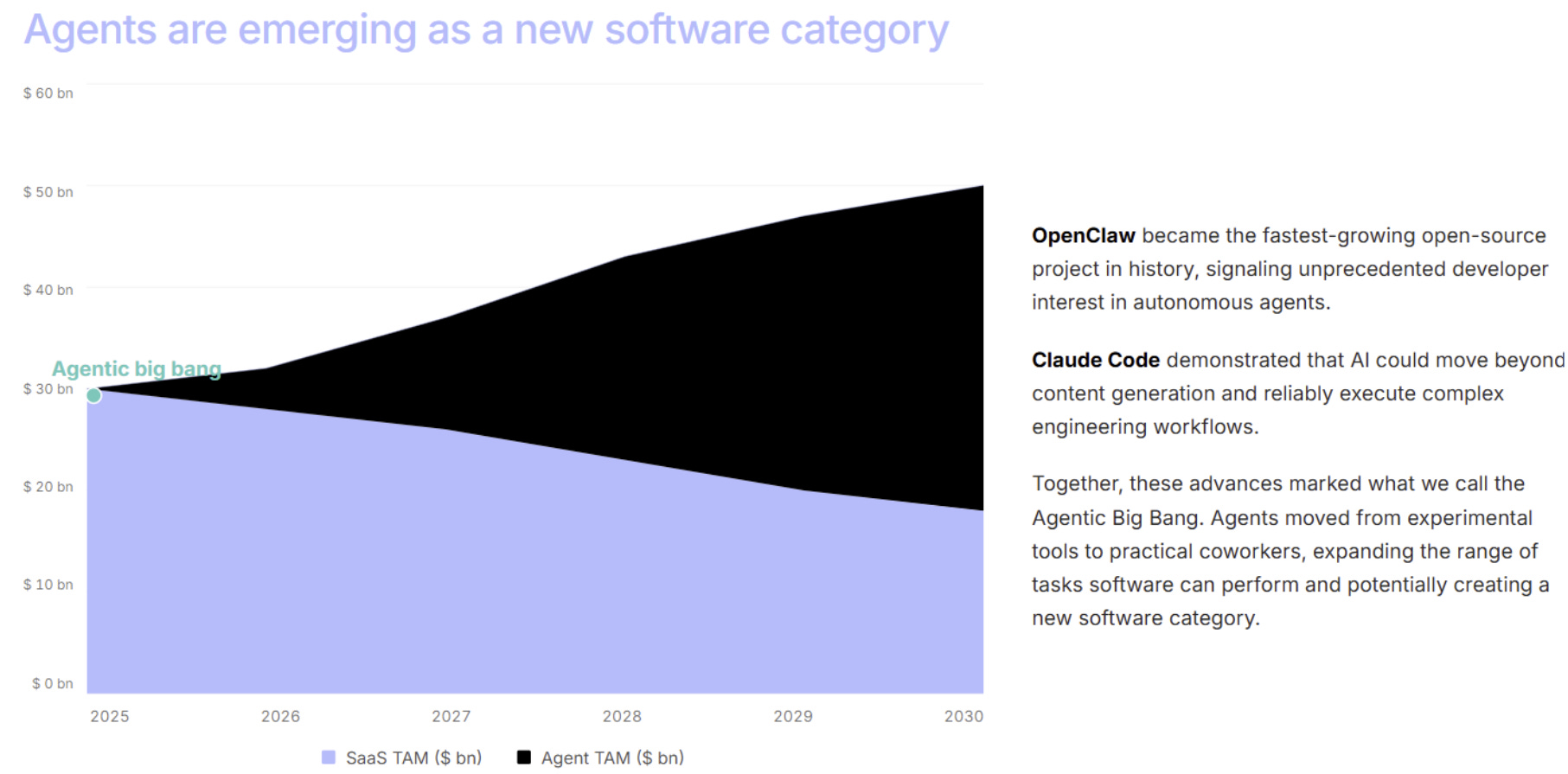
One of the most interesting ideas in the report is what Hi Ventures calls the “agentic big bang.” AI is no longer just about generating text, images, or code. The next phase is about agents: systems that can pursue goals, use tools, navigate workflows, and operate with some level of autonomy. But the report is careful not to overstate this. It says 53% of startups already deploy agents in production, and 30% of corporates do too, but human-in-the-loop remains the dominant model. In other words, this is not yet a world of fully autonomous companies. It is a world where humans and AI agents are starting to work together in more structured ways.
The real opportunity is not simply to replace people or add chatbots on top of existing processes; it is to redesign workflows around what machines can do well and what humans should continue to own: judgment, creativity, accountability, trust, and relationships. That is probably the most important takeaway from the report. AI adoption by itself is becoming less interesting… AI-native operating models are the real story.
The regional data is also worth noting. Hi Ventures created an AI Readiness Index based on strategy, investment, talent and culture, infrastructure and data, and governance. Chile leads with 72.5, Argentina follows with 71.0, and Brazil jumped from 62.5 to 70.2, the largest year-over-year gain among the countries shown. Mexico reached 67.5 and Colombia scored 53.1. The broader message is that AI readiness across Latin America is converging, and Brazil in particular appears to be maturing quickly.
Another finding that stood out to me: talent, not capital, is becoming the binding constraint. The report says lack of technical talent is a top-three barrier for both startups and corporates, cited by 23% of startups and 28% of corporates. At the same time, 51% of startups allocate more than 10% of their operating budget to AI. That says a lot. The willingness to spend is there. The hard part is execution: finding people who can combine AI engineering, product intuition, data infrastructure, workflow design, and domain expertise.
The VC data is also telling. According to the report, 91% of VCs now use AI to analyze deals, up from 45% two years ago. And 61% say that more than 60% of their new investments have AI embedded in the core product. This means AI is changing both sides of the venture market: what investors fund and how investors work.
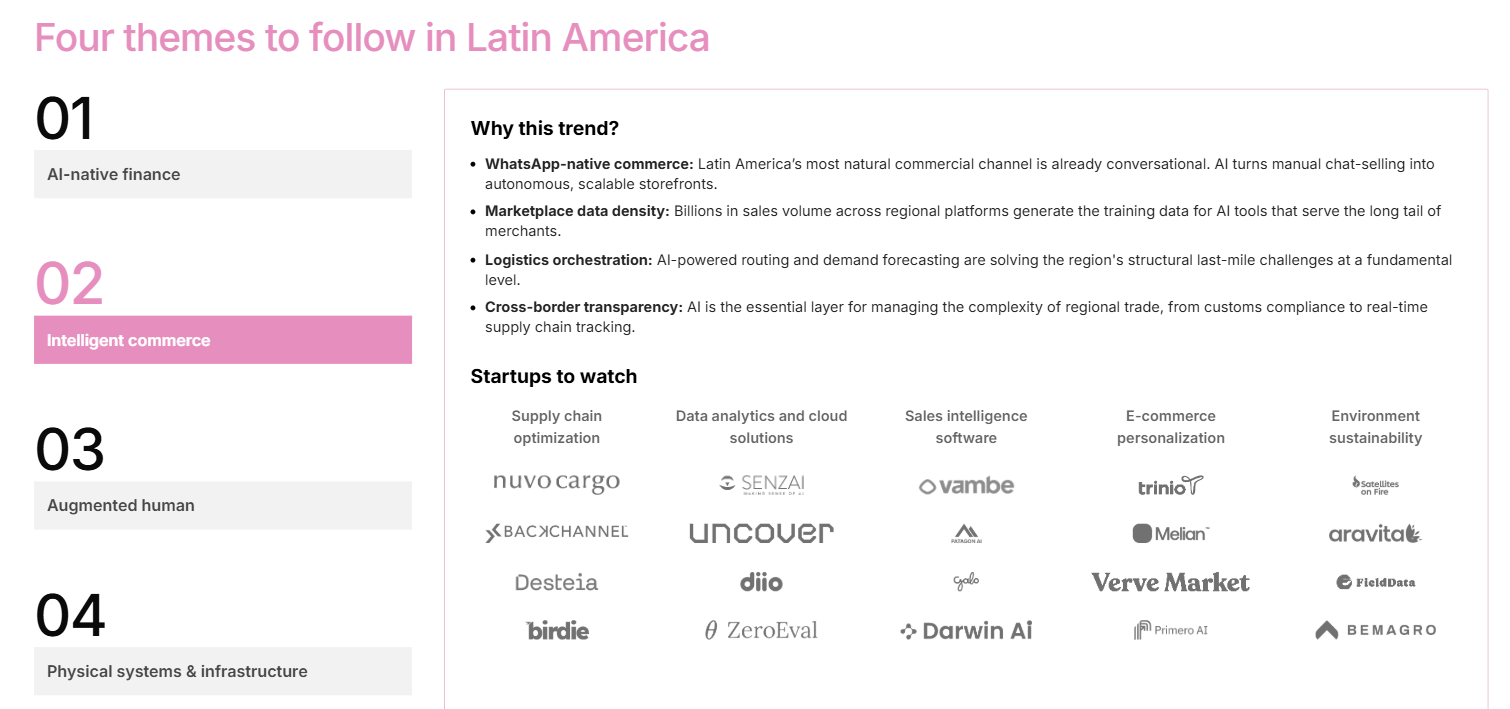
Hi Ventures highlights four big opportunity areas for Latin America.
The first is AI-native finance. This is especially relevant in a region with strong digital rails, including e-invoicing, mobile banking, Pix, open finance, and growing financial inclusion. The opportunity is not just better credit scoring. It is the possibility of AI agents helping individuals and businesses manage cash flow, invoices, taxes, compliance, working capital, underwriting, and financial decisions in a much more automated and personalized way.
The second is intelligent commerce. Latin America is already a conversational commerce region, especially through WhatsApp. Many businesses still sell, support, collect, and manage customers manually through chat. AI agents could turn that into something much more powerful: autonomous storefronts, sales assistants, pricing tools, customer support agents, and operating systems for small merchants.
The third is augmented human. This includes healthcare, education, diagnostics, wellbeing, and productivity. The common thread is that Latin America has large access gaps and shortage of specialists in many areas. AI will not solve these problems alone, but it can expand capacity, lower costs, and make services more personalized.
The fourth is physical systems and infrastructure. This includes robotics, logistics, manufacturing, agriculture, mining, energy, and maintenance. The report argues that AI is beginning to move from the digital world into physical operations, and Latin America has several large industries where that could matter a lot.
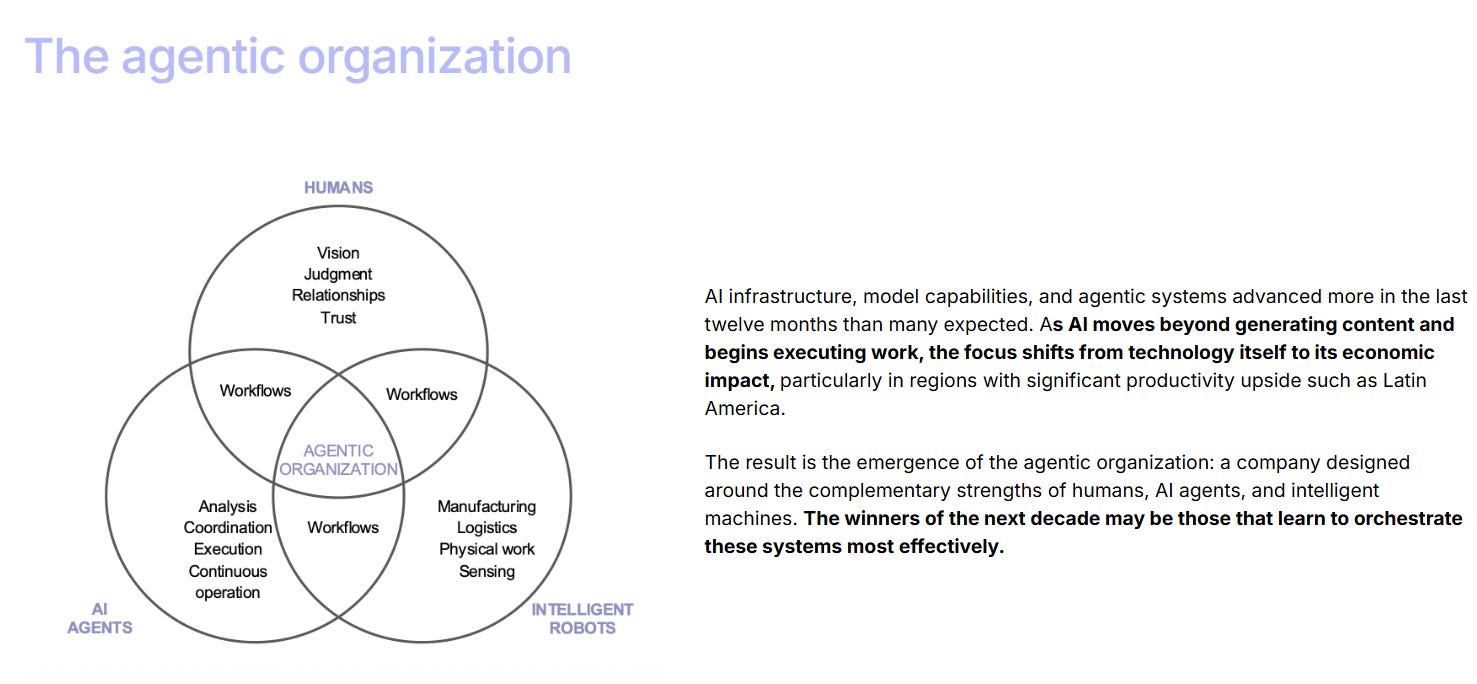
My favorite framework in the report is the idea of the “agentic organization.” A company built for this new era will not simply give every employee an AI tool. It will rethink how work gets done. Humans will define strategy, judgment, relationships, and accountability. AI agents will coordinate, analyze, execute, monitor, and learn across workflows. In some sectors, robots and physical automation will become part of the same system.
Of course, I would read the report with some caution. Hi Ventures is an AI-focused VC, so the lens is naturally optimistic. Also, terms like “agent,” “production,” and “autonomy” can mean very different things depending on the company. A startup saying it has agents in production does not necessarily mean it has reliable, auditable, economically proven automation at scale.
But that does not make the report less useful. Quite the opposite. I think its biggest contribution is to frame where the conversation is going. The first phase of AI was about experimentation. The second phase was about productivity tools and copilots. The next phase is about workflows, agents, and organizations designed around human-machine collaboration.
And for Latin America, that is a big deal. The region has complex markets, fragmented workflows, underpenetrated services, strong digital adoption, and many industries where software has still not fully transformed operations. That combination may actually make Latin America a very interesting place for the next wave of AI-native companies.
The one-line takeaway for me: Latin America has moved past the question of AI adoption. The real question now is who will redesign workflows, companies, and industries around AI agents first.

General news:
• Comp became the only Brazilian startup selected for the World Economic Forum’s Technology Pioneers 2026 cohort. The recognition highlights the company among 100 global startups developing next-generation AI, computing and digital infrastructure technologies. 🇧🇷
• iFood surpassed R$10 billion in revenue in fiscal year 2026, with EBITDA rising 40% to R$2.2 billion. New businesses—including fintech, ERP, grocery and pharmacy—already account for one-third of revenue, reinforcing iFood’s evolution into a broader digital commerce and financial services platform. 🇧🇷
• JPMorgan warned that cyberattacks now represent a greater systemic risk for banks than credit shocks, as AI significantly shortens the time available to detect and remediate vulnerabilities. The report argues that institutions with stronger technology infrastructure and larger cybersecurity budgets will be better positioned, while Brazilian banks are expected to invest R$50.4 billion in technology in 2026. 🌎
• WhatsApp introduced username reservations for its 3 billion users, allowing users and businesses to connect without sharing phone numbers. The feature strengthens privacy while laying the foundation for conversational commerce, payments and AI-powered customer engagement. 🌎
• DM is accelerating its transformation into a broader financial services platform, targeting one-third of revenue from non-card products by 2028. The company is expanding into personal loans, payroll lending and BNPL while reducing dependence on the increasingly competitive credit card market. 🇧🇷
Deals:
• Jota raised a US$30 million Series A led by Haun Ventures at a US$185 million post-money valuation. The funding will accelerate its AI-native banking platform, expand AI agents and embedded credit offerings, and support growth from 300,000 to nearly 1 million users by year-end. 🇧🇷
• AI hardware startup Pocket raised US$11 million to accelerate development of its wearable AI assistant for voice recording, transcription and meeting productivity. The round reflects growing investor interest in AI-native consumer hardware. 🌎

General news:
• Itau, Visa, Mastercard, Stripe, Coinbase and more than 140 companies formed the Open Standard consortium to launch Open USD, a dollar-backed stablecoin designed for enterprise payments. The initiative aims to accelerate stablecoin adoption through an open, interoperable network while intensifying competition with USDC and USDT. 🌎
• Amazon Web Services (AWS) is investing US$1 billion to launch its new Forward Deployed Engineering unit, deploying dedicated engineering teams to help enterprises build and scale AI applications directly within AWS environments. The initiative expands AWS beyond cloud infrastructure as hyperscalers compete to deliver end-to-end enterprise AI implementation. 🇺🇸
• MedToken is preparing a token offering backed by physicians’ on-call shifts, allowing investors to gain exposure to future healthcare revenues while providing doctors with upfront liquidity. The initiative expands the use of tokenized real-world assets (RWAs) beyond traditional financial markets. 🇧🇷
Deals:
• Buser acquired product design studio Designa in an acquihire transaction to strengthen its AI and product development capabilities. The acquisition supports Buser’s transformation into a data- and AI-driven technology company while diversifying beyond its core mobility business. 🇧🇷
• Bianca AI raised a US$500,000 pre-seed round to build an AI platform for consumer packaged goods companies. The startup is developing industry-specific intelligence tools to improve commercial decision-making and retail execution. 🌎
• Mexican fintech Digitt secured a US$50 million credit facility from Victory Park Capital to expand its consumer lending platform. The funding will support loan portfolio growth and strengthen technology and underwriting capabilities in Mexico’s high-interest consumer credit market. 🇲🇽
• Brazilian mobility startup Guipa raised R$7.5 million in a pre-seed round to expand its platform that transforms delivery motorcycles into connected urban data and advertising networks. The company plans to scale nationwide as demand grows for smart mobility and public safety infrastructure. 🇧🇷
• Kikos acquired gym marketplace GuruPass to accelerate its expansion into digital fitness services. GuruPass will become Kikos’ technology arm, developing management software, data integration tools and wearable solutions while supporting the company’s regional growth strategy. 🇧🇷

General news:
• Global M&A activity reached a record US$2.8 trillion in the first half of 2026, driven by a surge in transactions exceeding US$10 billion. Technology remained the most active sector as companies accelerated acquisitions to strengthen their position in the AI race. 🌎
• The “Magnificent Seven” lost approximately US$2.3 trillion in market value during June as investors questioned whether record AI infrastructure spending will translate into stronger future earnings. Meanwhile, semiconductor companies continued outperforming on sustained AI demand. 🇺🇸
Deals:
• Argentine investment platform Cocos Capital agreed to acquire the core assets of Warren Investimentos, including its brokerage, asset management and capital markets businesses. The transaction gives Cocos its entry into Brazil while adding more than R$20 billion in assets under custody. 🇦🇷🇧🇷
• Brazilian luxury resale marketplace Cansei Vendi is restructuring its operations after closing its physical store, shifting to a leaner, digital-first model focused on profitability, cash efficiency and sustainable growth. 🇧🇷
• Brazilian govtech V360 is expanding into credit by leveraging the more than R$530 billion in annual payment volume it processes for public-sector entities. The company plans to offer financing solutions tailored to government-related ecosystems, diversifying beyond payment processing. 🇧🇷
• Flash is entering AI-powered recruitment as part of a planned R$400 million investment in 2026. The HR tech aims to unify the entire employee lifecycle into a single platform while expanding beyond its core benefits business. 🇧🇷
• CADE reopened its investigation into 99Food over alleged exclusivity clauses with restaurants, reversing its previous decision to close the case. The move comes as competition intensifies among Brazil’s major food delivery platforms. 🇧🇷

General news:
• The Central Bank of Brazil introduced a new regulatory framework for virtual asset service providers (VASPs), requiring cryptocurrency firms to comply with prudential rules similar to those applied to regulated financial institutions starting in 2027. The regulation strengthens governance, capital requirements and risk management under the principle of “same activity, same risk, same regulation.” 🇧🇷
• Microsoft launched Microsoft Frontier Company (MFC), a new AI business unit backed by a US$2.5 billion investment and 6,000 specialists to help enterprises deploy AI at scale. The initiative intensifies competition among hyperscalers to provide end-to-end AI implementation services. 🇺🇸
• The Financial Times reported that OpenAI is exploring granting the U.S. government a 5% equity stake as part of a broader IPO strategy. The proposal could strengthen regulatory alignment while reinforcing AI’s growing importance as a matter of U.S. industrial policy and national competitiveness. 🇺🇸
Deals:
• German agritech Stenon raised R$106 million to expand its AI-powered nitrogen management technology in Brazil. The company uses real-time soil analysis to optimize fertilizer application, reduce costs and improve agricultural productivity. 🇩🇪🇧🇷
• Peruvian fintech Blanco Financiero raised a US$5.2 million seed round led by Krealo to accelerate its digital lending platform and expand financial access for underserved consumers and businesses. 🇵🇪
• Cloud9 Capital raised R$600 million for its second fund, doubling the size of its inaugural vehicle to invest in profitable, AI-focused growth-stage technology companies across Brazil. 🇧🇷
• Pinbank raised R$100 million through a FIDC structured by XP to expand the financing capacity of its acquiring business and support technology investments as it scales its payments platform. 🇧🇷
• Omie allocated R$100 million to acquire franchisees as part of a strategy to consolidate its commercial network, strengthen its direct presence and accelerate growth in Brazil’s SMB software market. 🇧🇷

General news:
• Positivo Tecnologia is expanding its edge AI and local computing capabilities to capitalize on rising demand for enterprise AI infrastructure. AI servers have already generated more than R$500 million in sales, with infrastructure accounting for over half of the company’s revenue as organizations increasingly adopt on-premise AI solutions. 🇧🇷
• Brazil’s CVM will require enhanced due diligence for clients using offshore structures in the British Virgin Islands and Monaco following both jurisdictions’ inclusion on the FATF grey list. The measure strengthens Brazil’s anti-money laundering framework and increases compliance requirements for financial institutions. 🇧🇷
• Delend launched an AI-powered credit risk model for Brazil’s electronic duplicate ecosystem, using more than 30 million invoices to improve SME credit analysis. The solution supports the Central Bank’s initiative to modernize receivables infrastructure and expand access to credit. 🇧🇷
Deals:
• Chilean edtech Lab4U was acquired by Britebound in what the companies describe as the first social impact acquisition of a Latin American edtech. The deal expands access to STEM education through mobile-based learning technologies. 🇨🇱
• Mexican fintech Baubap secured a US$23 million credit facility from BBVA Spark and SixPoint to expand digital consumer lending and increase financial inclusion. The non-dilutive financing will support loan origination and portfolio growth. 🇲🇽
• AI Pathology joined Nvidia Inception as it advances its AI-powered skin cancer detection platform. The Brazilian healthtech is preparing an US$8 million Series A round to support global expansion and regulatory approvals. 🇧🇷
• SRM Ventures exited Blipay through its acquisition by U.S.-based Tilt, marking the venture firm’s first exit. The acquisition supports Tilt’s expansion into Brazil while reinforcing momentum in the country’s fintech ecosystem. 🇧🇷🇺🇸

See above the update on the AI Novela!!!

Febraban Tech 2026
Date: August 24–26, 2026
Location: São Paulo, Brazil
Description: One of the main financial technology and innovation events for the banking and financial services sector in Latin America.
More infoConta Azul Con 2026
Date: August 1, 2026
Location: São Paulo, Brazil
Description: A conference connecting accounting, entrepreneurship, and technology through keynotes, workshops, networking sessions, and discussions on business innovation.
More infoRio Innovation Week 2026
Date: August 4–7, 2026
Location: Rio de Janeiro, Brazil
Description: One of Brazil’s largest innovation festivals, bringing together entrepreneurs, startups, corporations, investors, and policymakers to discuss technology, business, and social transformation.
More infoSP2B (São Paulo Beyond Business) 2026
Date: August 9–16, 2026
Location: São Paulo, Brazil
Description: A new business and innovation event designed to connect entrepreneurs, executives, investors, and corporations through discussions on growth, creativity, and the future of business.
More infoDeep Tech Summit 2026
Date: August 11–12, 2026
Location: São Paulo, Brazil
Description: A conference focused on science-based innovation, bringing together deep tech startups, investors, corporations, and researchers to explore frontier technologies and emerging opportunities.
More infoStartup Summit 2026
Date: August 26–28, 2026
Location: Florianópolis, Brazil
Description: One of Latin America’s leading startup events, connecting founders, investors, and ecosystem leaders through content, networking, and business opportunities.
More infoHackTown 2026
Date: September 3–7, 2026
Location: Santa Rita do Sapucaí, Brazil
Description: A unique innovation, technology, and culture festival that transforms an entire city into a hub for networking, learning, entrepreneurship, and creative collaboration.
More infoHotmart Fire 2026
Date: September 10–12, 2026
Location: Belo Horizonte, Brazil
Description: One of the leading events for the digital business and creator economy ecosystem, covering marketing, sales, online education, innovation, and business growth.
More infoDreamforce 2026
Date: September 15–17, 2026
Location: San Francisco, United States
Description: Salesforce’s flagship conference focused on CRM, AI, digital transformation, customer experience, and enterprise innovation.
More infoTechCrunch Disrupt 2026
Date: October 13–15, 2026
Location: San Francisco, United States
Description: A leading global startup conference where founders, investors, and technology leaders discuss entrepreneurship, fundraising, and innovation.
More infoWeb Summit Lisbon 2026
Date: November 9–12, 2026
Location: Lisbon, Portugal
Description: One of the world’s largest technology conferences, bringing together entrepreneurs, investors, executives, and policymakers to discuss global innovation trends.
More infoSlush 2026
Date: November 18–19, 2026
Location: Helsinki, Finland
Description: A globally recognized startup and venture capital conference focused on connecting founders and investors while fostering innovation and growth.
More infoAWS re:Invent 2026
Date: November 30 – December 4, 2026
Location: Las Vegas, United States
Description: AWS’s flagship cloud computing conference, featuring product launches, technical sessions, training, and discussions on cloud infrastructure, AI, and data.
More info

nothing worth noting this week, apart from the report I summarized above (which I also mentioned last week here)

