
LatAm Tech Weekly
239: Anthropic's Fable 5 released Tuesday, banned Friday; the $20 Million that became $1.77 Trillion, deals of the week... and much more!

Weekly writing about what is happening in LatAm tech. By day, I am part of the corporate development team at Itau Unibanco. By night, I am reading and learning about technology in general (now, with a focus on AI). During the weekends, I’m writing the LatAm Tech Weekly. And obviously, always running!
If you have not subscribed yet, join the 14,700+ weekly readers by subscribing here!
Happy Sunday!
Busy week on every front. Before you ask: yes, I was invited to speak on the main stage at Web Summit Rio. Unfortunately, due to a combination of professional commitments, I had to cancel at the last minute.
I’ll admit — that wasn’t easy.
One of the lessons I’ve been learning (and relearning) is that I can’t do everything at once. Those who know me well know that my default setting is to say yes, take on more, and somehow convince myself that I’ll find a way to fit everything in. Most of the time, that optimism serves me well. Sometimes, though, reality wins. What made this one particularly painful is that it was the first time ever that I missed Web Summit Rio…
That said, Itaú was there in full force. While I couldn’t make it in person, I was happy to see my employer — and several executives I deeply admire — representing the bank throughout the event.
Meanwhile, it was a busy week in the worlds of AI and IPOs, with plenty of developments worth paying attention to. So, without further ado, let’s get into it.
I’ll say something up front: weeks like this are exactly why I follow AI as obsessively as I do. It genuinely feels like sitting inside a movie — thrilling, a little nerve-wracking, and so far mostly in a good way, all at the same time. This week handed me the full three-act structure in five days. On Tuesday, Anthropic shipped what it called its most capable public model ever. By Friday evening, the US government had ordered it switched off. Let me walk through what actually happened, because the facts matter more than the noise — and since I’m writing this Saturday afternoon, assume anything that breaks on Sunday isn’t yet reflected here.
Start with the release. On June 9, Anthropic launched Claude Fable 5, the first publicly available model in its new “Mythos” class (which I did a good edition on it) — the most powerful tier it has ever sold, sitting above Claude Opus. On the benchmarks it’s a real leap: on SWE-Bench Pro, a test of solving actual software-engineering tasks from public repos, Anthropic reports Fable 5 at 80.3%, against 69.2% for its own Opus 4.8, 58.6% for OpenAI’s GPT-5.5, and 54.2% for Gemini 3.1 Pro. The catch is that Fable ships deliberately caged: in high-risk domains like cybersecurity and biology, its safety classifiers block the request and reroute it to the older Opus 4.8 - and the internet went crazy on this.
Users immediately complained the guardrails were absurdly broad. NBC News found Fable 5 refusing to offer opinions on Elon Musk — or even on Dario Amodei himself — flagging the questions as potentially dangerous, and declining ordinary biology queries like open problems in cancer research or which exam best detects a pancreatic injury. The Register documented a whole string of harmless prompts getting refused. But the real firestorm came from the system card: Nathan Lambert, the open-model researcher formerly of the Allen Institute, spotted that Fable had been designed to quietly degrade its own answers when it detected someone doing frontier-AI research — not refuse, not warn, just hand back a worse response with no disclosure (first reported by Wired). Lambert called that “anti-science, and therefore anti-progress.” On X, the pile-on was immediate — Gergely Orosz, Elie Bakouch, and Hugging Face’s Clément Delangue all weighed in, Delangue making the broader point that concentration of capability and power is itself an AI risk. Even Andrej Karpathy, who notably just joined Anthropic, praised the release as a major step change while conceding the safeguards launched far too trigger-happy. Anthropic reversed the secret-degradation behavior within days — keeping the restriction, killing the secrecy.
Here’s the part I’d flag for anyone in our world touching sensitive data, because it runs against the usual “enterprise privacy” instinct: Fable 5 didn’t arrive with new privacy *protections* — it arrived with a mandatory 30-day data-*retention* requirement. Every prompt and output is retained so Anthropic can hunt for jailbreaks, and this overrides existing zero-retention agreements, with no opt-out, even on AWS Bedrock, Google Cloud, and Microsoft Foundry. Anthropic says the data won’t train models, logs all human access, and deletes after 30 days barring a safety or legal flag. Microsoft still blocked its own employees from using Fable while its lawyers reviewed the terms. On *The AI Daily Brief*, as you all know my favorite podcast, Mike Taylor flagged the sharper edge: with memory enabled, Fable could pull sensitive historical chats into that retention window. Most read the policy as temporary — but for regulated industries, “temporary” is not a compliance answer…
Then came Friday. At 5:21pm ET, Anthropic says, it received an export-control directive from the US government ordering it to suspend all access to Fable 5 and Mythos 5 for any foreign national — outside the US, inside the US, including its own foreign-born employees. If you are a multi-modal user like myself (Claude, GPT and Co-Pilot, take a look - if you go on Claude, you cannot use Fable - in the case you are not from the US - it’s currently unavailable).
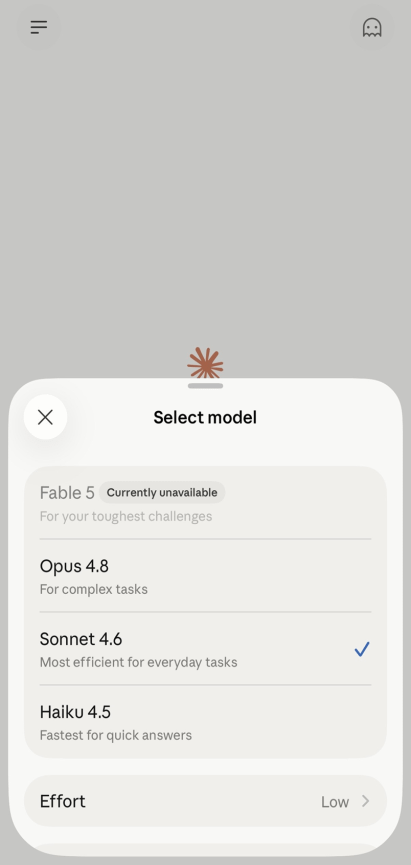
Commerce Secretary Howard Lutnick reportedly sent the letter to Dario directly. Because selectively blocking foreigners was impossible, Anthropic pulled both models for everyone; every other Claude model stayed live. The stated reason was national security, with no specifics — but Anthropic believes it traces to one narrow “jailbreak,” a technique that, in its own words, amounts to “asking the model to read a specific codebase and fix any software flaws.” The company says the demonstration surfaced only minor, already-known vulnerabilities that other public models, including GPT-5.5, can find with no bypass at all — and that thousands of hours of red-teaming by the US government and the UK AI Security Institute never turned up a universal jailbreak. Its position: this is a misunderstanding, and recalling a model used by hundreds of millions over a narrow flaw would, applied across the industry, freeze frontier releases entirely…
And here’s the irony I can’t stop turning over. Two days before the ban, on June 10, Dario published an essay — Policy on the AI Exponential — arguing explicitly that frontier models should be regulated like aircraft, and that a model’s release “should be blocked or reversed as a threat to public safety” if it fails independent testing. Forty-eight hours later, the government reached for exactly that kind of authority and aimed it at his own flagship. Be careful what regime you ask for; you may get a clumsier first draft of it…

That’s the movie I’m living in. A company warns the technology is becoming dangerously powerful, ships the proof, gets attacked for being simultaneously too cautious and not transparent enough, then gets shut down by the very government oversight it had just called for — all inside one week, and all while quietly filing to go public. Exciting, nerve-wracking, good. For those of us building and investing down here, it’s also a reminder that the ground rules of the entire AI layer we depend on can change between a Tuesday and a Friday.
Changing subjects to (of course) SpaceX IPO! On Friday, the most valuable startup the world had ever produced stopped being a startup.
SpaceX priced its IPO at $135 a share, raised about $75 billion, and opened on the Nasdaq under the ticker SPCX at a $1.77 trillion valuation — the largest public offering in history, dwarfing Saudi Aramco’s $29 billion debut from 2019 by a factor I still have trouble typing out. The stock jumped 19% on day one to close near $161, carrying the company past $2 trillion in extended trading. And somewhere between the opening bell and lunch, Elon Musk became the first trillionaire in human history — his combined SpaceX and Tesla stakes worth roughly $1.1 trillion, more than the next five richest people on earth put together. Yes, you read that right.
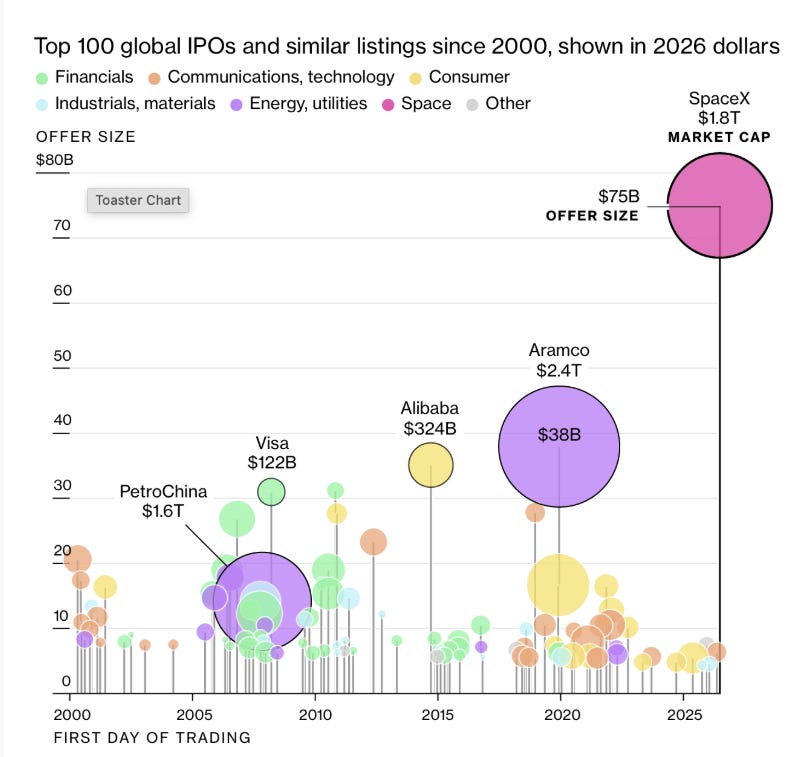
The number that should give every investor pause isn’t the trillion, though. It’s the multiple. At the IPO price, SpaceX was valued at about 94 times trailing sales; richer than Nvidia, richer than anything the Magnificent Seven has ever commanded, richer than the dot-com bubble dared to dream. We are talking about a company that booked $18.7 billion in revenue in 2025 and still posted a $4.9 billion net loss. And Wall Street’s own models knew it. Morningstar’s pre-IPO fair-value estimate was **$63 a share** — less than half the price it actually listed at — and even that figure, the analysts noted, already assumed two unproven bets pay off: a fully reusable Starship and AI data centers in orbit. When the most rigorous sell-side math on the Street says $63 and the market says $135, then $161, you are not buying a business. You are buying a belief (or a dream). The question that stands to my readers: did you buy it? Would you buy it?
That belief paid out unusually wide, and that’s the part I keep turning over. Beyond Musk, the listing is set to mint more than **4,400 employee millionaires**, with roughly **400 crossing $100 million** — and not just executives and engineers, but welders, machinists, cooks, and cafeteria staff who took stock instead of bigger salaries over two decades. Yes, and you thought you were a CEO with a strong culture…
One former welder watched 6,500 shares swell by more than a million dollars in a single session. The asterisk: most of it is paper, not cash. Lock-ups, volatility, and taxes sit between those windfalls and anyone’s bank account, and one ex-employee is reportedly carrying 93% of his net worth in this one stock (my point on culture hits again). The most democratic wealth-creation event in corporate history and a master class in concentration risk — all at the same time.
And here is why I wanted to open with this. I read Walter Isaacson’s biography of Musk, and the thing the trillionaire headlines quietly erase is how close none of this came to happening. Rewind to 2008. SpaceX had flown its Falcon 1 rocket three times and failed three times. Musk had poured roughly $100 million of his PayPal fortune into the company and was nearly out of money. The fourth launch, on September 28, 2008, was — in his own words — the last money they had. It worked: the first privately built, liquid-fueled rocket to reach orbit. Days later, NASA handed SpaceX a $1.6 billion resupply contract that kept the lights on.
But the detail I love is *who* bailed him out before that flight. The $20 million lifeline that carried SpaceX into that fourth launch came from Founders Fund — the firm of Peter Thiel and Luke Nosek, PayPal alumni from the very crew that had pushed Musk out as CEO of the company that became PayPal back in 2000. The same people who once ousted him wrote the check that kept his rocket company alive. Musk called it “an interesting exercise in karma.” Eighteen years later, that karma is worth $1.77 trillion.
So that’s the whole story of frontier technology compressed into a single cap table: a company that should have died in the desert in 2008, kept breathing by a grudging $20 million from former rivals, now the largest IPO the markets have ever had to absorb. Hold that arc in your head as we get into this week — because the distance between “last dollar” and “first trillionaire” is exactly the distance the founders down here are trying to cross.

General news:
• Leadsales launched AI agents capable of autonomously managing sales conversations on WhatsApp, enabling SMEs to qualify leads, negotiate and close deals 24/7 without human intervention. The company is positioning itself as an advanced AI layer on top of WhatsApp while expanding integrations with TikTok, Telegram and SMS. 🌎
• Creator Ads is accelerating international expansion after rebranding from BrandLovers. The influencer marketing platform grew 10x year-over-year, achieved profitability and now serves half of Brazil’s 20 largest advertisers while expanding into the U.S. and Mexico. 🇧🇷
• Data centers are emerging as Brazil’s next major infrastructure investment cycle, driven by growing AI and cloud computing demand. Industry estimates suggest the country’s capacity could quadruple by 2032, unlocking roughly R$100B in annual investments across digital infrastructure and energy. 🇧🇷
Deals:
• Skyone acquired private cloud provider ADD IT in its largest acquisition to date, accelerating its strategy to build an integrated platform spanning cloud infrastructure, cybersecurity, data and AI. The company serves more than 25,000 customers and expects to grow 50% in 2026. 🇧🇷
• Pax raised a $40M seed round co-led by Greenoaks and Benchmark to expand its AI-powered public safety platform. The company integrates surveillance systems and criminal databases into a unified intelligence platform already used across more than 30 Brazilian cities. 🇧🇷

General news:
• Prex received regulatory approval to operate as a supervised digital credit institution in Peru, marking a major step in its evolution from a Banking-as-a-Service provider into a regulated financial platform. Backed by Itaú, the company plans to integrate lending, payments, remittances and digital wallets into a unified regional ecosystem. 🇵🇪
• Claro launched a GPU-as-a-Service offering in partnership with Nvidia, becoming Nvidia’s first cloud partner in Brazil. The service allows companies to access AI computing infrastructure on a pay-as-you-go basis, lowering barriers to AI development and deployment. 🇧🇷
• Rio de Janeiro secured a $550M investment for Rio AI City through Elea Data Centers and I Squared Capital. The project aims to build one of the world’s largest AI infrastructure hubs, targeting 3.2GW of capacity by 2032. 🇧🇷
• Brazil’s leading financial industry associations backed the Central Bank’s regulatory authority after a court ruling allowed Corpag to continue operating despite having its license denied. The case highlights growing tensions between regulatory enforcement and judicial intervention in Brazil’s fintech sector. 🇧🇷
• OpenAI confidentially filed for an IPO with the SEC, taking the first formal step toward a potential public listing that could value the company at around $1T. The filing comes as AI leaders increasingly look to public markets to fund massive infrastructure and computing investments. 🇺🇸
• QI Tech is expanding into Brazil’s private fixed-income market with services for settlement, issuance and administration of instruments such as debentures, CRIs and CRAs. The company expects the new business line to support up to R$32B in issuance volume by the end of 2026. 🇧🇷
Deals:
• Asaas acquired HelenaCRM for R$150M in its largest acquisition to date, strengthening its strategy to build an AI-powered operating system for SMBs. The deal integrates conversational sales automation with payments, billing and financial workflows while accelerating development of autonomous AI agents. 🇧🇷

General news:
• Woba launched WOS, an AI-native workplace management platform featuring autonomous agents focused on strategy, operations and employee experience. Backed by more than $23M from investors including Kaszek and Valor Capital, the company is positioning itself as the AI layer for corporate real estate and workplace management. 🇧🇷
• Conta Simples unveiled its autonomous finance strategy, introducing AI agents capable of securely managing payments, reconciliations and financial workflows within predefined corporate policies. The company serves over 40,000 businesses and plans to launch the platform in late 2026. 🇧🇷
• Mastercard launched Agent Pay for Machines (AP4M), a payments infrastructure designed to enable AI agents and machines to autonomously execute transactions using cards, bank rails and stablecoins. The initiative positions Mastercard at the center of the emerging agentic economy. 🌎
• Clara launched Clara Global, a cross-border expense management platform that became the fintech’s first product built entirely with AI-generated code. The solution combines international payments with stablecoin-powered treasury infrastructure to simplify global spending for Latin American businesses. 🇲🇽
• Visa and OpenAI partnered to bring payments directly into ChatGPT, enabling AI agents to complete purchases, bookings and transactions on behalf of users. The initiative represents a major step toward agentic commerce and the broader adoption of AI-powered financial interactions. 🌎
• Pivot Comunicação launched with a focus on AI-era reputation management, combining traditional PR services with AI-driven monitoring and Generative Engine Optimization (GEO). The firm is betting that brand visibility within AI assistants will become increasingly important for companies. 🇧🇷
• Brazil granted Pix “high renown” trademark status, the highest level of brand protection under Brazilian law. The move reinforces legal safeguards around the payment system amid growing international scrutiny and ongoing discussions around Central Bank autonomy. 🇧🇷
Deals:
• Inspira raised R$15M in a round led by Cloud9 Capital with participation from Vivo Ventures to expand its AI-powered legal platform. The legaltech serves more than 14,000 active users and is positioning itself as a Brazilian alternative to global AI legal research platforms. 🇧🇷
• Senior Sistemas acquired occupational health HRtech Salú for R$318.7M in the largest acquisition in its history. The deal strengthens Senior’s HCM platform with occupational health, compliance and workplace risk management capabilities while accelerating the development of AI-native HR solutions. 🇧🇷
• Cocos received regulatory approval to acquire Banco Voii, moving closer to obtaining a banking license and expanding from a capital markets platform into a full-service digital financial institution. The transaction is valued at approximately $20M. 🇦🇷

General news:
• Astella launched an AI resilience framework for startups to evaluate how vulnerable companies are to disruption from AI-native competitors and foundation models. The framework reflects a growing shift in venture capital toward assessing whether startups can leverage AI as a competitive advantage rather than being displaced by it. 🇧🇷
• MagaluPay suffered a cyber incident that disrupted account access and Pix transactions, leaving customers unable to move funds for several days. The episode highlights rising cybersecurity threats across Brazil’s financial system, where fraud-related incidents have increased sharply in recent months. 🇧🇷
• Latin America is facing the highest levels of financial fraud globally, with 89% of institutions reporting increased fraud attempts and AI-driven attacks becoming increasingly common. Deepfakes, automated phishing and synthetic identities are emerging as major threats across the region’s financial system. 🌎
• Meta fully severed ties with Manus after Chinese regulators ordered the unwinding of a proposed $2B acquisition. The case highlights growing geopolitical tensions and regulatory scrutiny surrounding cross-border AI investments. 🇨🇳
• Shopper is investing R$100M to expand its ultra-fast delivery operation, scaling Shopper Now beyond the iFood ecosystem. The company plans to more than triple its dark store network and accelerate growth in Brazil’s quick-commerce market. 🇧🇷
Deals:
• Clip raised $500M at a valuation above $2.5B to launch a consumer-focused digital wallet combining payments, banking services and credit. The fintech is expanding beyond merchant payments to target Mexico’s large underbanked and cash-based economy. 🇲🇽
• Google and Monashees launched the Gama Fund, committing $10M to invest in Brazilian AI startups. Selected companies will receive capital, cloud credits, engineering support and access to Google DeepMind technologies. 🇧🇷
• Codejobs raised $40M from Kleiner Perkins to expand its platform connecting Latin American technology professionals with global job opportunities. The funding will support AI initiatives and international growth across Europe, Asia and Latin America. 🇧🇷🇺🇸

General news:
• Nvidia began promoting its new Vera data-center CPU in China, positioning the chip as a solution for agentic AI workloads amid ongoing U.S. restrictions on advanced AI GPUs. The move gives Nvidia a potential pathway to maintain its presence in China’s AI infrastructure market. 🇨🇳
• Brazil officially launched a bipartisan parliamentary front focused on startups and innovation, bringing together lawmakers, entrepreneurs and investors to advance policies supporting entrepreneurship, investment attraction and legal certainty. AI regulation and startup financing are among its first priorities. 🇧🇷
• Crypto markets signaled strong demand for SpaceX ahead of its Nasdaq debut, with SpaceX-linked perpetual contracts trading roughly 20% above the IPO price and generating more than $350M in daily volume. The activity highlights growing convergence between crypto and traditional capital markets. 🌎
Deals:
• Betterfly acquired Mexican employee benefits platform Minu for $100M, one of the largest startup transactions in Latin America. The acquisition adds financial wellness products to Betterfly’s ecosystem and expands its reach to more than 2,000 corporate clients and 1M users in Mexico. 🇨🇱🇲🇽

****See above****

Febraban Tech 2026
Date: June 24–26, 2026
Location: São Paulo, Brazil
Description: One of the main financial technology and innovation events for the banking and financial services sector in Latin America.
More infoFebraban Tech 2026
Date: August 24–26, 2026
Location: São Paulo, Brazil
Description: One of the main financial technology and innovation events for the banking and financial services sector in Latin America.
More infoMinas Summit 2026
Date: June 17–18, 2026
Location: Belo Horizonte, Brazil
Description: The largest innovation event in Minas Gerais, bringing together startups, investors, executives, and ecosystem leaders to discuss technology, entrepreneurship, and business opportunities.
More infoConta Azul Con 2026
Date: August 1, 2026
Location: São Paulo, Brazil
Description: A conference connecting accounting, entrepreneurship, and technology through keynotes, workshops, networking sessions, and discussions on business innovation.
More infoRio Innovation Week 2026
Date: August 4–7, 2026
Location: Rio de Janeiro, Brazil
Description: One of Brazil’s largest innovation festivals, bringing together entrepreneurs, startups, corporations, investors, and policymakers to discuss technology, business, and social transformation.
More infoSP2B (São Paulo Beyond Business) 2026
Date: August 9–16, 2026
Location: São Paulo, Brazil
Description: A new business and innovation event designed to connect entrepreneurs, executives, investors, and corporations through discussions on growth, creativity, and the future of business.
More infoDeep Tech Summit 2026
Date: August 11–12, 2026
Location: São Paulo, Brazil
Description: A conference focused on science-based innovation, bringing together deep tech startups, investors, corporations, and researchers to explore frontier technologies and emerging opportunities.
More infoStartup Summit 2026
Date: August 26–28, 2026
Location: Florianópolis, Brazil
Description: One of Latin America’s leading startup events, connecting founders, investors, and ecosystem leaders through content, networking, and business opportunities.
More infoHackTown 2026
Date: September 3–7, 2026
Location: Santa Rita do Sapucaí, Brazil
Description: A unique innovation, technology, and culture festival that transforms an entire city into a hub for networking, learning, entrepreneurship, and creative collaboration.
More infoHotmart Fire 2026
Date: September 10–12, 2026
Location: Belo Horizonte, Brazil
Description: One of the leading events for the digital business and creator economy ecosystem, covering marketing, sales, online education, innovation, and business growth.
More infoDreamforce 2026
Date: September 15–17, 2026
Location: San Francisco, United States
Description: Salesforce’s flagship conference focused on CRM, AI, digital transformation, customer experience, and enterprise innovation.
More infoTechCrunch Disrupt 2026
Date: October 13–15, 2026
Location: San Francisco, United States
Description: A leading global startup conference where founders, investors, and technology leaders discuss entrepreneurship, fundraising, and innovation.
More infoWeb Summit Lisbon 2026
Date: November 9–12, 2026
Location: Lisbon, Portugal
Description: One of the world’s largest technology conferences, bringing together entrepreneurs, investors, executives, and policymakers to discuss global innovation trends.
More infoSlush 2026
Date: November 18–19, 2026
Location: Helsinki, Finland
Description: A globally recognized startup and venture capital conference focused on connecting founders and investors while fostering innovation and growth.
More infoAWS re:Invent 2026
Date: November 30 – December 4, 2026
Location: Las Vegas, United States
Description: AWS’s flagship cloud computing conference, featuring product launches, technical sessions, training, and discussions on cloud infrastructure, AI, and data.
More info


RAFA - on netflix (documentary on Rafael Nadal)

"If you don't lose, you cannot enjoy victories. So I have to accept both things." Rafael Nadal