

Weekly writing about what is happening in LatAm tech. By day, I am part of the corporate development team at Itau Unibanco. By night, I am reading and learning about technology in general (now, with a focus on AI). During the weekends, I’m writing the LatAm Tech Weekly. And obviously, always running!
If you have not subscribed yet, join the 14,900+ weekly readers by subscribing here!
Follow me on LinkedIn , Instagram or X for daily updates!
Opinions expressed here are solely my own and does not represent those of people, institutions, organizations that I may or may not be associated with in any capacity, unless explicitly stated.
Happy Sunday!
This weekend started a little differently. I woke up at 6:00 a.m. on Saturday — which, for me, is very rare. I’m usually more of an 8:00 a.m. person on weekends. But we had an event at my stepdaughter’s school at 11:00 a.m., and before that, I somehow needed to fit in a 25km run. So I did what I had to do: struggled out of bed, got dressed, and headed straight to Ibirapuera Park.
When I arrived, the park was packed. I’ve mentioned this here before, but running has really become a phenomenon in São Paulo — which I genuinely think is great. Anyway, about 3km in, it started to rain. Lightly at first. No big deal. I thought, I can definitely keep going.
By kilometer five, “light rain” had turned into a complete downpour.
Still, my stubborn side kicked in: You woke up at 6:00 a.m. for this. You have 25km to run. Keep going. At that point, most people had already left, and the park was getting noticeably emptier. I kept running. Partly out of discipline, partly out of stubbornness, and partly because I absolutely hate abandoning a plan once I’ve committed to it.
Then came the lightning. And the thunder.
At that point, even I had to admit that stopping was probably the reasonable thing to do. There were maybe twenty of us still running in the entire park, and suddenly this was no longer about discipline — it was just unnecessary risk. So I stopped…
And I was annoyed. Really annoyed.
I hate when things don’t go according to plan. I like organizing my days, controlling my schedule, knowing what comes next, and then executing against it. But every once in a while, life gives me a very clear reminder that not everything is mine to control. I went back today and ran the 25km (under the sun at least).
And somewhere between yesterday’s frustration and today’s finish, I was reminded of something I’m still learning: discipline isn’t always about sticking stubbornly to the original plan. Sometimes it’s about knowing when to adapt, accepting what you cannot control, and finding another way to get it done.
Not everything in life will happen exactly when — or how — I envisioned it. Apparently, I’m still working on being okay with that…

AI is becoming more distributed. Capital is becoming more concentrated.
This weekend I read two PitchBook reports back-to-back: Q2 2026 AI Report: $407 Billion Raised as Megadeals Dominate and the Q2 2026 US VC Valuations Report. Both were published on August 10, and reading them together was much more interesting than reading either one in isolation. The first looks at where the money is going inside AI; the second looks at what investors are willing to pay for it. My main takeaway from combining the two is a paradox that I think explains a lot of what is happening right now: AI technology is becoming more distributed, while AI capital is becoming more concentrated. And the timing could hardly have been better, because this past week almost felt like a live demonstration of the reports.
First: this is not simply an AI funding boom. It is a concentration boom.
The headline number is extraordinary: $407 billion went into AI companies in H1 2026 across 3,500 transactions, already well above the $264.1 billion invested during all of 2025. Q2 alone accounted for $144.4 billion, the second-largest quarter in PitchBook’s dataset after Q1’s $262.7 billion. But the more interesting number is underneath: in Q2, AI represented 64.3% of all global VC dollars while accounting for only 16.6% of deals.
And there is concentration inside that concentration. PitchBook divides AI into horizontal platforms, vertical applications, semiconductors and autonomous machines. Horizontal platforms—the category that includes the frontier-model and core AI companies—captured 70.8% of all AI funding, or $288.1 billion in H1. Vertical applications were almost the exact mirror image: only 12.9% of capital, but 62.9% of all deals.
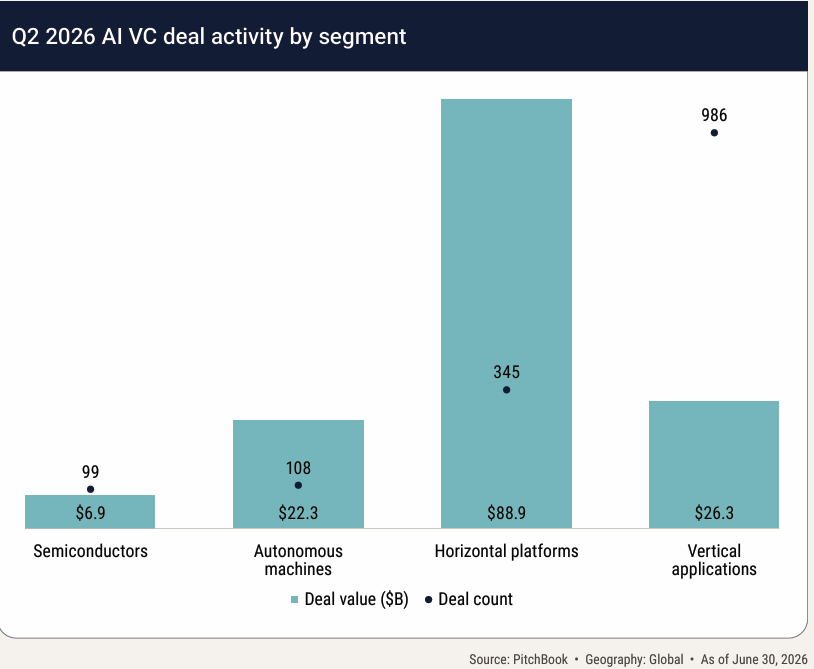
There are effectively two AI economies developing at the same time. One is extremely capital-intensive and increasingly dominated by a handful of foundational platforms. The other consists of thousands of companies building applications on top of increasingly capable—and increasingly interchangeable—models.
Then come the valuations.
The US VC Valuations Report makes the same concentration story visible from another angle. Median Series A pre-money valuations reached $64 million in Q2, while Series C jumped 84.5% YoY to $546 million. Flat and down rounds fell to just 13.1% of deals, which at first glance makes the entire VC market look remarkably healthy.
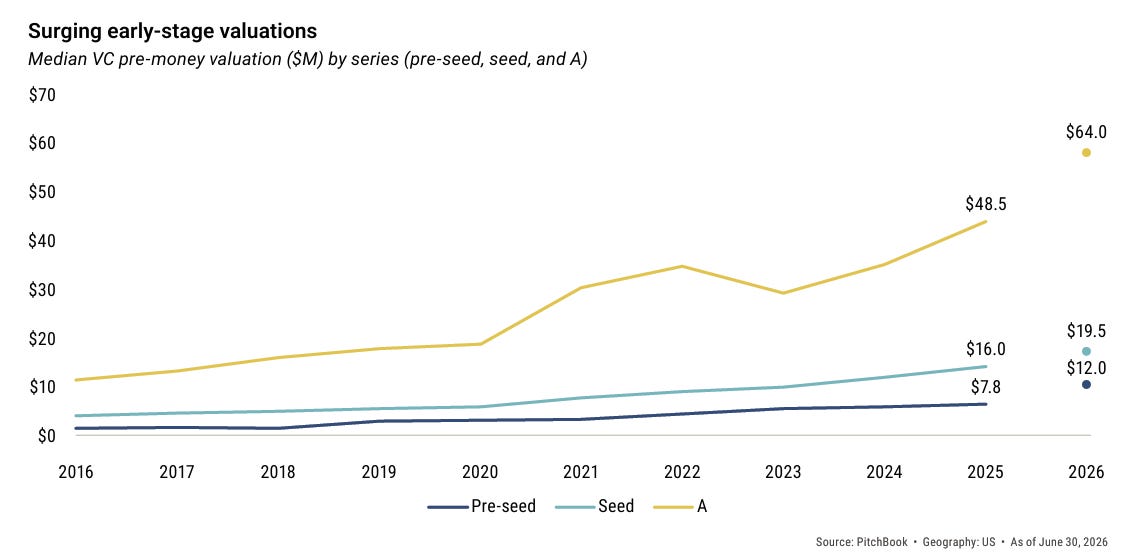
But PitchBook makes an important point that I think is easy to miss: the companies that cannot raise simply disappear from the valuation dataset. The startups raising today tend to be high-conviction AI names or companies strong enough to dictate their own terms; everyone else is often cutting costs and extending runway. So rising median valuations are partly telling us how valuable the winners have become—not necessarily how healthy the average startup is.
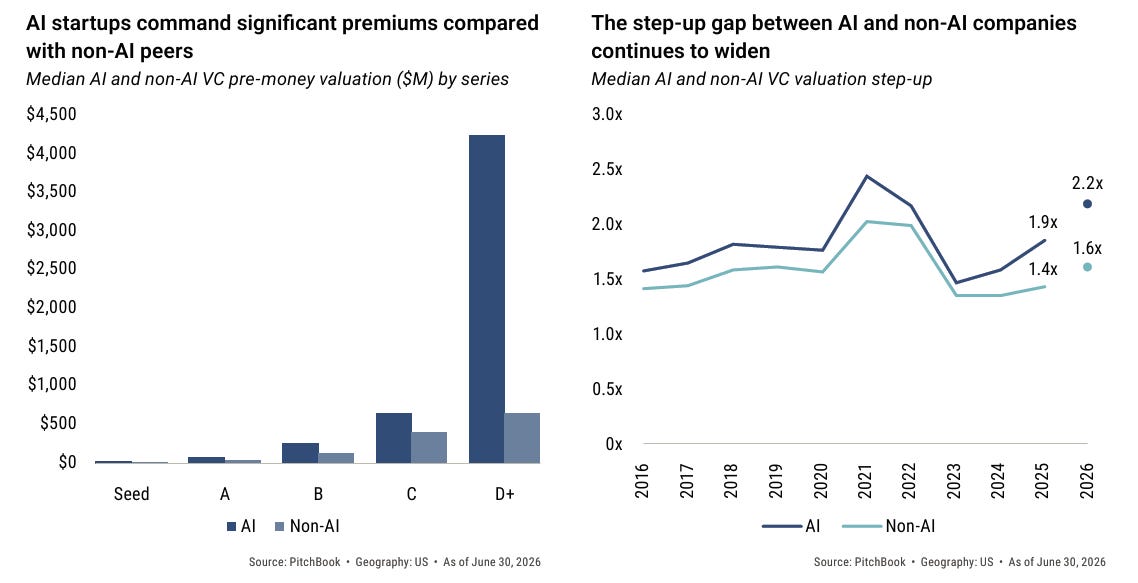
The AI premium is particularly striking. Megadeals of $100 million or more accounted for 87.5% of dollars deployed in H1, AI companies achieved a median 2.2x valuation step-up versus 1.6x for non-AI companies, and by Series D+, AI companies are being valued at 6.6x their non-AI peers. The median pre-money valuation of a US Series D+ AI company is now $3.95 billion. That is where I think the reports get particularly interesting when connected to what happened this week.
The models are moving in the opposite direction from the capital
In the span of a few days, Meta released Muse Glimmer, a smaller open-weight model designed to run agentic workloads on a PC with a single GPU—and Mark Zuckerberg explicitly framed the launch as an argument against concentrating AI in the hands of a few companies.
SpaceXAI released Grok 4.6, focused on long-running agents, coding and knowledge work, at $2 per million input tokens and $6 per million output tokens. xAI says it now performs roughly alongside GPT-5.6 Sol on the Artificial Analysis Intelligence Index.
Google followed with Gemini 3.7 Flash, positioning it as its new “workhorse” model for coding and agents—and introduced it at half the original price of Gemini 3.6 Flash.
OpenAI went in a different direction and released GPT-5.6-Cyber, a specialized model for advanced cybersecurity work available through its controlled Daybreak Red program. Instead of one model for everything, the industry is increasingly creating models optimized for specific high-value domains.
And on Friday, China’s Z.ai unveiled GLM-5.3, with particularly strong cybersecurity capabilities. The company said it will delay the public release of the model’s weights while completing additional safety work—another example of how the frontier is spreading geographically even as access and governance become more complicated.
Anthropic did not launch another flagship this week, but it made Sonnet 5’s introductory $2/$10 per million token pricing permanent, abandoning the previously planned increase to $3/$15.
Put all of that together and something important is happening: the supply of intelligence is expanding while its unit cost keeps falling. More labs are approaching frontier performance, smaller models can do increasingly useful work locally, specialized models are emerging for specific functions, and price is becoming a competitive weapon. Which makes the amount of capital concentrating at the top even more interesting.
This week’s funding rounds basically recreated PitchBook’s market map in real time
Databricks closed a $5 billion round at a $190 billion valuation. Perhaps the most revealing detail: it reportedly set out to raise around $1 billion, received roughly $15 billion of investor demand, and ultimately took $5 billion. Databricks now reports a revenue run rate above $7 billion, growing more than 80% YoY. In other words, there is clearly no shortage of capital for assets investors have decided they must own...
Then River AI, founded by former xAI co-founder Igor Babuschkin earlier this year, raised $1.1 billion, backed by General Catalyst and AMP PBC with strategic capital from Nvidia and AMD Ventures.
At the application and deployment layer, Thrive Holdings raised $2 billion at a $12 billion valuation to acquire traditional businesses and use AI to transform their workflows; Lovable raised $400 million at a $13.3 billion valuation; and CodeRabbit raised $143 million at a $1.5 billion valuation to build an AI-based code review and governance layer around the explosion in AI-generated software.
And the infrastructure/physical-AI side was busy as well. Cambridge Aerospace raised $300 million at a $3.4 billion valuation, Neros Technologies raised $250 million for defense drones, Point2 Technology raised $136 million for AI data-center interconnects, and AI-native drug-discovery company Aureka raised $100 million.
That is more than $9 billion across just those large AI and AI-adjacent financings in one week.
And they map almost perfectly onto PitchBook’s thesis: huge checks for horizontal platforms, lots of company formation at the application layer, accelerating investment into AI infrastructure, and growing capital flows toward autonomous machines and defense.
PitchBook’s numbers are particularly striking on that last point. On a trailing-12-month basis, funding for autonomous machines grew 165.7% YoY, while intelligent robotics alone grew almost 197%. Semiconductor funding grew 60.4%, and AI core funding grew more than 200%.
There is another part of this story: who is writing the checks?
Venture is becoming much less “venture-only.” Deals involving corporate VCs represented 82.6% of all US VC deal value in H1 2026, despite accounting for only 21.1% of deal count. Deals involving nontraditional investors accounted for an even more remarkable 91.9% of value and only 26.2% of transactions. River AI is a perfect real-time example: Nvidia and AMD Ventures are investors. At the frontier, capital, compute, distribution and strategic positioning are increasingly becoming part of the same transaction.
That makes AI funding structurally different from previous software cycles. The investor is often also the supplier, customer, infrastructure provider, distribution channel—or all four at once.
And then there is the question nobody can avoid: how does all of this eventually exit?
The valuation report is considerably more cautious here. Yes, SpaceX’s IPO produced a historic amount of liquidity. But PitchBook’s argument is that one gigantic IPO does not mean the IPO market is broadly fixed. The median public-listing valuation in 2026 remained basically flat versus 2025 at $862 million, and many of the largest VC-backed listings of the past 18 months have traded below their IPO prices.
The secondary market tells the same story. Annualized VC secondary volume reached $121.7 billion, but the top 20 companies represented 86% of Q2 secondary value, and the top five alone represented 50.3%. Meanwhile, 62% of AI transactions on EquityZen traded at a premium to their previous primary rounds. Investors aren’t necessarily paying for private-company exposure—they are paying for access to a very short list of names. Which brings me back to the biggest risk embedded in these numbers…
If late-stage AI companies are already valued at 6.6x comparable non-AI businesses, then eventually the public markets have to validate those expectations. Private markets can price ten years of potential. Public markets eventually ask for revenue, margins and cash flow. PitchBook itself flags that disconnect as one of the biggest tests ahead.
I came away from the two reports with a slightly different conclusion than “AI is eating venture capital.” AI is creating a barbell. On one side, there is a very small group of frontier labs, infrastructure platforms and strategically important companies absorbing extraordinary amounts of capital. They are expensive to build, increasingly tied to national security and industrial policy, and investors seem willing to treat access to them almost as a scarce asset.
On the other side, there are thousands of application companies that require dramatically less capital and account for most of the actual deal volume. And this week’s model launches arguably make that side more interesting, not less. If intelligence keeps getting cheaper, faster and more interchangeable, application companies get a continuously improving raw material without having to finance the underlying models themselves.
But that also changes what constitutes a moat. Simply having access to a great model won’t be enough. The defensibility increasingly has to come from distribution, proprietary data, workflow ownership, trust, regulatory positioning or demonstrable ROI. Lovable, CodeRabbit and Thrive Holdings are three very different examples of investors betting that the value will ultimately be captured in the workflow around the model—not only by the company training it.
And at the frontier, I think the opposite question becomes increasingly important: if model capabilities keep converging while prices keep falling, how much valuation premium can the model layer sustainably capture?
PitchBook’s conclusion is that capital concentration, rather than capital scarcity, will define AI investing through the rest of 2026. After reading both reports and then watching this week’s rounds and model launches unfold, I think that’s exactly right. But I would add one thing: The most interesting contradiction in AI right now is that the technology is becoming more distributed while the capital behind it is becoming more concentrated.
Models are multiplying. Performance gaps are narrowing. Prices are falling. Intelligence is becoming easier to access. Money is doing exactly the opposite.
And if those two curves keep moving in opposite directions, the trillion-dollar question may eventually be less about which model wins and much more about who actually captures the economics when intelligence itself becomes abundant.

General news:
• Brazil’s Anvisa revoked restrictions on pharmaceutical sales through digital platforms, opening the way for marketplaces such as Mercado Libre, iFood, Amazon and Shopee to connect consumers with third-party pharmacies. Full implementation still depends on additional regulation, but the change could significantly expand competition and digital distribution in Brazil’s pharmaceutical market. 🇧🇷
• Mercado Libre launched Mercado Libre Basics in Brazil, introducing its own private-label products across home, pet and apparel categories. The move strengthens the company’s retail superapp strategy and increases its competition with Amazon, which already operates Amazon Basics in the country. 🇧🇷
• Brazil’s Central Bank is preparing the next phase of Pix, with plans for international transfers, automatic tax withholding and fully offline payments. The roadmap also includes hybrid Pix/boleto billing and stronger fraud prevention through an AI-powered risk indicator, further expanding Pix beyond domestic instant payments. 🇧🇷
• Nvidia is reportedly arranging a US$500 billion financing package with investors including Apollo, Blackstone, BlackRock, Brookfield, Goldman Sachs and KKR to support the AI infrastructure boom. The initiative could finance both Nvidia’s expansion and customers purchasing its GPUs, deepening the chipmaker’s role as a financial backer of the broader AI ecosystem. 🇺🇸
• Meta and Nvidia launched new open-weight AI models, intensifying competition with Chinese labs such as DeepSeek, Moonshot AI and Alibaba’s Qwen. Meta introduced Muse Glimmer for local and on-device AI applications, while Nvidia unveiled Nemotron 3.5 Lightning alongside training datasets and methodologies. 🌍
Deals:
• Speedbird Aero is seeking US$30 million in Series B funding to scale its autonomous drone delivery operations across Brazil, the U.S. and Europe after raising a US$5.8 million bridge round led by iFood. The Brazilian startup has completed more than 43,000 urban deliveries and plans to invest in aircraft and coordination systems as regulatory approvals enable greater scale. 🇧🇷

General news:
• More than 600 Brazilian startups applied to Google and Monashees’ Gama Fund, a US$10 million program targeting AI-native Pre-Seed and Seed companies. Selected startups can receive up to US$2 million in funding, US$350,000 in Google Cloud credits and access to Google DeepMind models and technical mentorship. 🇧🇷
• Brazilian fintechs are turning recurring utility bills into a gateway for financial services, using Pix, Open Finance and Pix Automático to leverage long-term payment histories for products such as credit, installment payments and insurance. Companies including Celcoin, Pluggy, Belvo and Lider Energia see utility data as a potential new layer for embedded financial services, particularly for small businesses with limited traditional credit histories. 🇧🇷
• Latitud Ventures is reshaping its investment thesis as more Latin American startups target global markets from day one, particularly in AI. The share of founders in its fellowship pursuing international markets increased from 3.6% in 2021 to 46.1% in late 2025, reinforcing Latin America’s emerging role as a talent base for globally oriented startups. 🌎
• Brazilian payments company Bemobi is expanding into the residential condominium market, targeting a fragmented sector that moves more than R$100 billion annually. Its first contract is with Apsa, which manages more than 7,000 properties, as Bemobi expands a payments business that already represents roughly 70% of its revenue. 🇧🇷
• Belvo launched an MCP infrastructure layer connecting AI agents with Open Finance data, allowing banks and fintechs to give agents secure access to verified financial, employment and tax information with user consent. The platform aims to simplify the development of agentic financial applications by handling connectivity, identity, consent and regulatory infrastructure. 🌎
• IBM and Together AI signed a multiyear US$240 million AI infrastructure agreement to build a large-scale inference cluster on IBM Cloud using Nvidia Blackwell systems. The infrastructure will support open-source models including DeepSeek, MiniMax and Kimi as enterprise demand for lower-cost, scalable AI inference grows. 🇺🇸
Deals:
• Delivery das Favelas is raising R$2.5 million to expand beyond Rio de Janeiro and São Paulo, with Recife and Salvador planned as its next markets. The startup operates in more than 100 territories in Rio and plans to grow its courier network from over 400 registered workers to 1,000 by year-end. 🇧🇷
• Manus is separating from Meta after Chinese regulators ordered the reversal of their roughly US$2 billion deal over national security concerns. The AI-agent startup is returning to independent operations, with the separation involving the termination of Meta system access and data sharing and affecting some user accounts and subscriptions. 🌍

General news:
• Itaú is accelerating the use of AI across its banking operations, with CTO Carlos Mazzei arguing that the technology could have a greater transformational impact than the internet. AI-supported development is already delivering productivity gains of 20%–35% depending on the use case, while around 70% of vulnerabilities identified in code reviews are fixed with AI assistance. 🇧🇷
• Agent.Shop is shifting from traditional SaaS subscriptions to a “Result as a Service” model, tying pricing directly to outcomes such as sales, completed transactions and marketing-attributed revenue. The Brazilian AI-commerce startup has raised more than R$5.5 million and aims to reach breakeven by the end of 2026 before pursuing a new round to support global expansion. 🇧🇷
• Preâmbulo launched an AI assistant for Brazil’s legal sector, combining Gemini and ChatGPT to monitor cases, research legislation and case law, draft documents and automate administrative tasks. The legal-tech group reaches around 500,000 lawyers and expects AI products to represent 40% of its business within five years. 🇧🇷
• Skyone launched Skyone Creator, an AI-powered vibe-coding platform for enterprise customers, enabling companies to build internal applications, dashboards, portals and automations through natural-language prompts. The initiative supports Skyone’s expansion beyond cloud infrastructure as the company targets 50% revenue growth in 2026. 🇧🇷
• Foreign investors represent 68% of the value of control acquisitions in Brazil despite accounting for only 30% of deals, according to Acorn Advisory. Cross-border transactions reached a record 40% of activity in Q1 2026, with growing U.S. and Middle Eastern interest in areas such as data centers and telecommunications. 🇧🇷
• Brazilian companies are reassessing their corporate venture capital strategies as higher interest rates, difficult exits and pressure on core businesses push some groups away from standalone CVC funds. The number of Brazilian companies with CVC funds fell from 84 in July 2023 to 65 in July 2026, although AI and energy transition remain strategic investment priorities. 🇧🇷
• Positivo Tecnologia reported R$938.7 million in Q2 2026 net revenue, up 11.5% year over year, while EBITDA increased 16.4% to R$85.9 million. Net income reached R$2.6 million, although higher financial expenses and rising net debt continued to pressure results. 🇧🇷
Deals:
• Ume raised R$500 million through FIDCs to expand its AI-powered embedded credit infrastructure, with participation from Itaú, Bradesco, XP, Milenio, Verde and Credit Saison. The fintech expects to process R$2 billion in transactions in 2026 across a network of 10,000 points of sale and around 4 million consumers. 🇧🇷
• Zayra raised R$15 million in seed funding to develop an education platform focused on Web3, blockchain, tokenization and digital finance. The Brazilian startup will invest in technology, content and its AI-powered learning assistant ZAI as it targets demand for professionals working with tokenized financial infrastructure. 🇧🇷
• Uber made a strategic investment in Chilean fintech Galgo to expand motorcycle financing for drivers and delivery partners across Latin America. The partnership will launch in Mexico before expanding to Chile and Colombia, while Galgo aims to increase annualized revenue from US$100 million to US$500 million by 2030. 🇨🇱

General news:
• Shopee launched Turbo, a new delivery service promising eligible orders within four hours, initially covering Greater São Paulo with 4,000 partner stores including Heineken, Americanas and Daki. The service expands Shopee’s logistics offering as the marketplace competes more directly with iFood, Mercado Libre and Amazon in Brazil’s fast-delivery market. 🇧🇷
• NearX is shifting from B2C education to an exclusively B2B model, focusing on corporate training and custom technology projects across blockchain, tokenization, AI and cybersecurity. The bootstrapped company expects revenue to reach R$10 million in 2026 and plans to strengthen recurring revenue before pursuing external funding. 🇧🇷
• Mercado Pago launched Mago, a new generation of its AI-powered financial assistant, enabling customers to execute Pix transfers, pay bills and simulate investments directly through natural-language conversations. The launch marks a broader shift toward conversational banking interfaces, building on an earlier version that reached 17 million unique users in roughly ten months. 🇧🇷
• LWSA reported adjusted net income of R$65.7 million in Q2 2026, up 48.7% year over year, while net revenue increased 12.4% to R$276 million. Adjusted EBITDA reached R$81.2 million, with margin expanding to 21.6%, as the company also approved a share buyback program of up to 50 million shares. 🇧🇷
• Robinhood is accelerating the rollout of publicly traded venture funds for retail investors, with its newest product targeting early-stage Y Combinator startups. Robinhood is committing US$20 million across 80 companies and plans to increase the pace of new products as it expands retail access to private markets. 🇺🇸
Deals:
• RPC launched RPC Ventures, a new fund combining media-for-equity and private equity to back mature companies with validated products and strong growth potential in Paraná. The Globo affiliate plans to use both capital and advertising inventory to accelerate portfolio companies, targeting its first investment in 2026 and two to four deals annually thereafter. 🇧🇷
• Beacon is incorporating 314 Capital through an all-stock transaction, strengthening its asset management business and expanding into liquid investment products. The combination takes the group’s assets under management to around R$650 million, with a target of surpassing R$1 billion in 2026. 🇧🇷
• Anthropic is reportedly preparing for an October IPO at a potential US$2 trillion valuation, potentially making it the largest public listing in U.S. history. Investors expect annualized revenue to reach US$100–120 billion by the end of 2026, putting the Claude maker’s rapid enterprise growth and premium valuation to a major public-market test. 🇺🇸
• Yuno raised US$45 million in a Series B led by Global PayTech Ventures, with participation from Andreessen Horowitz, Tiger Global, Kaszek, Monashees and other investors. The Colombian payments infrastructure startup will use the capital to accelerate R&D, expand into in-person and agentic commerce and grow its U.S. operations. 🇨🇴

General news:
• Brazil’s Central Bank ordered the extrajudicial liquidation of Simpala’s consortium administrator and financial institution after identifying financial deterioration, serious operational violations and abnormal risks to unsecured creditors. The FGC estimates that roughly 21,000 eligible creditors hold R$622 million in guaranteed deposits, as regulatory intervention in smaller Brazilian financial institutions continues to intensify. 🇧🇷
• Micron Ventures launched the US$250 million Paradigm Fund, its largest venture vehicle to date, bringing total committed capital to US$550 million. The fund will invest globally across AI models, computing infrastructure, enterprise applications and physical AI, targeting technologies that drive demand for advanced memory, storage and data-center infrastructure. 🇺🇸
Deals:
• Brazilian AI startup NeoSpace is raising up to US$250 million at a potential US$1.25 billion post-money valuation, which could make it a unicorn less than three years after its founding. The Itaú-backed company develops large data models for enterprise AI and plans to use the funding to expand into the U.S., while expecting R$300 million in revenue in 2026. 🇧🇷
• Yellow Card raised US$40 million to support its expansion into Brazil, marking the stablecoin infrastructure provider’s first entry into Latin America. After processing more than US$10 billion over the past 12 months, the company plans to use Brazil as a regional hub for further expansion across cross-border payments and stablecoin infrastructure. 🌍
• Stripe and Advent are considering raising their bid for PayPal after an initial US$60.50-per-share proposal, valuing the payments company at roughly US$53 billion, was deemed too low by its board. A transaction could combine Stripe’s merchant infrastructure with PayPal’s roughly 430 million accounts and businesses including Venmo and Braintree, creating one of the world’s largest online payments platforms. 🇺🇸

The biggest AI story of the week, in my view, was Google’s major reshuffle of its AI leadership — and what it says about how intense the frontier-model race has become. On August 12, Reuters reported that Demis Hassabis was stepping aside from the day-to-day leadership of Google DeepMind to become chair, with chief AI architect Koray Kavukcuoglu taking control of Gemini development, following pressure from Sergey Brin to accelerate product development and commercialization. The FT framed the change as Google shifting away from DeepMind’s historically research-heavy culture toward greater urgency, while The Verge asked, quite literally, whether Google still wants to “win” at frontier AI. The timing makes the story even more interesting: Gemini crossed 1 billion users this week, Google released the faster and cheaper Gemini 3.7 Flash, OpenAI countered with GPT-5.6 Sol Ultrafast, and the FT described OpenAI and Anthropic as entering a broader price war as Chinese open models become increasingly competitive. Taken together, this week felt less about one breakthrough model and more about a change in the AI race itself: frontier intelligence is no longer enough — speed, cost, distribution and the ability to turn models into products at massive scale are becoming just as important.

Febraban Tech 2026
Date: August 24–26, 2026
Location: São Paulo, Brazil
Description: One of the main financial technology and innovation events for the banking and financial services sector in Latin America.
More infoStartup Summit 2026
Date: August 26–28, 2026
Location: Florianópolis, Brazil
Description: One of Latin America’s leading startup events, connecting founders, investors, and ecosystem leaders through content, networking, and business opportunities.
More infoHackTown 2026
Date: September 3–7, 2026
Location: Santa Rita do Sapucaí, Brazil
Description: A unique innovation, technology, and culture festival that transforms an entire city into a hub for networking, learning, entrepreneurship, and creative collaboration.
More infoHotmart Fire 2026
Date: September 10–12, 2026
Location: Belo Horizonte, Brazil
Description: One of the leading events for the digital business and creator economy ecosystem, covering marketing, sales, online education, innovation, and business growth.
More infoDreamforce 2026
Date: September 15–17, 2026
Location: San Francisco, United States
Description: Salesforce’s flagship conference focused on CRM, AI, digital transformation, customer experience, and enterprise innovation.
More infoAsaas Connect 2026
Date: October 14, 2026
Location: São Paulo, Brazil
Description: A business conference bringing together CEOs, executives, and growth-focused professionals for keynote sessions, networking, and discussions on entrepreneurship, innovation, leadership, and business growth.
More infoTechCrunch Disrupt 2026
Date: October 13–15, 2026
Location: San Francisco, United States
Description: A leading global startup conference where founders, investors, and technology leaders discuss entrepreneurship, fundraising, and innovation.
More infoWeb Summit Lisbon 2026
Date: November 9–12, 2026
Location: Lisbon, Portugal
Description: One of the world’s largest technology conferences, bringing together entrepreneurs, investors, executives, and policymakers to discuss global innovation trends.
More infoSlush 2026
Date: November 18–19, 2026
Location: Helsinki, Finland
Description: A globally recognized startup and venture capital conference focused on connecting founders and investors while fostering innovation and growth.
More infoAWS re:Invent 2026
Date: November 30 – December 4, 2026
Location: Las Vegas, United States
Description: AWS’s flagship cloud computing conference, featuring product launches, technical sessions, training, and discussions on cloud infrastructure, AI, and data.
More info



“You have power over your mind—not outside events. Realize this, and you will find strength.” — Marcus Aurelius
O novo foco do mercado de tecnologia
Hoje, criar programas de computador com inteligência artificial ficou muito rápido e barato. O verdadeiro desafio atual é outro: garantir que o código gerado pela IA esteja correto e seguro.
Investimento em checagem: A empresa CodeRabbit recebeu um investimento de 143 milhões de dólares (sendo avaliada em 1,5 bilhão) para criar ferramentas que revisam e fiscalizam códigos feitos por IA. O dinheiro não foi para criar uma nova IA, mas sim para construir a camada que confere o resultado.
- O custo da validação: Gerar código virou uma tarefa simples, mas testar e aprovar esse material continua caro e complexo. Em setores como os bancos, essa checagem precisa seguir regras rígidas do governo antes que qualquer sistema comece a funcionar.
- À medida que o acesso à inteligência artificial se torna comum e acessível para todos, a parte mais valiosa do setor deixa de ser quem cria o modelo e passa a ser quem controla a sua qualidade e segurança.
The Colombian election timeline in May matters more than the deal announcements. Bogotá's ICT stack choices are getting locked in before voters weigh in.