
LatAm Tech Weekly
#211: October tech deal flow, public x private markets, recent fintech regulation in Brazil, deals of the week... and much more!

Weekly writing about what is happening in LatAm tech. By day, I lead the business development team at Itau Unibanco. By night, I am reading and learning about technology in general (now, with a focus on AI). During the weekends, I’m writing the LatAm Tech Weekly.
If you have not subscribed yet, join the 14,200+ weekly readers by subscribing here!
Happy Sunday!
…And just like that, October disappeared in our rear-view mirror and we’re already in November—2025 has sprinted past us. According to a recent article from Crunchbase, U.S. venture players stayed remarkably active in October. For example, Andreessen Horowitz backed at least 14 rounds of US startups with checks of $5M or more during the month, topping the list. Meanwhile, Sequoia Capital and General Catalyst each supported 13 deals, and Accel participated in nine. On the spending side, Nvidia led with a headline-making $2 billion Series B investment in Reflection.AI. All of this signals: for all the chatter about “cooling” markets, the checks are still flowing—setting the stage for what might be a lively finish to the year.
While global investors were busy in October, the Latin America tech market showed signs of recovery and selective deal-flow. With Brazil rebounding in Q3 to ~US$692 m raised (up 47 % y/y) and early-stage fintech/AI moves surfacing in Mexico and Peru, the region appears to be inching back into action — even as we await full monthly figures for October.
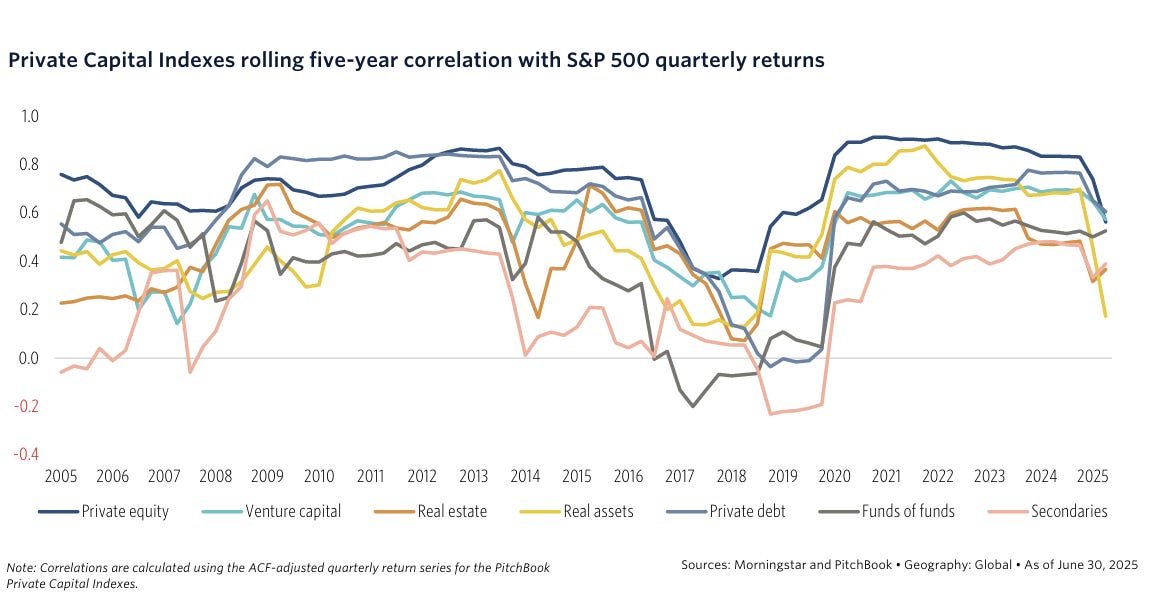
If you’re an avid reader of my newsletter—or have tuned into my podcasts or live presentations—you’ve probably heard me say that public markets set the tone for private ones. When stocks soar, venture capital tends to follow suit; when they wobble, investors in the private sphere often take a step back. But according to new data from PitchBook, that tight link may finally be loosening…
The firm’s Q2 2025 Private Capital Indexes show that the correlation between private markets and the S&P 500 has declined significantly since late 2024, suggesting a long-awaited return to independence for private strategies. This isn’t just a statistical quirk—though part of the drop does reflect a “reset” as pandemic-era volatility rolls out of the five-year window. Even on a six-year rolling basis, correlations continue to ease, reaffirming that diversification benefits across private markets remain intact.
Venture capital and private equity have both become less synchronized with public benchmarks, while real assets have decoupled even more sharply. The explanation is partly structural: public markets are hypersensitive to real-time policy shocks—like the latest trade or tariff moves—whereas private valuations are far “stickier,” updating quarterly and smoothing over the short-term noise. PitchBook notes that when you adjust for this smoothing, the picture becomes clearer: private markets aren’t immune to public swings, but they’re increasingly charting their own path through shifting regimes.
Follow me on LinkedIn , Instagram or X for daily updates!
As someone embedded in the Latin American tech ecosystem, I’ve been closely monitoring the regulatory shifts in Brazil’s fintech landscape. The Central Bank of Brazil (BCB) has unveiled a sweeping update in prudential requirements and oversight that signals a clear transition from growth-centric deregulation to a heavier focus on risk governance.
Under the newly published Joint Resolution No. 14/2025 and BCB Resolution No. 517, the levers for minimum capital and net-equity thresholds will no longer depend solely on the type of institution, but instead on the activities performed, including technological infrastructure intensity (e.g., payment-rails, Pix settlement, data processing). Equally material: the headline figure — the minimum capital requirement for many institutions has been raised from around R$ 5.2 billion to R$ 9.1 billion (≈ US$1.68 billion) with full implementation by January 2028.
On the payments and fintech side, the BCB is aggressively targeting so-called “shadow accounts” (contas-bolsão) and opaque structures where fintechs rely on third-party accounts with limited traceability of end-users. Under the new rules banks must close accounts held by fintechs if the fund origins or ultimate holders are unclear or used for unauthorised obligations.
When regulations are well-structured, data-driven, and aligned with market realities, they serve as critical enablers of a stronger financial ecosystem — enhancing systemic credibility, reducing fraud, and building long-term investor trust. However, when they’re poorly designed, rushed, or disconnected from the operational realities of innovation, they can do more harm than good. In that sense, Brazil’s current regulatory inflection carries both promise and risk. On one hand, stronger guardrails can professionalize the sector and reward fintechs that are built with compliance at their core. On the other, an overly rigid or punitive framework risks stifling innovation, raising barriers to entry, and discouraging the very entrepreneurial energy that made the ecosystem thrive in the first place. Ultimately, good regulation should foster trust without suffocating progress — and striking that balance will determine how capital and innovation continue to flow into Brazil’s fintech landscape.
Opinions expressed here are solely my own and does not represent those of people, institutions, organizations that I may or may not be associated with in any capacity, unless explicitly stated.

General news:
Brazil’s Central Bank announced new rules to boost financial system security and curb money laundering. The measures include shutting down irregular “pooled accounts” used by fintechs and raising minimum capital requirements to up to R$32.8M. Fintech and BaaS associations welcomed the move as key to transparency, stability, and investor confidence. 🇧🇷
OpenAI signed a $38B, seven-year deal with AWS to secure massive cloud capacity for advancing its AI platform. The partnership deepens its compute race toward AGI and will use Nvidia GPUs for ChatGPT and new models. Amazon’s shares surged after the announcement. 🇺🇸
Embedded finance is reshaping Brazil’s digital economy, enabling companies to offer banking-like services without Central Bank licenses. The sector is projected to grow 26.2% annually to $13.8B by 2029, driven by frictionless user experiences. Retail, mobility, and agribusiness lead adoption, supported by Pix, Open Finance, and digital readiness. 🇧🇷
Juspay partnered with LATAM Pass, the loyalty program of LATAM Airlines, to enhance its payment experience across Latin America. The collaboration integrates Juspay’s secure checkout and orchestration tech to streamline transactions with points, miles, and multiple payment methods. 🇧🇷
Deals:
Brazilian startup Mastery B2B Tech raised R$350K from Bossa Invest to expand its AI-driven platform that automates tax processes in B2B commerce. Founded in March 2025, it integrates with VTEX to automate product classification, tax validation, and real-time calculations—addressing one of Brazil’s biggest barriers to industrial digitalization. 🇧🇷
Brazilian EV startup Vammo raised a $45M Series B led by Ecosystem Integrity Fund, with Qualcomm, Monashees, and former Tesla executives joining. Based in Manaus, Vammo offers battery-swap motorcycles on subscription and plans to invest R$500M in a new factory to expand across Brazil and Latin America. 🇧🇷
Saudi-based WakeCap acquired Brazilian IoT startup Trackfy, which will become its global vertical for industrial safety and productivity management. Trackfy’s founders join WakeCap’s leadership, and investors like former Braskem CEO Carlos Fadigas become shareholders. The deal extends WakeCap’s worker monitoring network to 25,000 employees across seven countries ahead of its Series B. 🇧🇷
Brazilian fiber-optic provider SerraNet, founded in 2023 in Rio Grande do Sul, was acquired by telecom operator Unifique in November 2025, expanding its broadband footprint across southern Brazil. 🇧🇷
Brazilian telecom provider 3SNET, founded in 2019 in Indiana, was also acquired by Unifique in November 2025, strengthening its presence in fiber internet, mobile, TV, and home security services nationwide. 🇧🇷

General news:
Itaú Unibanco posted a recurring profit of R$11.9B in Q3 2025, up 11.3% year over year, with ROE at 23.3%. Its credit portfolio reached R$1.4T, rising 6.4% in 12 months, while delinquency remained near 2%. Efficiency stayed strong at 39.1%, supported by tech and digital gains. Shares are up 43.8% this year, valuing the bank at R$406.7B. 🇧🇷
The Central Bank of Brazil will shut down its Drex platform and rebuild its infrastructure from scratch. After four years testing Hyperledger Besu, the BC concluded it failed to meet privacy and security standards for financial applications, marking a major shift away from Campos Neto’s digital real initiative. 🇧🇷
Brazil’s BNDES and Finep have approved R$5.4B in AI-related projects since 2023, highlighting the technology’s expanding role in the country’s industrial and innovation strategy. The funding covers AI hardware, cloud infrastructure, and applied solutions in healthcare and industry, strengthening Brazil’s position as a regional AI leader. 🇧🇷
Brazil’s innovation agency Finep launched a new R$1B funding cycle under its Inovacred program to enhance national competitiveness through technology. At least R$300M will go to the North, Northeast, and Center-West regions, financing projects in equipment, software, and R&D. All proposals must be contracted by December 31, 2025. 🇧🇷
Patria’s Omnia is partnering with Casa dos Ventos to build Brazil’s largest single-client data center, a R$50B project in the Port of Pecém expected to serve ByteDance. The facility will consume 300MW and begin operations in 2027, becoming Brazil’s first export-oriented data hub and marking Patria’s return to digital infrastructure. 🇧🇷
Brazil’s antitrust regulator Cade has launched an investigation into the online food delivery market, citing concerns over unfair competition among iFood, 99Food, and newcomer Keeta. The probe will monitor practices in São Paulo, Rio, Santos, and Goiânia to prevent predatory pricing and ensure fair competition. 🇧🇷
Venture capital investment in Brazil reached R$2.1B across 27 deals in Q3 2025, up 23% year over year, the strongest quarter of the year according to ABVCAP and TTR Data. Top rounds included QI Tech (R$350M), NG.CASH (R$147M), and ABC da Construção (R$100M), signaling renewed VC and CVC momentum despite high interest rates. 🇧🇷
Brazilian startup Nero.AI won the Latin America Regional Award at Google’s Kubernetes Engine Turns 10 Hackathon with its project NeroFashion, earning $8K and $1K in Google Cloud credits. The AI platform allows users to virtually try on clothes and get personalized recommendations, reinforcing Nero.AI’s position in enterprise AI innovation. 🇧🇷
Brazilian accounting startup Agilize announced partnerships with Wellhub and Starbem to offer health, fitness, and wellness benefits to entrepreneurs. The Agilize Multibenefits program gives access to gyms, online therapy, and medical consultations, bringing corporate-level perks to small business owners and their families. 🇧🇷
At COP30 in Belém, Brazilian startup Incentiv partnered with Sebrae Pará to launch the En-Zone, a hub for impact and sustainability businesses running November 10–21. The space will connect Amazonian entrepreneurs, investors, and startups. Incentiv, which has enabled over R$500M in social funding, aims to link companies and ESG projects through data intelligence. 🇧🇷
Deals:
Brazilian data startup Indicium merged with UK-based Mesh-AI to form Indicium AI, a global consultancy focused on enterprise AI transformation. Backed by Columbia Capital, the new firm will serve Fortune 500 clients through advanced data engineering and AI frameworks, expanding Indicium’s international reach. 🇧🇷🇬🇧
Brazilian healthtech Conexa launched Hospital Conexa with a R$2M investment to transform corporate healthcare management. The digital platform aims to reduce company health plan costs through data-driven care coordination and has already cut per capita claims by 16%, targeting R$300M in revenue by 2025. 🇧🇷
Ripple acquired Palisade, a digital asset custody and wallet provider, as part of its $4B crypto infrastructure expansion. The acquisition strengthens Ripple Custody, enabling secure storage and high-frequency transactions for banks and fintechs while integrating Palisade’s wallet tech into Ripple Payments. 🇺🇸
Mexico-based Allie raised $5.2M in a Seed round led by BDev Ventures and Spero Ventures to expand its AI solutions for industrial manufacturing. Its generative AI platform predicts production downtime and enables real-time factory communication across multiple sectors. 🇲🇽
Brazilian supply chain giant nstech acquired Runtec, a logistics monitoring and control platform, marking its 37th M&A deal and fifth anniversary. The acquisition reinforces nstech’s new Transportation Network System (TNS), integrating 130 solutions across 75K clients to position Brazil as a global logistics tech hub. 🇧🇷

General news:
Rio de Janeiro partnered with X – The Moonshot Factory, Alphabet’s innovation lab, to launch Rio AI City, aiming to position the city as Brazil’s AI capital. The initiative will test technologies in clean energy, connectivity, and urban planning through projects like Tapestry (smart power grids), Taara (light-based internet), and Materra (AI-driven recycling). 🇧🇷
Brazil’s Central Bank approved the sale of Provu’s direct credit company (SCD) to Vinicius Garcia Cipullo and Holditsafe Financeira. Once a major personal credit fintech backed by Goldman Sachs, Provu now appears to be winding down operations after years of losses, layoffs, and rising defaults. 🇧🇷
Mexico’s Xal Digital is accelerating its Latin American expansion with AWS-based solutions focused on cloud innovation, local talent, and AI transformation. With 34.5% annual growth and $21M projected revenue in 2025, the company delivers end-to-end digital services across AI, IoT, and data analytics, aiming to become a regional tech powerhouse. 🇲🇽
President Lula sanctioned a new law expanding consumer rights in financial services, guaranteeing automatic salary portability, lower-interest credit, and clearer disclosure of fees. The Central Bank and CMN have 180 days to regulate it. Lula vetoed provisions on prepaid accounts and automatic transfers due to security and regulatory concerns. 🇧🇷
Mercado Libre cofounder Hernán Kazah has built Kaszek Ventures into one of Latin America’s leading VC firms, raising over US$3B and backing companies like QuintoAndar and Wellhub. After a period of easy capital, Kaszek is now doubling down on AI and blockchain startups while preparing mature portfolio companies for IPOs in 2026–2027. 🇦🇷
Deals:
Brazilian proptech QuintoAndar sold its condominium-focused assets SindicoNet and Noknox, refocusing on its core real estate platform. The move reverses its 2020–2022 expansion funded by SoftBank’s $250M Series F. SindicoNet becomes independent, while Noknox is shutting down and migrating users to MyCond, as QuintoAndar doubles down on tech and transaction efficiency. 🇧🇷
Argentina’s The Mobile-First Company raised $12M in a round led by Base10 and Lightspeed to expand its AI-driven mobile productivity tools. Its flagship app, Allo, serves 5,000 clients with 50% monthly growth. The funds will support hiring in Buenos Aires and two new AI apps for billing and expense management. 🇦🇷
Brazilian startup Rastro Neural raised R$2.5M to become the “SEO of the AI era,” helping brands appear in ChatGPT, Gemini, Claude, and Perplexity responses. Its platform tracks how often companies are cited by AI models and what content drives visibility, redefining digital presence as search shifts from Google to AI assistants. 🇧🇷
Edtech Grupo NODS, based in Argentina, raised an undisclosed corporate funding round led by A Educação, which also acquired a majority stake. Founded in 2021, NODS provides digital transformation, cloud automation, and virtual campus solutions for universities across Latin America. 🇦🇷

General news:
Brazilian climate tech re.green won the 2025 Earthshot Prize founded by Prince William, in the “Protect and Restore Nature” category. The Rio-based startup will receive £1M to scale its AI-driven reforestation platform, which combines drones, satellite imagery, and ecological data. re.green has already planted over 6M trees and aims to capture 15M tons of CO2 annually by 2032. 🇧🇷
Brazil’s Seniortech Ventures is redefining longevity entrepreneurship, backing startups built by and for people over 50. Founded in 2021, it now has 15 portfolio companies and a network of 92 seasoned investors offering “smart money.” With Brazil’s “silver economy” worth R$2T, the firm sees major potential in senior-led innovation. 🇧🇷
Ame Digital, the fintech arm of Americanas, has officially relinquished its payment institution license with Brazil’s Central Bank. After failing to sell its assets or license, the company confirmed a full business discontinuation plan, marking the end of its operations as a regulated fintech in Brazil. 🇧🇷
Brazil’s Central Bank approved Stone to operate its own securities distributor (DTVM), expanding the fintech’s reach into investments. The move follows approvals for its finance and credit units, positioning Stone alongside peers like Nubank and Mercado Pago. The company reported R$1.2B in profit in H1 2025, up 25% year over year. 🇧🇷
Deals:
Brazilian VC firm Valutia closed its first $10.6M fund to back global-minded startups founded by Brazilians. Led by Bruno Lino and Kiko Lumack, the firm will invest $300K–$1M from pre-seed to Series A. With 10 deals signed—including AI music app Moises—Valutia plans 10 more investments and a second fund by 2028. 🇧🇷
Patagon AI raised $2.75M from Kfund, ONEVC, and others to scale its AI platform that automates lead generation and sales workflows. With 600% client growth since 2023, its AI agents qualify leads, schedule meetings, and update CRMs in real time, reducing acquisition costs and boosting conversions. 🇨🇱
Mexico-based Solfium raised $7M in seed funding, part of a $10M Series A led by Accion and ALIVE Ventures. The startup helps companies decarbonize supply chains by making solar energy accessible to SMEs, offering financing, installation, and long-term support. Clients include Coca-Cola and major Mexican banks. 🇲🇽

General news:
Global VC funding reached $120.7B in Q3 2025, up 7% from the previous quarter and marking the fourth consecutive period of growth, according to KPMG’s Venture Pulse report. AI continues to dominate investor attention, with nearly all major rounds involving AI-driven firms. Fintech remains a standout exception in emerging markets like Latin America, Africa, and Southeast Asia. 🌎
Totvs reported an 18% revenue increase but a 16.4% drop in profit in Q3, as it expands its credit products through a partnership with Itaú. The ERP leader is deepening its fintech strategy to integrate financial services into business management platforms. 🇧🇷
Ambev launched the second edition of its Brasilidades Fund, investing R$67M to strengthen Brazil’s creative economy — the largest cultural investment in the company’s history. The initiative will fund music, sports, and regional projects across the country, expanding its 2024 program that supported 117 cultural ventures. 🇧🇷
Brazil recorded 954 M&A deals between January and August 2025, a 13% increase and the highest level since 2008, according to PwC. Most transactions involved domestic capital, with technology (320 deals), finance, and entertainment leading activity. Highlights include the BRF–Marfrig merger that created MBRF, now among Brazil’s top 10 companies. 🇧🇷
US cybersecurity firm Netskope, now listed on Nasdaq after a $908M IPO, is expanding globally with Brazil as a top priority. The company plans to open its fifth local data center in early 2026 to reduce latency and support regional cloud and AI adoption. With $328M in Q3 revenue, Netskope targets profitability next year. 🇺🇸🇧🇷
Deals:
Inception, an AI startup founded by Stanford professor Stefano Ermon, raised $50M from Menlo Ventures, Nvidia’s NVentures, Microsoft M12, Databricks, and others to build diffusion-based AI models for text and code. Its Mercury model promises faster, cheaper generation compared to LLMs, challenging autoregressive architectures like GPT and Gemini. 🇺🇸

You will see below an updated list of events. If I forgot your event, and you want to include it - please sure to send those my way asap!
Web Summit Lisbon 2025
Date: November 10–13, 2025
Location: Lisbon, Portugal
Description: One of the world’s most influential tech conferences, Web Summit Lisbon connects 70,000+ attendees from startups, enterprises, and media to discuss trends shaping the tech industry.
More infoBrazil Tech Summit 2025
Date: December 9, 2025
Location: São Paulo, SP
Description: Part of the Global Startup Ecosystem Series, Brazil Tech Summit brings together entrepreneurs, government leaders, and investors to foster tech-driven innovation across Latin America.
More info

Pitchbook- Q2 2025 Private Capital Indexes

BG2 Pod with Sam Altman and Satya Nadella

“We might screw it up. This is the bet that we’re making, and we’re taking a risk along with that.”
“If you want to sell your shares, I’ll find you a buyer. Enough.”
Sam Altman
Hey, great read as always. This analisys truly resonates with the current market dynamics.