
LatAm Tech Weekly
239: Anthropic's updates, Marc Rowan & a16z, deals of the week... and much more!

Weekly writing about what is happening in LatAm tech. By day, I am part of the corporate development team at Itau Unibanco. By night, I am reading and learning about technology in general (now, with a focus on AI). During the weekends, I’m writing the LatAm Tech Weekly. And obviously, always running!
If you have not subscribed yet, join the 14,700+ weekly readers by subscribing here!
Happy Sunday!
I’m on my way to Money20/20 as I write this. Will you be there? I’d love to meet up in person — drop me a line!
Let’s start with the two biggest AI stories of the week.
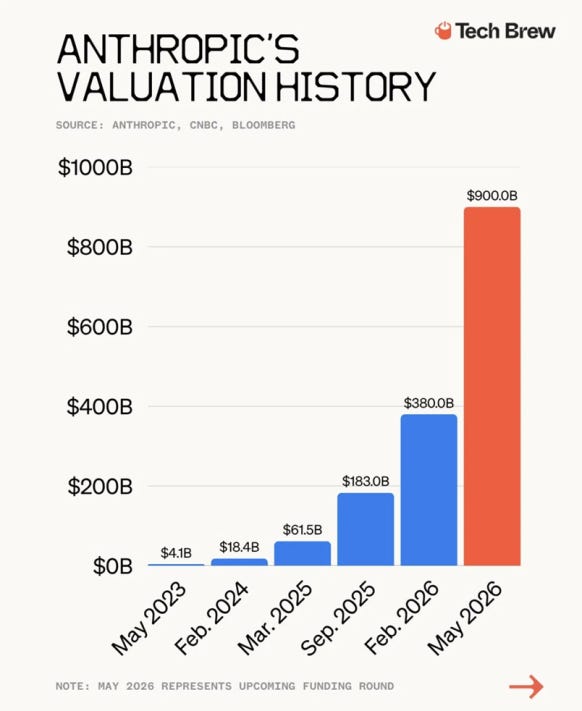
Anthropic just raised $65 billion — and is now officially worth more than OpenAI. The Series H closed at a $965 billion post-money valuation, led by Altimeter, Dragoneer, Greenoaks, and Sequoia. That edges it past OpenAI, which last raised in March at $852 billion. What makes the number almost hard to process is the speed: Anthropic’s previous round closed in February, which means the valuation roughly tripled in about three months. Run-rate revenue crossed $47 billion earlier in May. This is widely expected to be the company’s last private round before an IPO that’s being floated for as early as October.
The raise landed alongside a new model: Claude Opus 4.8. And the interesting part is the framing. Anthropic itself called it “a modest but tangible improvement,” which is strikingly restrained language for a launch in a market addicted to generational-leap claims. The headline feature isn’t a benchmark — it’s honesty: the model is reportedly around 4x less likely than its predecessor to let flaws in its own code pass without flagging them, and it tends to abstain when uncertain rather than confidently make something up.
First reactions split into roughly three camps. The benchmark crowd is celebrating the coding gains (SWE-bench Pro up to 69.2%, ahead of GPT-5.5). The skeptics note it lost ground to OpenAI on agentic terminal tasks and read the “modest” label literally. But the group I find most interesting is the one focused on AI alignment. Their view is that the biggest breakthrough isn’t necessarily raw performance — it’s honesty and reliability. For the past three years, the AI race has mostly been judged by who had the most powerful model. Now, the fact that a major lab is emphasizing transparency and trustworthiness may signal that the industry’s priorities are starting to change. Notably, the fast cadence (just 41 days after 4.7) follows a chilly reception to the previous release, so there’s a competitive read here too.
Apollo’s Marc Rowan on Capital, AI, and the Reinvention of Finance
A deep read on the a16z podcast with David Haber
I spent this weekend on a David Haber interview with Marc Rowan, CEO of Apollo Global Management, and it’s one of the densest conversations on private capital, AI, and financial architecture I’ve come across in a while. What follows isn’t a summary. It’s an attempt to connect the dots — across the conversation, the industry, and what’s happening in the market right now.
1. The Drexel DNA: Why Business Understanding Beats Finance Fluency
Rowan opens with a revealing origin story. When he graduated from Wharton in 1984, every peer went to Goldman. He went to Drexel Burnham Lambert — Michael Milken’s firm — not for prestige but because it was intellectually honest. (if you know me, you know that this is one of the characteristics I most value) Drexel financed companies that weren’t Exxon: businesses with real questions hanging over the model. To lend to them you had to understand the business, not just run the numbers.
That distinction matters more than it sounds. 2008 was, in large part, a failure of exactly this — an industry that had learned to securitize, tranche, and rate-arbitrage its way into believing it understood risk when it had only priced it. The Drexel veterans who went on to build Apollo, Blackstone, the KKR credit arm, and Ares carried a different instinct: start from the business, then figure out the financing.
The Drexel era also forced what Rowan calls clean sheet thinking, a phrase he returns to often. There were no high-yield bonds, no leveraged loans, no ETFs. Every product had to be invented to solve a real problem. The PIK bond, created in an afternoon. Silver-indexed bonds, another problem and another solution. The highly confident letter, bridge financing — necessity-driven inventions that became the scaffolding of modern credit.
You can read the Drexel story as an information revolution dressed up as a financial one. Milken’s insight was that many companies weren’t risky because they were bad businesses; they were risky because nobody had the analytical machinery to evaluate them efficiently. The innovation wasn’t financial engineering. It was a better system for understanding risk.
Which is what makes the AI moment rhyme. As underwriting gets more automated and data-rich, the boundary between bankable and unbankable assets keeps moving. Data centers, energy infrastructure, robotics fleets, satellite networks, future revenue streams — all of it becomes easier to model and therefore to finance. Much of financial history is just the steady conversion of opaque cash flows into investable assets, and we’re in another stretch where the existing products don’t map cleanly onto the new asset types. Clean sheet thinking, again.
2. The 1990 Origin: Starting Apollo at the Worst Possible Time
Apollo was founded in the wreckage of Drexel’s collapse, in the middle of a global recession, a banking crisis, a Texas real estate crisis, and the savings & loan disaster. Rowan frames it with a line worth putting on a founder’s wall:
“Financial services firms die from one of two causes: heart attacks or cancer.”
Heart attack is funding risk. Borrow short, lend long. Bear Stearns, Lehman, and more recently Silicon Valley Bank. The maturity mismatch that looks like genius in good times turns fatal in a rate spike or a confidence shock.
Cancer is the slow accumulation of bad assets. Double down, triple down, defer the reckoning. What killed a lot of regional banks in 2023 was both at once — rate-driven unrealized losses that became fatal the moment depositors ran.
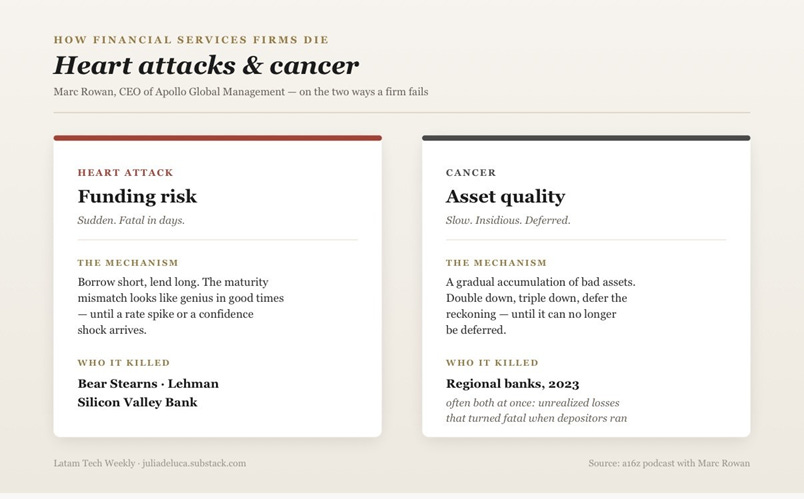
Apollo, born from a heart attack, has been architecturally allergic to funding risk ever since. That’s not accidental. It’s formative trauma turned into institutional design.
The founding itself is almost too good: a cold call from Crédit Lyonnais, the French government bank, led to an $800M mandate that became $6 billion — in 1990, when nobody had $6 billion.
3. What Apollo Actually Is (And Why “Private Equity” Is the Wrong Label)
This is the most important reframe in the conversation, and one the market still hasn’t fully absorbed.
Apollo today: roughly $1 trillion in AUM, about 80% of it credit, and the vast majority of that investment grade. The remaining ~$200B splits evenly between “hybrid equity” — partner-like capital — and traditional PE structures.
So the firm everyone files under private equity is really an investment grade credit firm with a retirement services engine underneath it. That engine is Athene, the annuities business Apollo acquired, and it’s the permanent capital base: a pool of insurance liabilities funding long-duration, yield-seeking assets, with none of the 10-year clock that defines a fund.
Rowan’s logic is clean: cost of liabilities versus excess return per marginal unit of risk. Athene brings in low-cost liabilities. Apollo originates high-quality, complex, non-vanilla credit that yields more than public bonds of equivalent credit quality — not because it’s riskier, but because it’s private, less liquid, and demands real underwriting. The spread between the two is the whole economic engine.
It’s also why Rowan is skeptical of the “capital light” religion that swept asset management in the 2010s. In a world of rapid change, he argues, guaranteeing outcomes — certainty of financing for issuers, certainty of income for retirees — takes capital. Brand and relationships are fine until things get uncertain. Then capital is what lets you write the check and stand behind it.
4. Concentration Risk and the Case for Private Markets
One of the sharpest empirical claims in the conversation: ten stocks are now nearly half the S&P 500, and they’re all levered to the same macro trend (AI, obviously). Nvidia, Microsoft, Apple, Amazon, Alphabet, Meta, Tesla, Broadcom — the names are familiar and the concentration is historically anomalous.
Rowan’s point is that this isn’t only an equity problem. The same consolidation is happening in credit, where a market once dominated by ten large banks is migrating toward five banks plus five large tech companies. He thinks this is the more alarming of the two, precisely because most investors never see it.
His conclusion is that diversification now requires private markets. Here’s where I’d push back, and where I think the pitch is partly circular. Many of the largest private opportunities are built around the same technological forces driving the public indices — AI infrastructure, data centers, power generation, semiconductor supply chains, next-gen software. So you can move your money out of public equities and into private credit and infrastructure and still be making the same underlying bet, just through instruments that happen not to reprice daily. The diversification is structural, not economic. That’s not nothing — different instruments carry different risk and liquidity profiles — but it’s worth being honest that “go private to diversify” and “the whole economy is concentrating into one trend” can’t both be fully true at once.
What’s harder to argue with is where the value is being created. Anthropic, OpenAI, SpaceX, Cognition, Cursor — the defining companies of this moment are all private. Trillions in value creation, and most investors have zero exposure to any of it.
5. Private Credit: The Real Scope vs. the Media’s Narrow Lens
The financial press mostly treats “private credit” as direct lending to mid-market companies through BDCs. Rowan pushes back hard.
The real opportunity, he argues, is investment grade origination for complex, non-vanilla situations: Intel financing a new fab, Air France restructuring fleet obligations, EDF managing nuclear infrastructure, AT&T monetizing tower assets, Meta funding data center buildout off-balance sheet. None of these are distressed. They’re large, creditworthy borrowers whose situations are too complex for the public bond market’s plain-vanilla appetite. Public markets do standardization at scale; private capital does customization at scale, and customization commands a spread.
This slots into a longer transition. For most of the twentieth century banks allocated capital. The 1980s brought securitization. The post-2008 years brought private capital. The next phase may be AI-assisted allocation, where the edge comes less from balance-sheet size than from the ability to analyze assets that are too complex for everyone else. Through that frame, Apollo starts to look less like an asset manager and more like an operating system for capital.
Final Thought: Apollo Isn’t Really Betting on Private Credit
The deepest takeaway is that Apollo isn’t betting on private credit so much as on the continued privatization of capital markets themselves.
If the twentieth century was defined by the rise of public markets, the first quarter of the twenty-first may be defined by their slow retreat. Companies stay private longer. More financing happens outside banks. More infrastructure is funded through customized structures. More value is created before public investors ever get a look.
The winners here won’t necessarily be the firms with the most capital. They’ll be the ones that can underwrite what’s too complex, too customized, or too novel for standardized markets to touch. And that — not AI as a sector to lend against, but AI as the thing that decides who can understand risk well enough to finance the future — is the bet underneath the bet.

General news:
Pope Leo XIV calls for global AI regulation in first encyclical — Pope Leo XIV published Magnifica Humanitas, his first encyclical, urging stronger international oversight of artificial intelligence. The document warns about the concentration of technological power, AI-driven misinformation, autonomous weapons, and environmental impacts, while advocating for global governance, data transparency, and ethical standards. 🇻🇦
Impacta VC opens applications for the fifth edition of Modo Fundraising — Impacta VC, in partnership with Oracle, has launched applications for the fifth cohort of Modo Fundraising, its fundraising acceleration program for Latin American startups. 🌎
Tako launches AI-powered labor litigation platform — Brazilian HR-tech startup Tako has entered the labor litigation market with Tako Legal, an AI platform designed to analyze labor lawsuits, generate legal defenses, and provide compliance guidance. Backed by over R$175 million from investors including Ribbit Capital, a16z, and ONEVC, the company expects the new business unit to generate R$50 million in revenue within its first year. 🇧🇷
Huawei unveils new chip architecture to reduce reliance on restricted technologies — Huawei introduced Logic Folding, a new chip architecture that it claims can increase transistor density by 55%. The design could help China advance semiconductor development despite U.S. restrictions, potentially enabling the production of 1.4-nanometer chips without depending on ASML’s EUV lithography systems. 🇨🇳
CADE recommends blocking B3’s acquisition of CRDC stake — Brazil’s antitrust authority has recommended rejecting B3’s proposed acquisition of a 60% stake in CRDC, a receivables and credit infrastructure registry. Regulators argue the transaction could further concentrate the market and strengthen B3’s dominant position. The final decision will be made by CADE’s tribunal. 🇧🇷
Deals:
Trinio raises R$32 million seed round to expand AI in omnichannel retail — Retailtech startup Trinio secured a R$32 million seed round led by Hi Ventures, with participation from Activant, Caravela, Latitud, and Gilgamesh. 🇧🇷
Laqus acquires goLiza to strengthen capital markets infrastructure — Laqus acquired goLiza, a platform specializing in fund onboarding and registration, marking its second acquisition of 2026. 🇧🇷

General news:
Asaas launches Drones to build new ventures beyond payments — Asaas unveiled Drones, an internal venture-building initiative aimed at creating and validating products outside its core payments business. Supported by the fintech’s recent R$820 million funding round and M&A activity, the program will recruit experienced entrepreneurs to develop solutions in areas such as credit, CRM, and business management, with successful ventures expected to be integrated into the broader Asaas ecosystem. 🇧🇷
Forlex launches AI legal assistant for consumers via WhatsApp — Forlex introduced LIVIA Cidadão, a free AI-powered legal assistant available through WhatsApp that helps Brazilians navigate topics such as labor rights, social security benefits, FGTS, and tax reform in plain language. The launch follows a partnership with Brazil’s Bar Association (OAB) and a US$32 million agreement with AWS, reinforcing the company’s ambition to become a key AI infrastructure provider for the legal sector. 🇧🇷
Brazilian agtech ecosystem matures, but funding remains regionalized — A study by ABStartups and USP found that 48% of Brazilian agtechs have raised external funding, though 70% of investments originate from their home states. While the sector continues to be concentrated in the Southeast, partnerships with universities, innovation hubs, corporations, and government institutions remain critical drivers of growth and technological development. 🇧🇷
Brubank launches secured credit card backed by U.S. dollar deposits — Brubank introduced Open Card, a secured credit card that allows customers to use U.S. dollar deposits held in their accounts as collateral for a credit limit. . 🇦🇷
Deals:
Didit raises US$7.5 million seed round to expand identity verification platform — Didit secured a US$7.5 million seed round backed by Y Combinator, Pioneer Fund, SaaSholic, and other global investors. The company provides identity verification and fraud prevention APIs powered by AI, offering document authentication, biometric liveness checks, and deepfake detection to more than 1,500 clients across 220+ countries. 🌎
Klar acquires Yave to enter Mexico’s digital mortgage market — Mexican neobank Klar acquired digital mortgage platform Yave, expanding beyond credit cards, investments, and personal loans into housing finance. Founded in 2018, Yave has originated nearly MXN 5 billion in mortgages, and its technology will enable Klar to offer fully digital home financing while supporting future expansion into other asset-backed lending products. 🇲🇽

General news:
Google opens new engineering hub in São Paulo focused on AI and security — Google expanded its presence in Brazil with a new engineering hub in São Paulo capable of hosting 400 employees. The facility includes Latin America’s first Google Safety Engineering Center and Accessibility Discovery Center, as well as a startup campus dedicated to AI ventures, reinforcing Brazil’s role as a strategic R&D hub for globally deployed technologies. 🇧🇷
Dapper expands into Brazil after surpassing US$1 million in annual revenue — Colombian AI startup Dapper, which specializes in regulatory intelligence, is entering the Brazilian market after exceeding US$1 million in annual revenue and securing a US$600,000 seed round. Its platform uses AI to monitor legislation, regulatory changes, and government activity in real time for clients including Coca-Cola, TikTok, Philip Morris, and General Motors. 🇨🇴🇧🇷
Avla turns profitable in Brazil as the country becomes its largest market — Avla’s Brazilian operation reported a net profit of R$8.6 million in 2025, reversing a loss from the previous year and accounting for more than 34% of the group’s revenue. The Chilean insurtech credited its growth to simplified insurance products, expansion into underserved sectors, and increasing use of AI for underwriting and risk assessment. 🇧🇷🇨🇱
Ascenty invests US$1.2 billion in AI-ready data centers in Brazil — Ascenty announced a US$1.2 billion investment to build and expand four data centers in São Paulo state. The facilities, already fully pre-leased, will add at least 150 MW of capacity and include AI-optimized infrastructure, strengthening Brazil’s position as a leading data center hub in Latin America. 🇧🇷
Loggi appoints new president as it pushes toward profitability — Loggi named Rafael Szarf as president to lead operational execution and accelerate the company’s path to profitability. The logistics startup expects to reach operational breakeven in the second half of the year while focusing on efficiency, route optimization, and last-mile technology rather than aggressive expansion. 🇧🇷
BNDES approves R$28 million for AI-driven industrial modernization — BNDES approved R$28 million in financing for Bruning Tecnometal to advance its digital transformation strategy. The project includes AI-powered manufacturing, autonomous robots, 3D printing, and an internal AI assistant, with expected productivity gains of up to 12.5% and the creation of 200 new jobs. 🇧🇷
Listo targeted by Pix-related cyberattack — Automotive fintech Listo was hit by a cyberattack linked to Pix operations, prompting the Central Bank to issue an alert to financial institutions. The company stated that mitigation measures were immediately activated and that its services remain operational, amid a broader rise in fraud-related incidents across Brazil’s payments ecosystem. 🇧🇷
Deals:
Belo raises US$14 million Series A led by Tether — Argentine digital wallet Belo secured a US$14 million Series A round led by Tether. The company provides cross-border payments, stablecoin services, and digital-dollar accounts for freelancers, remote workers, and migrants, and plans to expand into seven additional Latin American markets. 🇦🇷
RedGirasol secures US$5.8 million from Credit Saison Mexico — Mexican impact-investing fintech RedGirasol received a US$5.8 million investment from Credit Saison Mexico to expand lending through its crowdfunding platform. The partnership will support sustainable projects, including solar energy initiatives, while increasing liquidity and financing capacity for investors. 🇲🇽
Cognition AI raises over US$1 billion, reaching a US$26 billion valuation — Cognition AI, creator of the autonomous coding agent Devin, raised more than US$1 billion in a Series D round, doubling its valuation to US$26 billion in less than a year. The company’s annual recurring revenue surged from US$37 million to US$492 million, fueled by enterprise adoption from customers including Goldman Sachs and Citibank. 🇺🇸
SpaceX reportedly prepares a US$75 billion IPO at a valuation above US$2 trillion — SpaceX is reportedly planning a US$75 billion initial public offering that could value the company at more than US$2 trillion, potentially making it the largest IPO in history. The move highlights growing investor appetite for companies operating at the intersection of space, AI, cloud infrastructure, and advanced technology. 🇺🇸
JPMorgan signals up to US$20 billion for acquisitions — JPMorgan CEO Jamie Dimon said the bank could deploy between US$10 billion and US$20 billion on acquisitions over the next two years. Potential targets include fintechs, wealth management firms, and financial technology platforms that complement the bank’s core businesses and long-term growth strategy. 🇺🇸
Banco Rendimento acquires N26’s former Brazilian lending license — Banco Rendimento acquired the Brazilian lending fintech license (SCD) previously held by N26, following approval from Brazil’s Central Bank. The transaction strengthens Banco Rendimento’s strategy in credit, payments, foreign exchange, and Banking-as-a-Service, while reflecting a growing trend of regulatory-license acquisitions in Brazil. 🇧🇷🇩🇪

General news:
Aggir Ventures adopts a deal-by-deal investment strategy — Health-focused VC firm Aggir Ventures is moving away from a traditional fund structure toward a deal-by-deal investment model, reflecting the longer development cycles and capital requirements of healthcare startups. After investing in seven healthtechs, the firm plans to create dedicated vehicles for individual opportunities while maintaining a strong focus on AI-driven healthcare and clinical research. 🇧🇷
TRC Recruitme expands into Peru with AI-powered hiring technology — Chilean HR-tech startup TRC Recruitme is entering Peru after receiving support from CORFO’s Escalamiento program. Its platform automates candidate screening through video interviews and AI-based assessments, reducing recruitment timelines by up to 90% while helping companies improve hiring efficiency and talent retention. 🇨🇱🇵🇪
Open Finance industry warns of higher barriers for startups — Brazil’s Open Finance sector is raising concerns that proposed regulations could increase entry barriers, with estimates suggesting companies may need up to R$30 million to operate within the ecosystem. Industry participants argue the measures could reduce competition and innovation, prompting calls for a more proportional regulatory framework. 🇧🇷
Operation Hidden Carbon uncovers R$26 billion in suspicious transactions — Brazil’s Operation Hidden Carbon identified R$26 billion in suspicious financial transactions between 2022 and 2025, leveraging enhanced reporting requirements for payment institutions. The investigation reflects growing regulatory efforts to combat fraud, money laundering, and financial crime while increasing oversight of fintechs and payment companies. 🇧🇷
Brazilian fintech funding reaches US$2.77 billion in 2025 — Brazilian fintechs raised US$2.77 billion across 106 funding rounds in 2025, matching 2021 funding volumes despite a significantly lower number of transactions. According to Sling Hub, investors are concentrating capital in more mature companies, while structured debt vehicles such as FIDCs are becoming an increasingly important source of growth capital. 🇧🇷
Deals:
Pax raises US$40 million seed round for AI-powered public safety platform — Brazilian startup Pax secured a US$40 million seed round led by Greenoaks and Benchmark, making it one of the largest seed financings in Latin America. The company uses AI to help law enforcement analyze surveillance footage, connect evidence, and accelerate investigations, with its platform already deployed in approximately 30 Brazilian cities. 🇧🇷
Anthropic raises US$65 billion and nears a US$1 trillion valuation — Anthropic secured a US$65 billion Series H round, reaching a post-money valuation of US$965 billion. Backed by investors including Altimeter, Sequoia, Coatue, and Capital Group, the company plans to invest heavily in compute infrastructure, AI safety research, and product development ahead of a potential IPO. 🇺🇸
Conty raises pre-seed round to scale creator economy infrastructure — Brazilian startup Conty, which connects brands with content creators, raised a pre-seed round backed by Entrypoint and angel investors including iFood CEO Diego Barreto. The company plans to expand its team and strengthen its platform for creator discovery, campaign management, contracts, and payments. 🇧🇷

General news:
Coinbase and Kalshi plan regulated perpetual crypto futures in the U.S. — Coinbase and Kalshi announced plans to launch CFTC-regulated perpetual crypto futures for U.S. investors, bringing one of the largest segments of the crypto derivatives market under domestic regulatory oversight. The initiative aims to attract traders currently using offshore platforms while providing leveraged, non-expiring crypto contracts within a regulated framework. 🇺🇸
Iniciador launches agentic payments powered by Pix and Open Finance — Brazilian fintech Iniciador introduced an agentic payments solution that enables AI agents to initiate transactions autonomously through Pix and Open Finance. The platform is designed to connect models such as ChatGPT, Claude, and Gemini to Brazil’s financial infrastructure, supporting use cases ranging from autonomous commerce to automated investments and payments. 🇧🇷
GetHome uses AI to digitize and accelerate home construction — Brazilian proptech GetHome is modernizing the homebuilding process by allowing customers to select land, customize projects, and monitor construction through a single platform. The company leverages AI to improve budgeting and procurement efficiency, aiming to reduce costs by up to 10% and cut delivery times roughly in half. 🇧🇷
AI is reshaping SaaS valuations, according to Acorn Advisory — Acorn Advisory argues that AI is creating a growing divide in the SaaS sector, with AI-native companies likely to command premium valuation multiples while generic software providers face increasing competitive pressure. Businesses with proprietary data, workflow automation, and exposure to regulated industries are expected to be among the biggest beneficiaries. 🌎
Brazil’s Central Bank tightens requirements for crypto service providers — Starting June 1, crypto companies seeking authorization to operate in Brazil must submit an independent audit report from a CVM-registered auditor evaluating their anti-money laundering and suspicious transaction monitoring procedures. The measure aims to strengthen oversight and align the sector with international compliance standards. 🇧🇷
Corpag secures court injunction after Central Bank license denial — Brazilian fintech Corpag obtained a court injunction suspending the Central Bank’s decision to deny its payment institution authorization, preserving its access to Pix. The case highlights increasing regulatory scrutiny as authorities tighten licensing standards across the financial sector. 🇧🇷
Finnet launches AI foundation model for corporate finance — Finnet introduced Finnet Agentic AI, which it describes as the first AI foundation model built specifically for corporate finance. The platform enables autonomous AI agents to analyze data, make decisions, and execute financial processes in real time, helping finance teams become more strategic and efficient. 🇧🇷
Brazil launches free public streaming platform for national content — The Brazilian government launched Tela Brasil, the country’s first free public streaming service dedicated to national audiovisual content. The platform debuts with 555 titles and plans to add more than 3,000 hours of programming from TV Brasil, expanding public access to cultural and educational content. 🇧🇷
Up to US$82 billion in wholesale banking revenue could shift to digital rails by 2030 — A study by Oliver Wyman and Morgan Stanley estimates that up to US$82 billion in wholesale banking revenue may migrate to digital infrastructure over the next decade. The transition is expected to be driven by real-time settlement, programmable transactions, and the digitization of traditional banking services rather than cryptocurrencies alone. 🌎
Deals:
Vitrify raises R$5 million to expand AI-powered capital markets intelligence — Vitrify secured a R$5 million round from SVN and Plug and Play just six months after its first funding round. The company uses AI to extract and structure information from financial documents and will invest in broader data coverage, stronger AI capabilities, and agentic solutions for financial institutions. 🇧🇷
Kaszek invests US$15 million in AI startup Wonderful — Kaszek invested US$15 million in Israeli AI startup Wonderful as part of an extension to its Series B round, which valued the company at US$2 billion. Wonderful plans to use the capital to expand into Latin America, including opening a São Paulo office and scaling its AI agents platform for enterprise customers. 🇮🇱🇧🇷

See intro above!!!!

RIO2C 2026
Date: May 26–June 1, 2026
Location: Rio de Janeiro, Brazil
Description: A creativity-driven event connecting technology, media, audiovisual, music, sustainability, and entrepreneurship.
More infoSouth Summit Madrid 2026
Date: June 3–5, 2026
Location: Madrid, Spain
Description: A global innovation conference connecting startups seeking scale with investors and corporations looking for new opportunities.
More infoMoney20/20 Europe 2026
Date: June 2–4, 2026
Location: Amsterdam, Netherlands
Description: One of the world’s leading fintech and financial services conferences, gathering global banks, fintechs, investors, regulators, and technology companies to discuss the future of payments, banking, AI, embedded finance, and digital assets.
More infoWeb Summit Rio 2026
Date: June 8–11, 2026
Location: Rio de Janeiro, Brazil
Description: Part of the Web Summit global series, the event connects startups, investors, and tech leaders across Latin America.
More infoFebraban Tech 2026
Date: June 24–26, 2026
Location: São Paulo, Brazil
Description: One of the main financial technology and innovation events for the banking and financial services sector in Latin America.
More info

nothing worth noting this week…

The AI Daily Brief - special highlight to the edition “The 4 AI Team Members Execs you should hire”

“You either accept change, or change is visited upon you” - Marc Rowan (or Milken) in the podcast I mention in the intro…