
LatAm Tech Weekly
241: Update on the AI novela, is Michael Burry picking sides in AI, deals of the week... and much more!

Weekly writing about what is happening in LatAm tech. By day, I am part of the corporate development team at Itau Unibanco. By night, I am reading and learning about technology in general (now, with a focus on AI). During the weekends, I’m writing the LatAm Tech Weekly. And obviously, always running!
If you have not subscribed yet, join the 14,700+ weekly readers by subscribing here!
Follow me on LinkedIn , Instagram or X for daily updates!
Opinions expressed here are solely my own and does not represent those of people, institutions, organizations that I may or may not be associated with in any capacity, unless explicitly stated.
Happy Sunday!
This week, the topic of school choice came up in more than one conversation — and stayed on my mind throughout my long run on Saturday (22km, yes). While running, I couldn’t stop thinking about how grateful I am to have studied at the American School of Rio de Janeiro. (Thanks Dad!!!)
I deeply believe in the American curriculum — not because it’s “better” in the classical sense, but because it develops the whole person: sports, arts, critical thinking, teamwork. A formation that prepares you for life, not for a standardized entrance exam. And that point has never been more relevant than in the AI-driven world we live in today.
But there’s another element that tends to be underestimated: the bonds.
I graduated from EARJ 18 years ago. My lifelong friends are still the same ones from there. And I feel that the people I met and the experiences I had in that environment help me in ways I can still identify today — inside and outside of work. Obviously, education starts at home. No school can replace that. But the right combination can be extraordinarily powerful…
Choosing a school is one of the most complex and personal decisions a family faces. There’s no single right answer. But it’s worth thinking beyond the rankings — and asking what kind of person you want your child to be at 36.
(picture of my lifelong friends during our graduation… 18 years ago)

Update on the AI novela
Two weeks after the U.S. government pulled the plug on Anthropic’s Mythos, Commerce Secretary Lutnick signed off on bringing it back — but only for a curated list of 100+ organizations operating critical American infrastructure. Fable, the one that was in your subscription? Still out. The pattern is becoming hard to ignore: on the same day Mythos was quietly restored for the chosen few, OpenAI launched GPT-5.6 in a “limited preview” — also at the government’s request, under a Trump executive order signed in June that now mandates federal vetting before any frontier model goes public.

AI has formally become a matter of national security, which introduces a risk variable that didn’t exist six months ago: how do you price the upside of a lab whose best product can be switched off by decree on a Friday night? On the other side of that equation, China isn’t waiting. GLM 5.2 is so saturated with Western model outputs that it reportedly refuses to believe it isn’t one — and Anthropic is now suing Alibaba for allegedly running the largest model distillation campaign ever documented: 25,000 fraudulent accounts, 28.8 million prompts over 44 days, all aimed at replicating Mythos-level capability on the cheap. The uncomfortable punchline: the U.S. is tapping the brakes on frontier access at the exact moment its competitors are flooring it. For the first time, the distance between you and the best the technology has to offer isn’t decided by your credit card or a company’s roadmap. It’s apparently decided in Washington.
Michael Burry Is Not Calling the Top. He’s Picking Sides.
The Brazilian press picked up the easy version this week: Michael Burry thinks AI is a bubble, so investors should hide in cash. That is not quite the trade - and not quite what he said. After reading the local newspaper, I decided to dig in to understand exactly what he said.
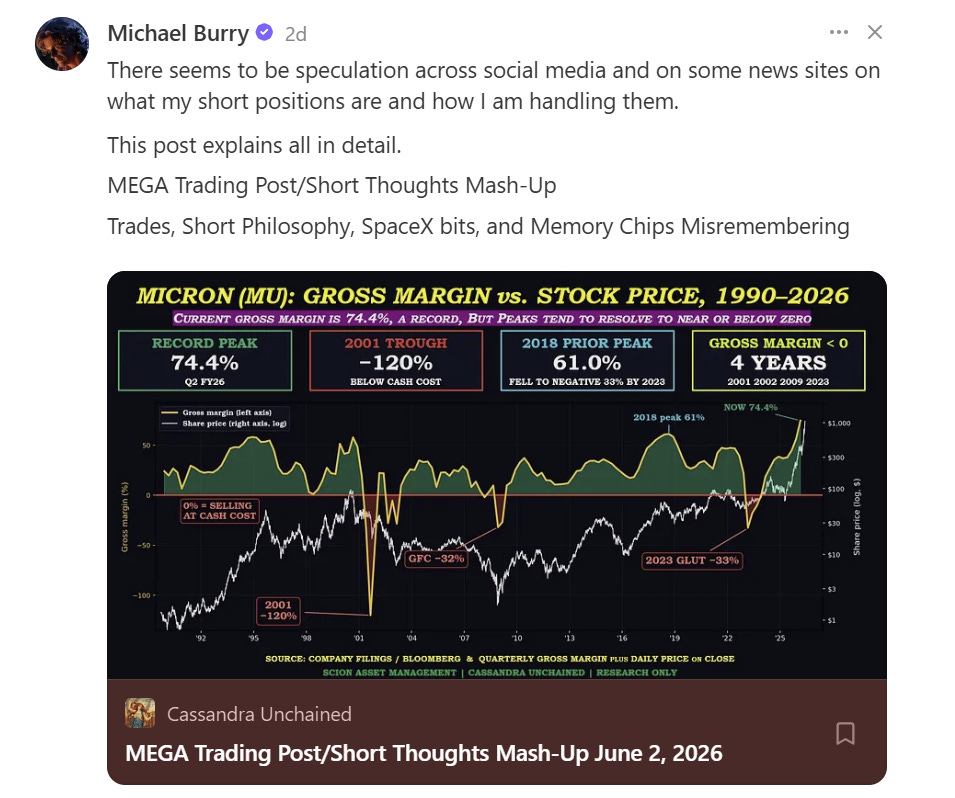
Burry has been writing on Substack since late 2025, after winding down Scion, and his recent Trading Posts have given readers something very useful: a look at how he is actually positioning. When read carefully, the story becomes less “Burry calls crash” and more “Burry rotates away from the crowded part of the AI trade.”
In mid-May, he urged investors to reduce exposure to parabolic tech names and “reject greed,” arguing that AI-driven momentum was starting to resemble the final stretch of the dot-com bubble. Then, on June 12, he sharpened the critique: LLMs are language models, not AI. His point was not that the technology is useless; it was that the market is capitalizing a massive infrastructure buildout (chips, data centers, power, depreciation schedules and all) before there is enough evidence that the returns will justify the spend.
That is, Burry is not simply saying “AI is fake.” He is saying the capex cycle may be real, powerful and still over-owned. And then came the part most headlines missed (including the recent one from a Brazilian newspaper).
In a Trading Post titled June 18, Burry disclosed that he bought Mercado Libre at around $1,630. A week later, he reportedly added a new long position in Microsoft through December 2028 LEAP call options — a leveraged, long-dated bet that Microsoft will be materially higher by late 2028. Microsoft then closed sharply higher the next day, although the move was also part of a broader rebound in beaten-down software names.
So, the call is not that Burry is short on AI - or that investors should be fully in cash - It is rotation. He appears bearish on the most crowded expression of the AI boom — the semiconductor and capex-heavy infrastructure layer — while selectively buying companies where the market may have thrown out durable cash flows, embedded distribution and real software or payments franchises along with the AI bathwater.
That is why Mercado Libre is the interesting detail for Latin America. It is not an LLM company. It does not need a $100 billion data center buildout to justify its equity story. It is an e-commerce, fintech, logistics and payments platform with scale, operating history and multiple monetization engines already in place. Whatever AI does for MELI over time will likely be incremental to a business that already exists, not the entire reason the valuation has to work…
That read-across is relevant across our region. The companies that may benefit from this kind of rotation are not necessarily the ones shouting the loudest about AI. They are the companies that can use AI to improve underwriting, customer service, fraud detection, collections, productivity or personalization — without needing to become frontier-model labs themselves.
If Burry is right, the next phase of the AI market will not reward every company attached to the word “infrastructure.” It will reward businesses that can turn AI into margin, retention, distribution or lower operating cost — while avoiding the most dangerous part of the cycle: spending as if the payoff is guaranteed.
And if that rotation is real, the most interesting AI trade of the next 18 months may not look like another chip stock in Silicon Valley…

General news:
• Brazil’s Central Bank expanded Open Finance for Pix payments, allowing users to share account balances and available credit during Pix by Approximation and automated payments. The update improves payment success rates while strengthening Open Finance as an embedded payments infrastructure. 🇧🇷
• Revolut is targeting a $200B valuation in a future IPO but plans to remain private while expanding its banking operations globally. After surpassing 65 million customers and securing a UK banking license, the fintech is expected to pursue a secondary share sale before going public. 🇬🇧
• N5 launched Singular, an AI platform built exclusively for financial institutions, combining CRM, analytics, automation and AI to improve productivity, customer engagement and regulatory compliance across banks and insurers. 🇦🇷
• Lemon integrated with Colombia’s Bre-B instant payment network, allowing users to move pesos instantly across banks while seamlessly converting funds into digital dollars. The launch strengthens the connection between real-time payments and stablecoin adoption in Latin America. 🇨🇴
• Anthropic signed a strategic partnership with Micron Technology, securing long-term access to high-bandwidth memory and storage while adding Micron as an investor. The agreement strengthens Anthropic’s AI infrastructure strategy ahead of its planned IPO. 🇺🇸
Deals:
• Factorial acquired AI integration platform YepCode, accelerating its transition to an AI-first workforce management platform. The acquisition strengthens autonomous AI integrations across HR, payroll and enterprise software while supporting the company’s rapid expansion in Brazil. 🇪🇸🇧🇷

General news:
• Oracle launched Startup Growth Engine across Latin America, a new initiative supporting venture-backed startups with cloud infrastructure, technical expertise and access to Oracle’s enterprise ecosystem. Initially available in Brazil, Argentina and Colombia, the program reinforces Oracle’s strategy to become a long-term partner for AI and cloud-native startups. 🌎
• Microsoft plans to invest $190B in AI infrastructure, models and applications while expanding partnerships across its cloud and AI ecosystem. The strategy strengthens Microsoft’s position in enterprise AI as demand for AI agents and automation continues to accelerate. 🇺🇸
• SoftBank Latin America CEO Alex Szapiro will step down after five years, handing leadership to Rodrigo Costa and Juan Franck. The transition comes as nearly all portfolio companies have reached self-sustainability and up to 15 businesses are considered IPO-ready. 🌎
Deals:
• Layers launched a R$5M M&A program to acquire and integrate education startups across Latin America. The initiative supports the company’s strategy to build a unified digital ecosystem serving more than 9,000 schools and 3.5 million students. 🇧🇷
• BorderxPay launched a cross-border payments platform enabling businesses to operate across Colombia, Peru, Mexico and Brazil through a single API. The platform integrates local payment rails, global payment methods and digital assets to simplify cross-border commerce in Latin America. 🇨🇴

General news:
• Grupo Hub launched Hubble, an AI-native recruitment platform after investing R$2M to automate hiring workflows while keeping recruiters in control of final decisions. The platform is targeting SMBs and preparing its first seed round later this year. 🇧🇷
• Endeavor Brasil launched an International Expansion Playbook featuring best practices from companies including Pipefy, VTEX, Ebanx and Nomad. The initiative aims to help Brazilian startups build sustainable international expansion strategies. 🇧🇷
• OpenAI unveiled Jalapeño, its first custom AI inference chip, developed with Broadcom to reduce dependence on Nvidia and strengthen its long-term AI infrastructure strategy. The launch reflects the industry’s shift toward vertically integrated AI hardware. 🇺🇸
• A new Driva and Caravela Capital study found AI could impact nearly half of Brazil’s formal payroll, with knowledge-intensive professions facing the highest automation exposure. The report estimates that up to 10 million jobs could eventually be partially or fully automated. 🇧🇷
• Peru’s banking regulator outlined a phased Open Finance rollout, starting with the country’s four largest banks before expanding across the financial system. The first Open Finance data exchanges are expected to begin in 2028. 🇵🇪
Deals:
• Open Finance fintech Floid sold its U.S. subsidiary to PayModum to sharpen its focus on Latin America, where Open Finance adoption is accelerating. The company will prioritize expansion in Chile and Peru following strong regional revenue growth. 🇨🇱
• Taktile raised a $110M Series C led by Goldman Sachs Alternatives to expand its AI-powered decision automation platform for banks and insurers. Around $20M will be invested in Brazil and Latin America as financial institutions accelerate AI adoption. 🌎
• LiveKid acquired Mexican edtech Aldea and committed an additional $3M to expand across Latin America. The combined platform will serve more than 5,000 educational centers and 600,000 families. 🇲🇽
• El Dorado raised a $9M Series A led by Paradigm with participation from Coinbase Ventures to scale its stablecoin-powered cross-border payments infrastructure across Latin America. The fintech already serves more than 100,000 active users in 12 countries. 🌎
• Nava acquired a majority stake in CS Global IT, strengthening its multicloud consulting and governance capabilities. The acquisition is the company’s third in less than a year as it targets R$1B in revenue by 2030. 🇧🇷

General news:
• ABStartups launched the National Council of Startup Associations (CNAS) to strengthen coordination among regional startup organizations and create a unified national agenda for innovation and entrepreneurship. The initiative aims to improve collaboration with policymakers, funding institutions and local ecosystems across Brazil. 🇧🇷
• China called for coordinated global AI regulation, arguing that stronger international governance is needed to prevent the loss of control over advanced AI systems. The proposal highlights the growing geopolitical competition over AI standards, regulation and technological leadership. 🇨🇳
• Meta is reportedly developing a standalone prediction markets app, internally codenamed Arena, to compete with platforms such as Kalshi and Polymarket. The initiative reflects Meta’s broader push into emerging digital finance and event-based forecasting markets. 🇺🇸
• Onyx Impact launched Aisha, an AI assistant built for the Black community, focusing on culturally relevant responses, privacy and bias mitigation. The platform reflects growing demand for specialized AI applications designed for specific communities and use cases. 🌎
• Ada Infrastructure began construction of its first Brazilian data center campus, backed by approximately R$2.7B in investments through 2030. The São Paulo project will deliver up to 300 MW of capacity to support hyperscale cloud and AI workloads, reinforcing Brazil’s role as a regional AI infrastructure hub. 🇧🇷
Deals:
• Zeom raised R$15M to accelerate its international expansion and officially launch its AI-powered healthcare platform in Brazil. Founded by Brazilian entrepreneurs in London, the company plans to expand local partnerships and product development. 🇬🇧🇧🇷
• Zeom also raised a R$15M pre-seed round led by Fabric Ventures to launch its blockchain-based global investment platform in Brazil. The wealthtech enables Pix-funded access to international assets while leveraging AI-powered financial planning tools. 🇬🇧🇧🇷
• Kalshi is reportedly seeking a new funding round at a $40B valuation, nearly doubling its valuation just weeks after its previous raise. The funding reflects explosive growth in prediction markets and rising investor confidence in the sector. 🇺🇸
• PicPay is facing a U.S. class action lawsuit and regulatory scrutiny in Brazil over disclosures related to its credit portfolio and payroll advance product. The investigations have added pressure as the company works to restore investor confidence following its IPO. 🇧🇷

General news:
• A Hi Ventures report found that 91% of Latin American VCs now use AI to evaluate investments, up from 45% just two years ago. AI is increasingly being used across deal sourcing, market research, portfolio monitoring and financial analysis, while 61% of respondents said most recent investments targeted AI-native startups, underscoring the rapid maturation of the region’s AI ecosystem. 🌎
• Brazil ended 2025 with 70 million consumers using Pix almost daily, a 71% increase year over year, while heavy business users grew 54% to 3.7 million. The figures reinforce Pix’s evolution into Brazil’s dominant payments infrastructure, creating new opportunities for embedded finance and digital financial services. 🇧🇷
• Brazil’s antitrust authority Cade dismissed its investigation into 99Food after concluding the company does not hold a dominant position in the food delivery market. Although Keeta has appealed the decision, the case highlights intensifying competition among delivery platforms in Brazil. 🇧🇷
• ON Semiconductor agreed to acquire Synaptics for approximately US$7 billion in an all-stock transaction to strengthen its edge AI, sensing and connectivity capabilities. The acquisition expands its addressable market and reflects the accelerating consolidation of AI hardware and semiconductor infrastructure. 🇺🇸
• Evertec is restructuring its Brazil operations to accelerate cloud modernization, engineering capabilities and AI initiatives. The reorganization introduces new leadership across payments engineering, architecture and operations to support the company’s next growth phase in financial technology. 🇧🇷
Deals:
• Teachy acquired AI software house Nero.AI in a seven-figure acquihire transaction, adding specialized engineering talent and intellectual property to accelerate its AI-powered education platform. The deal strengthens Teachy’s product roadmap as it serves more than 6 million teachers across over 100,000 schools globally. 🇧🇷
• Peigo partnered with fintech Félix to enable WhatsApp-based remittances from the U.S. to Ecuador. The partnership expands Félix’s regional footprint while simplifying cross-border transfers in a market that received a record US$7.7 billion in remittances during 2025. 🇪🇨🇺🇸

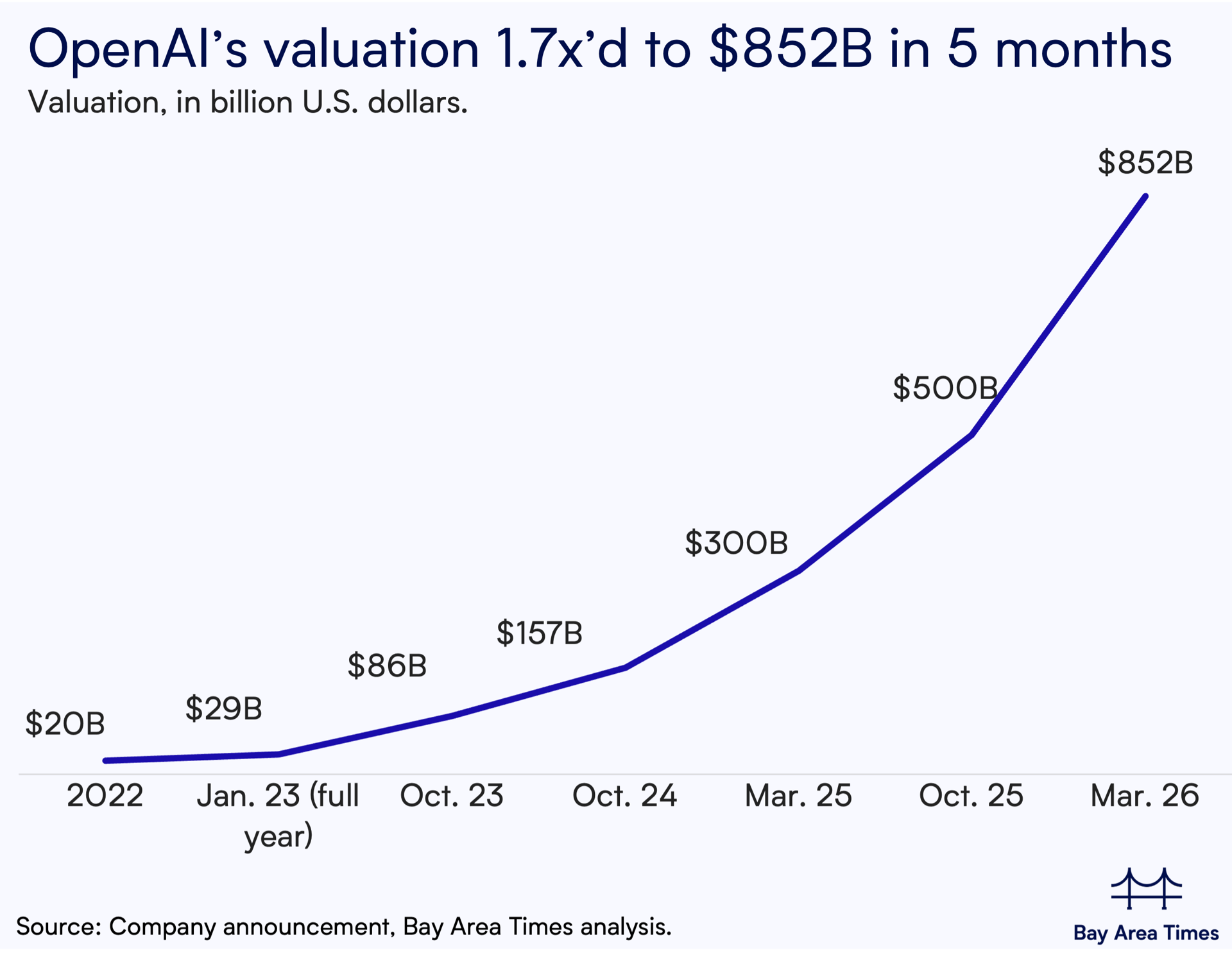
OpenAI is reportedly pushing its IPO timeline to 2027, as questions grow around Sam Altman’s ambition for a $1 trillion public valuation. That would mark a step up from the company’s most recent private valuation of $825 billion.

Febraban Tech 2026
Date: August 24–26, 2026
Location: São Paulo, Brazil
Description: One of the main financial technology and innovation events for the banking and financial services sector in Latin America.
More infoConta Azul Con 2026
Date: August 1, 2026
Location: São Paulo, Brazil
Description: A conference connecting accounting, entrepreneurship, and technology through keynotes, workshops, networking sessions, and discussions on business innovation.
More infoRio Innovation Week 2026
Date: August 4–7, 2026
Location: Rio de Janeiro, Brazil
Description: One of Brazil’s largest innovation festivals, bringing together entrepreneurs, startups, corporations, investors, and policymakers to discuss technology, business, and social transformation.
More infoSP2B (São Paulo Beyond Business) 2026
Date: August 9–16, 2026
Location: São Paulo, Brazil
Description: A new business and innovation event designed to connect entrepreneurs, executives, investors, and corporations through discussions on growth, creativity, and the future of business.
More infoDeep Tech Summit 2026
Date: August 11–12, 2026
Location: São Paulo, Brazil
Description: A conference focused on science-based innovation, bringing together deep tech startups, investors, corporations, and researchers to explore frontier technologies and emerging opportunities.
More infoStartup Summit 2026
Date: August 26–28, 2026
Location: Florianópolis, Brazil
Description: One of Latin America’s leading startup events, connecting founders, investors, and ecosystem leaders through content, networking, and business opportunities.
More infoHackTown 2026
Date: September 3–7, 2026
Location: Santa Rita do Sapucaí, Brazil
Description: A unique innovation, technology, and culture festival that transforms an entire city into a hub for networking, learning, entrepreneurship, and creative collaboration.
More infoHotmart Fire 2026
Date: September 10–12, 2026
Location: Belo Horizonte, Brazil
Description: One of the leading events for the digital business and creator economy ecosystem, covering marketing, sales, online education, innovation, and business growth.
More infoDreamforce 2026
Date: September 15–17, 2026
Location: San Francisco, United States
Description: Salesforce’s flagship conference focused on CRM, AI, digital transformation, customer experience, and enterprise innovation.
More infoTechCrunch Disrupt 2026
Date: October 13–15, 2026
Location: San Francisco, United States
Description: A leading global startup conference where founders, investors, and technology leaders discuss entrepreneurship, fundraising, and innovation.
More infoWeb Summit Lisbon 2026
Date: November 9–12, 2026
Location: Lisbon, Portugal
Description: One of the world’s largest technology conferences, bringing together entrepreneurs, investors, executives, and policymakers to discuss global innovation trends.
More infoSlush 2026
Date: November 18–19, 2026
Location: Helsinki, Finland
Description: A globally recognized startup and venture capital conference focused on connecting founders and investors while fostering innovation and growth.
More infoAWS re:Invent 2026
Date: November 30 – December 4, 2026
Location: Las Vegas, United States
Description: AWS’s flagship cloud computing conference, featuring product launches, technical sessions, training, and discussions on cloud infrastructure, AI, and data.
More info


THE WORLD CUP! GO BRAZIL!

"Reject greed." — Michael Burry
The Brazil angle on political ads misses the actual story, which is TSE's 2024 electoral rules forcing platform fragmentation while everyone watches Colombia's May election for which tech stack wins.