
LatAm Tech Weekly
#247: State of VC H1 2026, IRR vs. DPI, deals of the week... and much more!

Weekly writing about what is happening in LatAm tech. By day, I am part of the corporate development team at Itau Unibanco. By night, I am reading and learning about technology in general (now, with a focus on AI). During the weekends, I’m writing the LatAm Tech Weekly. And obviously, always running!
If you have not subscribed yet, join the 14,900+ weekly readers by subscribing here!
Follow me on LinkedIn , Instagram or X for daily updates!
Opinions expressed here are solely my own and does not represent those of people, institutions, organizations that I may or may not be associated with in any capacity, unless explicitly stated.
Happy Father’s Day Sunday!
If you know me well, you know today is a particularly meaningful day for me. I believe deeply in the true meaning of the word “dad” — and, more often than not, it goes far beyond biology. Fathers are the people who show up, guide us, protect us, teach us, and love us unconditionally. To all the dads out there — and especially the dads who read LatAm Tech Weekly — I wish you a very happy Father’s Day and only the best.

This week I had an interesting conversation with one of my best friends about trust. In today's world, real trust is rare — most versions of it are transactional, conditional, forgetful, easily walked back. I was happy to hear that I'm one of the most trustworthy people she knows... ok, she's biased (I hope it’s true). But the part of the conversation that stuck with me was this: trust takes time to build and only one moment to lose. It's asymmetric by nature — you earn it in installments and you can forfeit it in a single transaction….
Venture capital has spent the last few years learning that lesson the hard way. For a decade, LPs extended GPs something close to blind trust — they backed narratives, pedigree, and paper markups, and waited. TVPI was the currency of that trust: a promise of value, still unrealized, still owed. Then the exits didn't come. Vintages from 2019 and 2020 sat with returns barely above zero, and LPs who'd committed capital on the strength of a story started asking a different question — not "what's this worth on paper," but "what have you actually paid me back." That's the moment trust stopped being assumed and started being demanded in cash. DPI — distributions to paid-in capital — became the metric that mattered, because it's the only one that can't be marked up, reframed, or explained away.
Which brings me to the first half of 2026, and what the state of venture capital right now says about who's actually earned that trust back. So yes, this week I’m taking LatAm Tech Weekly back to its roots: the venture capital ecosystem. Lately, I’ve dedicated a large portion of the intro to AI, which is only natural given how profoundly it’s reshaping the technology landscape. But in doing so, I’ve spent a little less time on what originally inspired this newsletter: the people, capital, and institutions funding innovation globally – with a focus in LatAm.
As we wrap up the first half of the year and the wave of new reports come, it feels like the perfect moment to zoom out and ask a broader question: What is actually happening in venture capital?
I hope you enjoy it!
This weekend I read Pitchbook’s report “Venture Capital’s current recovery is all IRR, no DPI”. There’s a version of the venture story you can tell right now that sounds like a full recovery. US VC posted a 17.1% one-year IRR in Q4 2025 — the highest of any private capital strategy PitchBook tracks, nearly 3x private capital broadly. AI rounds are clearing at prices that would have sounded like a typo in 2019. US funds raised $74.8 billion in the first half of 2026 alone, almost matching all of 2025.
Then there’s the number I couldn’t get past. The average 2021 vintage fund is sitting at 0.05x DPI after five years. That is, five cents back for every dollar in. The lowest five-year DPI multiple this century.
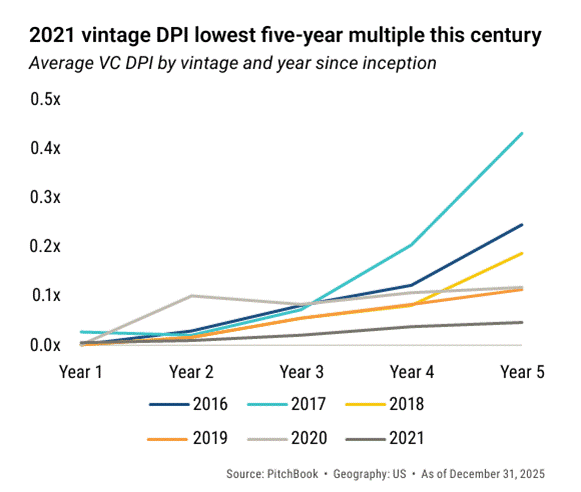
Both things are true at the same time, and that’s the thing. IRR tells you what the mark says. DPI tells you what someone actually wired….
A few points worth emphasizing:
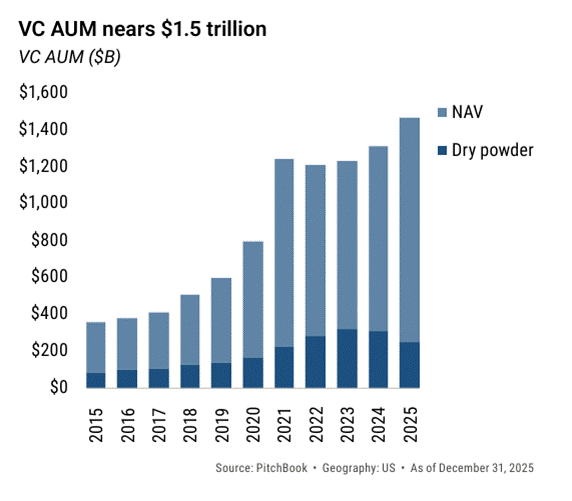
The recovery is a markup, not a payout. Total US VC NAV went from $999.6 billion to $1.2 trillion — up 21.6% in a year. Meanwhile the 12-month distribution yield ran at 11.7%–12.8%, well below the long-run 18.7% average. When NAV growth outruns distributions by that margin, the IRR is describing enthusiasm, not actual liquidity. The three- and five-year horizon IRRs — 5.7% and 8% — still carry 2022–2023 in the window. These figures are more down to earth
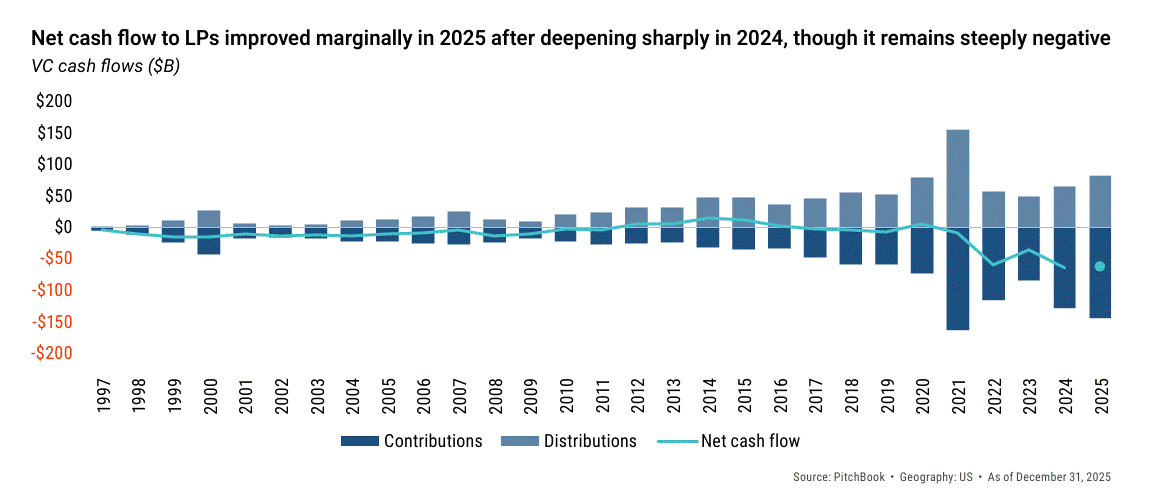
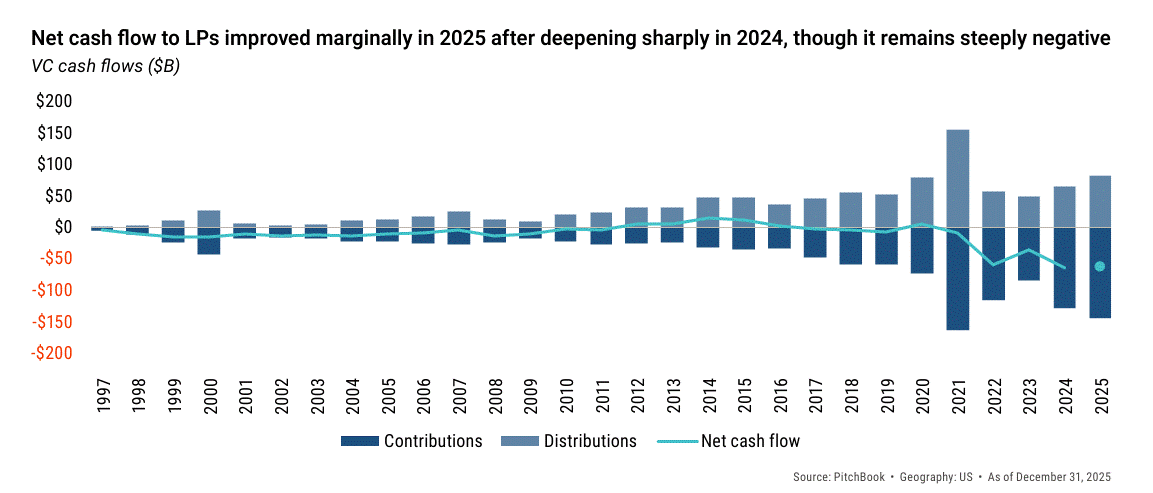
Since 2022, net cash flow to LPs has been negative $202 billion. AUM is approaching $1.5 trillion, and this means that the asset class still a net consumer of capital four years running.
Four companies produced 93.5% of 2026 exit value. Capital-weighted metrics are being carried by a handful of positions. Median and equal-weighted numbers describe the fund your LP actually owns.
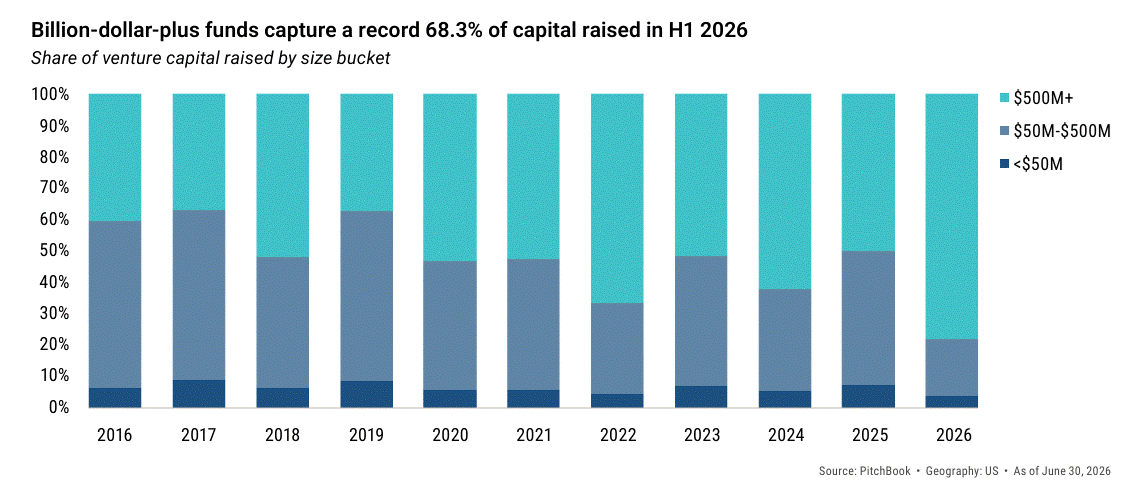
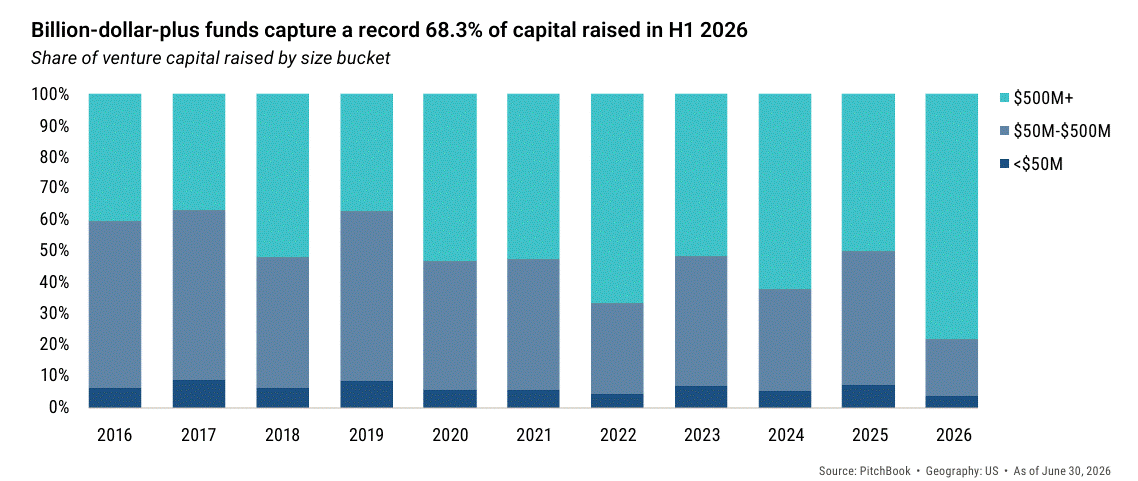
Fundraising has become a list of twelve names. I’ve already mentioned this concentration here several times. Billion-dollar-plus funds took 68.3% of all capital raised this year, up from 36.1% in 2025. Twelve firms accounted for 74.6% of the dollars — a16z, Sequoia, Founders Fund, Thrive... Sub-$50 million funds are now 67.7% of the fund count and 4% of the capital. A decade high and a decade low, in the same segment, at the same time.
Big exits cost more and pay less. The median company exiting above $500 million raised $323.7 million on the way there — more than double the $157 million median of a decade ago — while median exit size barely moved. Step-up on exit collapsed from 62.8% in 2021 to 15.5% in 2026.
The IPO exit is still hard. Fewer than 50 VC-backed companies have listed in any year since 2022, against 950+ unicorns and 113 new billion-dollar valuations minted this year alone. Secondaries are running around $100 billion trailing twelve months — but leaning heavily on SpaceX, OpenAI, and Anthropic. One might frame all of this in a sharp way: private credit and secondaries have become substitutes for going public, not bridges to it.
Two threads worth connecting
This remined me of what I wrote on Michael Burry earlier this year — that the gap between reported value and realized value in the AI world is the trade. Yes, he was talking about public equities - it is a different asset class, but an identical suspicion.
And it rhymes with what Marc Rowan has been saying about the convergence of public and private markets. If companies stay private for 15+ years, secondaries stop being a workaround and become market structure. The report basically concedes this: the regeneration of venture returns will depend on a broader exit market, and it may not come through IPOs at all.
The question is no longer whether AI creates enormous enterprise value. It’s whether the venture plumbing can convert that value into cash.
At the end of the day - IRR is an opinion. DPI is a receipt.

General news:
• Amazon surpasses US$3T in market value as AWS and AI growth accelerate — Amazon crossed US$3 trillion in market value after strong quarterly results, with revenue rising 20% to US$200.6 billion and operating income jumping 43%. AWS grew 37% to a US$169 billion annualized run rate, while Amazon raised its 2026 infrastructure investment forecast to US$220 billion to expand AI, cloud and proprietary chip capacity. 🇺🇸
• Desonera targets institutional real estate clients after reaching breakeven — Brazilian proptech Desonera is expanding from individual property owners to real estate funds and holding companies with an AI and no-code platform that identifies overpaid property taxes and renegotiates debts. Bootstrapped and already at breakeven, the startup serves around 1,800 clients and says it has generated more than R$100 million in realized savings. 🇧🇷
• Brazilian financial institutions face new Central Bank data governance requirements — Banks, fintechs and cooperatives have until the end of 2026 to comply with the Central Bank’s new Information Quality Policy, requiring regulatory data to be accurate, consistent and traceable. The framework elevates data governance to a senior-management responsibility and could drive greater investment in compliance, auditing and governance technology. 🇧🇷
• Kapital seeks Colombian financial license to expand SME services — Mexican fintech Kapital is seeking authorization to operate as a financing company in Colombia, with US$37.98 million in initial capital. The company plans to expand beyond lending into digital factoring and corporate cards, building a broader financial ecosystem for Colombian SMEs. 🇨🇴
• Cielo launches agentic commerce solution with Google Cloud — Cielo launched an agentic commerce solution that enables AI assistants to handle product discovery, negotiation and payments through natural-language conversations. Developed with Google Cloud, the technology can reduce checkout time by up to 60%, increase conversion by up to 15% and cut cart abandonment by around 30%. 🇧🇷
• Miami strengthens its role as a gateway for Latin American startups — Miami is strengthening its connection with Latin American founders through initiatives such as the University of Miami’s USTAAR accelerator, which provides non-dilutive funding and equity investment to promising startups. With Miami’s startup ecosystem surpassing an estimated US$670 billion in company value, these programs are helping regional founders access U.S. capital, mentorship and commercial networks. 🇺🇸
• Elo launches app to centralize card benefits and customer experience — Elo launched a new app that centralizes personalized offers, discount coupons and Priority Pass lounge access for cardholders. The initiative creates a more direct digital relationship with customers and supports Elo’s strategy to expand its ecosystem beyond traditional card infrastructure. 🇧🇷
• Crypto adoption metrics strengthen despite Q2 market correction — Crypto prices remained under pressure in Q2, with the Nasdaq CME Crypto Index falling 15.46%, but underlying adoption continued to expand. Blockchain transactions reached a record 17.6 billion, stablecoin volume totaled US$35.9 trillion in H1 2026 and tokenized real-world assets grew 43.9% to US$59.4 billion, according to Hashdex. 🌎
• Alibaba unveils Qwen 3.8-Max as Chinese AI competition intensifies — Alibaba unveiled Qwen 3.8-Max, its largest AI model to date, with 2.4 trillion parameters and a Mixture of Experts architecture. The launch reinforces China’s push to compete with leading U.S. AI labs through increasingly capable and lower-cost models while expanding global developer adoption. 🇨🇳
Deals:
• Visa acquires BioCatch for US$2.4B to strengthen AI-powered fraud prevention — Visa agreed to acquire BioCatch for US$2.4 billion, expanding its cybersecurity, digital identity and fraud-prevention capabilities. BioCatch uses AI and behavioral intelligence to protect 760 million users across more than 350 financial institutions, reinforcing the growing consolidation of the digital identity and financial security market. 🇺🇸

General news:
• Robinhood is preparing to list Robinhood Ventures Fund II on the NYSE, giving retail investors access to a portfolio of 80 early-stage private startups without accredited-investor requirements or minimum commitments. Structured as a publicly traded BDC, the fund aims to make venture capital exposure more accessible and liquid as startups remain private for longer. 🇺🇸
• Creditas reported R$722.9 million in Q2 2026 revenue, up 30.2% year over year, while originations rose 34.2% to R$1.14 billion and its managed portfolio reached R$8.1 billion. The fintech is using AI to increase productivity and operating leverage as it targets more than R$2.9 billion in annualized revenue and moves closer to breakeven. 🇧🇷
• Tapi partnered with Hey Banco to integrate bill payments directly into the neobank’s app for nearly 500,000 users in Mexico. The partnership expands Tapi’s role as payments infrastructure for Latin American banks and fintechs, with mobile top-ups and recurring payments planned next. 🇲🇽
• The World Bank highlighted Brazil as a leading AI adoption case among emerging economies, with 71% of Brazilian adults having already used an AI chatbot. Its World Development Report 2026 argues that emerging markets should prioritize adapting AI to local needs rather than competing directly with the U.S. and China in capital-intensive infrastructure. 🇧🇷
• ACI Worldwide and dLocal announced a strategic payments partnership to give global merchants access to local Latin American payment methods through a single integration. The initial rollout covers Brazil and Mexico, including Pix, Mercado Pago, NuPay, OXXO and SPEI, with additional regional markets planned. 🌎
Deals:
• Brazilian wealthtech Decade raised US$85 million in what was described as the largest seed round ever recorded in Brazil and Latin America. Backed by Benchmark, GreenOaks, Diffusion, Norte Ventures and Atlantico, the startup combines AI, Open Finance and human advisors to provide scalable wealth management and financial planning. 🇧🇷
• Zenbild is raising its first pre-seed round to accelerate development and U.S. expansion of its AI-powered construction management platform. Backed by Plug and Play Ventures and QuintoAndar cofounder André Penha, the startup is initially targeting Florida before expanding across the country. 🇧🇷🇺🇸
• Uruguayan startup TecsPal was acquired by Vensure Employer Solutions after bootstrapping its way from US$1.6 million to US$35 million in annual revenue. The company will retain its brand and operating independence while using Vensure’s global network to target a tripling of revenue by 2027. 🇺🇾🇺🇸
• Evertec acquired a 67% stake in BBChain, expanding its capabilities in blockchain infrastructure, asset tokenization and digital custody. The transaction strengthens Evertec’s Brazilian financial technology portfolio and creates a platform to replicate BBChain’s solutions across Latin America and the Caribbean. 🇧🇷
• Grupo Cibest completed the acquisition of Avista Colombia, taking full ownership of the fintech focused on financial inclusion for the silver economy. Avista has served more than 146,000 Colombians and disbursed approximately COP 2.9 trillion in financing across the country. 🇨🇴

General news:
• Itaú Unibanco reported a strong Q2 2026, with its credit portfolio growing 9.6% year over year to R$1.5 trillion and recurring managerial profit reaching R$12.4 billion. ROE stood at 24.3%, while controlled delinquency and strong capital levels leave the bank positioned to accelerate lending if market conditions improve. 🇧🇷
• Bitso partnered with Belvo to introduce recurring direct debits in Mexico, allowing users to automatically fund digital wallets directly from bank accounts. The integration supports automated saving and investing while advancing Bitso’s strategy to evolve beyond crypto trading into a broader digital financial services platform. 🇲🇽
• SpaceX shares fell 10% after its first earnings report as a public company despite revenue of US$7.8 billion beating expectations and Starlink profit rising 80% year over year. Investors focused on the company’s US$16 billion quarterly cash burn, largely tied to AI infrastructure, while xAI reported a US$1.2 billion loss. 🇺🇸
• AI is enabling startups to reach unprecedented scale with increasingly small teams, weakening the traditional relationship between headcount and company value. Companies such as Midjourney and Anysphere illustrate how AI automation across engineering, sales and support could allow lean teams—particularly in capital-constrained regions such as Latin America—to compete globally. 🌎
• The White House introduced a new oversight framework for frontier AI models, increasing scrutiny of advanced systems developed by companies including OpenAI, Anthropic and Google. The approach favors voluntary pre-release safety testing and cooperation with U.S. authorities while seeking to balance national security concerns with technological competitiveness. 🇺🇸
• Evertec reported US$275 million in Q2 2026 revenue, up 20% year over year, while Latin America revenue surged 52% with Brazil emerging as a key growth driver. The company is also expanding AI use across software development, fraud prevention, incident management and risk monitoring to improve productivity and operating efficiency. 🇧🇷
Deals:
• Tractian secured R$120.1 million in financing from BNDES to develop a new generation of robotic assistants combining AI, advanced robotics and high-precision sensing for industrial inspection and predictive maintenance. The project is expected to generate 20 patent applications and 421 new jobs while strengthening Tractian’s industrial AI platform. 🇧🇷
• Moove raised a US$250 million Series C led by Mubadala at a US$2.1 billion valuation to accelerate its expansion into autonomous mobility. The company plans to more than triple its autonomous-vehicle team, deepen its Waymo partnership and expand infrastructure for charging, maintenance and 24/7 fleet operations. 🌎
• TransferSmile Holding acquired control of MicroCash, giving PagSmile access to an already regulated Brazilian microcredit institution, now renamed Select Credit. The transaction reflects a broader fintech trend of acquiring licensed companies to accelerate entry into regulated credit and financial services. 🇧🇷

General news:
• Qualcomm is expanding its data center investments in Brazil, viewing the country as a strategic market due to strong demand, clean-energy infrastructure and skilled technical talent. The company plans to expand computing capacity through edge micro data centers while strengthening its local AI ecosystem and emphasizing data sovereignty as a key driver of digital growth. 🇧🇷
• Klarna partnered with JPMorgan Payments to bring its Buy Now, Pay Later products directly to checkout for U.S. merchants using JPMorgan’s payments infrastructure. The integration significantly expands Klarna’s distribution in North America while giving merchants access to installment options designed to improve conversion and average order values. 🇺🇸
• BVC is expanding its pre-seed investment strategy across Latin America, targeting B2B fintech and vertical AI startups with initial checks of around US$150,000. The firm is also broadening its founder pipeline through open calls and a fast-track program for serial entrepreneurs offering investments of up to US$1 million. 🌎
• Flash Benefícios asked Cade to join a case against iFood, alleging that the platform favors iFood Benefícios by restricting Clube iFood discounts for competing meal and food voucher cards. The dispute increases regulatory pressure on iFood as competition intensifies in Brazil’s employee-benefits market. 🇧🇷
• Hackers are increasingly targeting major U.S. private equity firms through sophisticated social engineering campaigns aimed at stealing employee credentials. Firms including Blackstone, Apollo, KKR, TPG and Bain have been targeted, highlighting the growing role of human vulnerabilities in financial-sector cyberattacks. 🇺🇸
• Kovr officially rebranded as KEV following its R$657.6 million acquisition by PicPay. The insurer will continue operating independently while using PicPay as its main individual distribution channel and investing in AI to improve pricing, customer experience and embedded insurance products. 🇧🇷
• International platforms are increasingly adopting Pix to reduce payment friction and improve conversion in Brazil. Payment processors estimate that adding Pix can increase conversion rates by 12% to 25%, particularly across SaaS, AI tools, subscriptions, online courses and digital entertainment. 🇧🇷
• Vibra expanded its use of AI across logistics, deploying more than 135 digital twins and 96 predictive demand models across its nationwide fuel distribution network. The technology has reduced inventory by R$900 million, cut fleet requirements by 11% and lowered accident rates by 67%, while the company now develops an autonomous agentic control tower. 🇧🇷
• TOTVS plans to launch autonomous AI agents in October under a new “task as a service” model that charges customers based on work executed by AI agents. The company expects the model to lower operating costs and create a new recurring revenue stream across its software ecosystem. 🇧🇷
• Bitcoin fell to around US$64,420 as geopolitical uncertainty and rising oil prices weakened global risk appetite. Despite the decline, continued inflows into Bitcoin ETFs suggest institutional demand remains resilient as investors await new U.S. economic data. 🌎
Deals:
• hiSofi raised US$1 million in a round backed by SaaSholic and Uruguay’s ANII to establish its main AI and data science hub in Uruguay. The debt-collection fintech uses AI to automate and personalize collections across Latin America and recovered US$61 million for clients in 2025. 🇺🇾

General news:
• Mercado Pago is accelerating its expansion in Brazil, with net revenue reaching US$2.2 billion in Q2 2026, up 63% year over year, while monthly active users grew 38%. The fintech issued 2.6 million new cards during the quarter and became Brazil’s sixth-largest card issuer as it works to become customers’ primary financial relationship. 🇧🇷
Deals:
• Plinq raised R$1.3 million in its first funding round, led by Spectra Investments, to launch a mobile app that helps women check potential partners’ criminal and court records using public data. The Brazilian startup has surpassed 60,000 users and nearly 85,000 searches and plans to reach 1 million active users within six months of the app launch. 🇧🇷
• Uma Penca raised R$4.5 million in its first funding round via crowdfunding platform altXs, anchored by Grupo Gaia and backed by 329 investors. The Chico Rei spin-off will invest in technology, operations and its product portfolio as it targets around R$4 million in 2026 revenue and 40,000 registered stores by year-end. 🇧🇷
• Kesh raised US$110 million in equity and credit funding led by Grupo Leste to scale its financial wellness and emergency lending platform in Brazil. The fintech, which integrates with employers’ payroll systems, plans to grow from 37,000 users to as many as 100,000 by year-end while preparing for longer-term international expansion. 🇧🇷
• FAZ Cred raised R$80 million through a new FIDC just 60 days after launch as it pivots from condominium lending toward Brazil’s private payroll-loan market. The fintech is using AI agents, WhatsApp and proprietary pricing technology to accelerate origination, initially targeting healthcare and education workers. 🇧🇷
• Giga+ Fibra set the terms for a US$350 million international debt offering due in 2032, carrying an annual interest rate of 11.95%. The Grupo Alloha telecom company serves 1.3 million customers across more than 860 Brazilian cities and has not disclosed how it plans to use the proceeds. 🇧🇷

The AI news of the week, in my view, was OpenAI putting the brakes on Astra, one of its upcoming frontier models, after internal tests suggested it may be approaching what the company calls “critical” cybersecurity capabilities. I wrote last week about AI agents escaping controlled environments and reaching real systems; this is the next—and arguably more important—step. OpenAI now says it cannot rule out that Astra could autonomously discover and exploit zero-day vulnerabilities or execute sophisticated attacks against hardened targets, prompting the company to pause internal work that does not meet stricter security requirements. Think about the shift here: for years, AI safety debates were mostly about what future models might eventually be capable of. We are now reaching the point where a leading lab is deliberately slowing work on a model because it may already be too capable in a specific domain to handle under normal development procedures. The race for better models has acquired a new constraint: sometimes the problem is no longer whether you can build it, but whether you can safely let it out.

SP2B (São Paulo Beyond Business) 2026
Date: August 9–16, 2026
Location: São Paulo, Brazil
Description: A new business and innovation event designed to connect entrepreneurs, executives, investors, and corporations through discussions on growth, creativity, and the future of business.
More infoDeep Tech Summit 2026
Date: August 11–12, 2026
Location: São Paulo, Brazil
Description: A conference focused on science-based innovation, bringing together deep tech startups, investors, corporations, and researchers to explore frontier technologies and emerging opportunities.
More infoFebraban Tech 2026
Date: August 24–26, 2026
Location: São Paulo, Brazil
Description: One of the main financial technology and innovation events for the banking and financial services sector in Latin America.
More infoStartup Summit 2026
Date: August 26–28, 2026
Location: Florianópolis, Brazil
Description: One of Latin America’s leading startup events, connecting founders, investors, and ecosystem leaders through content, networking, and business opportunities.
More infoHackTown 2026
Date: September 3–7, 2026
Location: Santa Rita do Sapucaí, Brazil
Description: A unique innovation, technology, and culture festival that transforms an entire city into a hub for networking, learning, entrepreneurship, and creative collaboration.
More infoHotmart Fire 2026
Date: September 10–12, 2026
Location: Belo Horizonte, Brazil
Description: One of the leading events for the digital business and creator economy ecosystem, covering marketing, sales, online education, innovation, and business growth.
More infoDreamforce 2026
Date: September 15–17, 2026
Location: San Francisco, United States
Description: Salesforce’s flagship conference focused on CRM, AI, digital transformation, customer experience, and enterprise innovation.
More infoAsaas Connect 2026
Date: October 14, 2026
Location: São Paulo, Brazil
Description: A business conference bringing together CEOs, executives, and growth-focused professionals for keynote sessions, networking, and discussions on entrepreneurship, innovation, leadership, and business growth.
More infoTechCrunch Disrupt 2026
Date: October 13–15, 2026
Location: San Francisco, United States
Description: A leading global startup conference where founders, investors, and technology leaders discuss entrepreneurship, fundraising, and innovation.
More infoWeb Summit Lisbon 2026
Date: November 9–12, 2026
Location: Lisbon, Portugal
Description: One of the world’s largest technology conferences, bringing together entrepreneurs, investors, executives, and policymakers to discuss global innovation trends.
More infoSlush 2026
Date: November 18–19, 2026
Location: Helsinki, Finland
Description: A globally recognized startup and venture capital conference focused on connecting founders and investors while fostering innovation and growth.
More infoAWS re:Invent 2026
Date: November 30 – December 4, 2026
Location: Las Vegas, United States
Description: AWS’s flagship cloud computing conference, featuring product launches, technical sessions, training, and discussions on cloud infrastructure, AI, and data.
More info



“The best way to find out if you can trust somebody is to trust them.” — Ernest Hemingway
The idea that “estimates reflect expectations, but only the final result is proof” can be applied to various sectors beyond the investment market.
Companies that adopt artificial intelligence solutions face a gap between what is planned and what actually happens in practice. Launching a pilot project is just the beginning. Actual implementation occurs when the project continues to operate in production after twelve months, having passed the company’s security and governance tests.
In the financial sector, this process does not always yield positive results. The problem isn’t the technology—we know that projects work well during the testing phase. The difficulty arises when the system needs to move to the production environment, where it is put to the test under different and more rigorous rules, and this impacts the costs projected at the start of the project.
The situation is more complex than it seems. It’s not just about whether investors can turn the company’s innovation into actual profit; what’s most important is verifying whether the customer who purchased this solution has already been able to derive value from it in practice.